Shri Sai Satcharitra
THE WONDERFUL LIFE AND TEACHINGS
OF
SHRI SAI BABA
Adapted from the original M arathi Book
SHRI SAI SATCHARITA
By
Govind Raghunath Dabholkar alias ‘Hemadpant’
In English
By
NAGESH VASUDEV GUNAJI
This Book is available for sale at the following places :
(1)
Shri Saibaba Sansthan Trust, Shirdi
P.O. Shirdi 423 109, Tal. Rahata,
Dist. Ahmednagar (Maharashtra).
(2)
Shri Saibaba Sansthan Trust, Shirdi
‘Sai Niketan’, 804-B, Dr. Ambedkar Road,
Dadar, Mumbai - 800 014.
Copyright reserved by the Sansthan
Published by :
Chairman,
Shri Saibaba Sansthan Trust, Shirdi
At Post : Shirdi 423 109, Tal. Rahata,
Dist. Ahmednagar (Maharashtra)
Printed by :
D E DIC A TIO N
“Whosoever offers to Me, wit h love or
devotion, a leaf, a flower, a fruit or water, that
offering of love of the pure and self-controlled
man is willingly and readily accepted by Me.”
— Lord Shri Krishna
in Bhagwad Gita, IX-26
TO
SHRI SAI BABA
THE ANTARYAMI
This work with myself
Life of Shri N.V. Gunaji
(1876-1963)
Shri N.V. Gunaji was an eminent scholar
who wrote over twenty eight books on
various people and issues. He was avidly
interested in the spiritual teachings of Sai
Baba, Sri Ramana Maharshi and Sri
Ramkrishna Paramhansa. He wrote and translated the Bhagwad Gita,
the Bhagwat, etc. He has written the life of Sri Paramhans Ramakrishna
as well as that of Sri Ramana Maharshi in Marathi and several books
on the teaching of Swami Ramtirth. He also translated Booker T.
Washington’s biography which he called “Atmoddhar”.
Born in Belgaum in July 1873 in a Saraswat Brahmin family he did his
school education in Belgaum, in Sardar High School and later graduated
from Mumbai’s Wilson College. He studied in the Government Law
College in Mumbai and passed his LLB examination. Soon after, he
returned to Belgaum to take up the practice of law. After practising law
for several years Shri N.V. Gunaji also joined the Belgaum Municipality
as Chief Executive Officer. Throughout his life he was an avid reader
and translated several books in English or Marathi. Shri Gunaji was
also keenly interested in naturopathy and published two books on
“Scientific and Efficient Breathing” and “Anti T.B. & Anti Heart Failure”.
He would treat patients through naturopathy and scientific massage.
He also had the good fortune of treating Mahatma Gandhi by his
scientific massage techniques when Gandhiji visited Belgaum several
times. Shri Gunaji also treated Sri Ramana Maharshi when he visited
the spiritual leader in Arunachalam.
Shri N.V. Gunaji adapted and translated Shri Hemand Pant Dabholkar’s
“Sri Sai Satcharita” into English and donated the entire proceeds to the
Sai Sansthan Trust. The book has reached out to thousands of devotees
and people over the last forty five years who have read it and have had
their faith and Shraddha in Baba reinforced. Many devotees use this
book to read it as a ‘Saptah’. Shri N.V. Gunaji passed away in 1963, a
few months before his ninetieth year.
SHRI SAI SATCHARITA
CONTENTS
Chapter
1.
2.
3.
4.
5.
6.
7.
8.
9.
Page
The wondrous Saint grinding wheat – Obeisances – The
story of grinding wheat and its philosophical significance
1
Object of writing the work – Incapacity and boldness in
the undertaking – Hot discussion – Conferring significant
and prophetic title of ‘Hemadpant’ – Necessity of a Guru
5
Sai Baba’s sanction and promise – Assignment of work to
the devotees – Baba’s stories as beacon-light – His motherly
love – Rohila’s story – His sweet and nectar like words
11
Mission of the saints – Shirdi a Holy Tirth – Personality of
Sai Baba – Dictum of Goulibua – Appearance of Vitthal –
Kshirsagar’s story – Das Ganu’s bath in Prayag –
Immaculate conception of Sai Baba and His first advent in
Shirdi – Three Wadas
... ... ...
16
Baba’s return with Chand Patil’s marriage party –
Welcomed and addressed as “Sai” – Contact with other
saints – His attire and daily routine – The story of the
Padukas – Wrestling bout with Mohiddin and change in
life – Turning water into oil – The Pseudo-Guru Javhar Ali
23
Efficacy of the touch of the Guru’s hand – Ram Navami
Festival – Its origin, transformation etc. – Repairs to the
Masjid
... ... ...
31
Wonderful Incarnation – Behaviour of Sai Baba – His yogic
practices – His all-pervasiveness and mercy – Leper
devotee’s service – Master Khaparde’s plague case – Going
to Pandharpur
... ... ...
39
Importance of human birth – Sai Baba begging food –
Baijabai’s service – Sai Baba’s dormitory – His affection for
Khushalchand
... ... ...
46
Effect of compliance and non-compliance with Baba’s orders
at the time of taking leave – A few instances – Mendicancy
and its necessity – Devotees’ (Tarkhad family’s) experiences
Chapter
Page
...
51
Sai Baba’s mode of life – His sleeping plank – His stay in
Shirdi – His teachings – His humility – Nanavali The easiest
path
... ... ...
57
Sai as Sagun Brahma – Dr. Pandit’s worship – Haji Siddik
Falke – Control over the elements
... ... ...
63
Sai Leelas – Experiences of (1) Kaka Mahajani (2) Dhumal
Pleader (3) Mrs. Nimonkar (4) Mule Shastri (5) A Doctor
67
More Sai Leelas – Diseases cured (1) Bhimaji Patil (2) Bala
Shimpi (3) Bapusaheb Buti (4) Alandi Swami (5) Kaka
Mahajani (6) Dattopant of Harda
... ... ...
72
Ratanji Wadia of Nanded – Saint Moulisaheb – Dakshina
... ... ...
77
Naradiya Kirtan Paddhati – Mr. Cholkar’s Sugarless tea –
Two Lizards
... ... ...
83
16-17.
Quick Brahma Gnyan
...
87
18-19.
How Hemadpant was accepted and blessed – Stories of
Mr. Sathe and Mrs. Deshmukh – Encouraging good
thoughts to fruition – Variety in Upadesh – Teachings
regarding slander and remuneration for labour ... ... ...
93
20.
Das Ganu’s problem solved by Kaka’s maid-servant
105
21.
Stories of (1) V.H. Thakur (2) Anantrao Patankar and
(3) Pandharpur pleader
... ... ...
110
Rescues from serpent-bites (1) Balasaheb Mirikar (2)
Bapusaheb Buti (3) Amir Shakkar (4) Hemadpant – Baba’s
opinion regarding killing of serpents
... ... ...
115
Yoga and onion – Shama cured of snake-bite – Cholera
ordinances broken – Ordeal of Guru-bhakti
... ... ...
120
Baba’s wit and humour – Chana Leela – (1) Hemadpant
(2) Sudama (3) Anna Chinchanikar vs. Maushibai ... ...
125
– Baba fed sumptuously
10.
11.
12.
13.
14.
15.
22.
23.
24.
... ...
... ...
Chapter
25.
Page
Damu Anna Kasar of Ahmednagar (1) Speculations
(2) Amraleela
... ... ...
130
Stories of (1) Bhakta Pant (2) Harishchandra Pitale (3)
Gopal Ambadekar
... ... ...
135
Favour shown by giving Bhagwat and Vishnu
Sahastranaam – Dixit’s Vitthal vision – Geeta-Rahasya –
Khapardes
... ... ...
140
Sparrows drawn to Shirdi (1) Lakhshmichand (2)
Burhanpore lady (3) Megha
... ... ...
146
Stories of (1) Chennai’s Bhajani Mela (2) Tendulkars (father
and son) (3) Dr. Captain Hate (4) Waman Narvekar
153
Drawn to Shirdi (1) Kakaji Vaidya of Vani (2) Ramlal
Punjabi of Mumbai
... ... ...
159
The passing away in Baba’s presence of (1) Sanyaasi
Vijayanand (2) Balaram Mankar (3) Noolkar (4) Megha
(5) Tiger
... ... ...
164
32.
In quest of Guru and God – Fasting disapproved ...
...
169
33.
Greatness of Udi – Scorpion-sting and plague cases cured
– Jamner miracle – Narayan Rao’s sickness – Balabua Sutar
– Appasaheb Kulkarni – Haribhau Karnik
... ... ...
175
Greatness of Udi (continued) – Doctor’s nephew – Dr.
Pilley – Shama’s sister-in-law – Irani girl – Harda gentlemen
– Mumbai lady
... ... ...
182
Tested and found not wanting – Kaka Mahajani’s friend
and master – Bandra insomnia case – Bala Patil Newaskar
187
Wonderful stories of (1) Two Goa gentlemen (2) Mrs.
Aurangabadkar
192
37.
Chavadi procession
...
197
38.
Baba’s Handi – Disrespect of shrine – Cup of butter milk
201
26.
27.
28.
29.
30.
31.
34.
35.
36.
... ...
Chapter
39.
Page
Baba’s knowledge of Sanskrit – His interpretation of a
verse from Gita – Construction of the Samadhi Mandir
206
Stories of Baba (1) Attending Mrs. Dev’s Udyapan
ceremony as Sanyaasi with two others (2) Hemadpant’s
house in the form of His picture
... ... ...
212
Story of the picture – Stealing the rags and reading of
Dnyaneshwari
... ... ...
216
Baba’s passing away – Previous indication – Averting death
of Ramchandra Dada Patil and Tatya Kote Patil – Charity
of Laxmibai Shinde – Last moment
... ... ...
220
Baba’s passing away (continued) – preparation – Samadhi
Mandir – Breaking of the brick – 72 hours’ Samadhi – Jog’s
Sanyaas – Baba’s nectar-like words
... ... ...
225
Kakasaheb’s doubt and Anandrao’s vision – Wooden plank
– Baba’s bed-stead and not Bhagat’s
... ... ...
231
46.
Baba’s Gaya trip – Story of the two goats
...
235
47.
Baba’s reminiscences – Story of Veerbhadrappa and
Chenbasappa (snake and frog)
... ... ...
239
Warding off devotee’s calamities – Stories of (1) Mr.
Shevade (2) Sapatnekar
... ... ...
244
Stories of (1) Hari Kanoba (2) Somadev Swami
(3) Nanasaheb Chandorkar
... ... ...
249
Stories of (1) Kakasaheb Dixit (2) Shri Tembe Swami
(3) Balaram Dhurandhar
... ... ...
253
EPILOGUE
... ...
...
258
AARTI
... ...
...
260
40.
41.
42.
43-44.
45.
48.
49.
50.
... ...
SHRI SAI SATCHARITA
CHAPTER I
Obeisances — The story of grinding wheat and its
philosophical significance.
According to the ancient and revered custom, Hemadpant begins
the work, Shri Sai Satcharita, with various salutations.
(1) First, he makes obeisance to the God Ganesh1 to remove all
obstacles and make the work a success, and says that Sri Sai is God
Ganesh Himself.
(2) Then, to goddess Saraswati2 to inspire him to write the work
and says that Shri Sai is one with this Goddess, and that He is Himself
singing His own life.
(3) Then, to the Gods; Brahma, Vishnu and Shankar – the Creating,
Preserving and Destroying deities respectively, and says that Sainath is
one with them and He, the great teacher, will carry us across the river
of worldly existence.
(4) Then, to his tutelary deity Narayan Adinath, who manifested
himself in Konkan – the land reclaimed by Parashurama3, (Ram in the
Hindi version) from the sea; and to the Adi (Original) Purush4 of the
family.
(5) Then, to Bharadwaj Muni, into whose gotra (clan) he was born
and also to various Rishis, Yagnyavalkya, Bhrugu, Parashar, Narad,
Vedavyas, Sanak, Sanandan, Sanatkumar, Shuka, Shounak,
Vishwamitra, Vasishtha, Valmiki, Vamadev, Jaimini, Vaishampayan,
Nava Yogindra etc; and also modern saints, such as Nivrutti, Dnyanadev,
Sopan, Muktabai, Janardan, Eknath, Namdev, Tukaram, Kanha, and
Narahari etc.
1. God Ganesh, a son of Lord Shiva, bears the head of an elephant and the body of a
human being. When starting anything, He is worshipped by the Hindu.
2. Saraswati – Goddess of Learning
3. Parashuram – One of the Avtars or Incarnations of God (before Lord Ram)
4. Purush – Man
2
SHRI SAI SATCHARITA
(6) Then, to his grandfather, Sadashiv, father Raghunath, his
mother, who left him in his infancy; to his paternal aunt, who brought
him up, and to his loving elder brother.
(7) Then, to the readers and prays to them to give their whole and
undivided attention to his work.
(8) And lastly, to his Guru Shri Sainath – an Incarnation of Shri
Dattatreya, Who is his sole refuge and Who will make him realize, that
Brahma is the reality and the world an illusion; and incidentally, to all
beings, in whom the Lord God dwells.
After describing in brief the various modes of devotion according
to Parashar, Vyasa and Shandilya etc., the author goes on to relate the
following story :
“It was some time after 1910 that I went, one fine morning, to the
Masjid in Shirdi to have darshan of Sai Baba. I was wonder-struck to
see the following phenomenon. After washing His mouth and face, Sai
Baba began to make preparations for grinding wheat. He spread a sack
on the floor, and thereon set a hand-mill. He took some quantity of
wheat in a winnowing fan, and then, drawing up the sleeves of His
kafni (robe), and taking hold of the peg of the hand-mill, started grinding
the wheat, by putting a few handfuls of wheat in the upper opening of
the mill and rotated it. I thought, “What business Baba had with the
grinding of wheat, when He possessed nothing and stored nothing,
and as He lived on alms!” Some people who had come there thought
likewise, but none had the courage to ask Baba, what He was doing.
Immediately, this news of Baba grinding wheat spread into the village,
and at once men and women ran to the Masjid and flocked there to see
Baba’s act. Four bold women, from the crowd, forced their way up and
pushing Baba aside, forcibly took the peg or handle into their hands,
and singing Baba’s Leelas started grinding. At first, Baba was enraged,
but on seeing the women’s love and devotion, He was much pleased
and began to smile. While they were grinding, they began to think that
Baba had no house, no property, no children, none to look after and He
lived on alms, and therefore, He did not require any wheat-flour for
making bread or roti, what will He do with this large quantity of flour?
Perhaps, as Baba is very kind, He will distribute the flour amongst us.
Thinking in this way and while singing, they finished the grinding and
CHAPTER I
3
after putting the hand-mill aside, they divided the flour into four portions
and began to remove them by taking one portion per head. Baba, Who
was calm and quiet up till now, got wild and started abusing them
saying, “Ladies, have you gone mad? Whose father’s property are you
looting away? Have I borrowed any wheat from you, so that you can
safely take the flour? Now, do this! Take the flour and throw it on the
village borders!” On hearing this, the women felt abashed and
whispering amongst themselves, went to the outskirts of the village and
spread the flour, as directed by Baba.
I asked the Shirdi people, “What was this that Baba did?” They
replied that, as cholera epidemic was spreading in the village this was
Baba’s remedy for the same; it was not wheat, that was ground, but
cholera itself was ground to pieces and pushed out of the village. From
this time onward, the cholera epidemic subsided and the people of the
village were happy. I was much pleased to know all this, but at the
same time my curiosity was also aroused. I began to ask myself ... What
earthly connection was there between wheat flour and cholera? What
was the causal relation between the two, and how to reconcile them?
The incident seems to be inexplicable. I should write something on this
and sing to my heart’s content Baba’s sweet leelas, thinking in this way
about this leela, my heart was filled with joy and I was thus, inspired
to write Baba’s life – The Sai Satcharita.
And as we know, with Baba’s grace and blessings this work was
successfully accomplished.
Philosophical Significance of Grinding
Apart from the meaning, which the people of Shirdi put on this
incident of grinding wheat, there is, we think, a philosophical
significance too. Baba lived in Shirdi for about sixty years and during
this long period, He did the business of grinding almost every day –
not, however, wheat alone, but the sins, the mental and physical
afflictions and the miseries of His innumerable devotees. The two stones
of His mill consisted of karma and bhakti; the former being the lower
one and the latter, the upper one. The handle, with which Baba worked
the mill, consisted of dhyan. It was the firm conviction of Baba that,
knowledge or self-realization is not possible, unless there is the prior
act of grinding of all our impulses, desires, sins; and of three gunas, viz.
4
SHRI SAI SATCHARITA
Sattva, Rajas and Tamas, and the Ahankar, which is so subtle and
therefore, so difficult to get rid of.
This reminds us of a similar story of Kabir, who seeing a woman
grinding corn, said to his Guru, Nipatniranjan, “I am weeping, because
I feel the agony of being crushed under this wheel of worldly existence,
like the corn in the hand-mill.” Nipatniranjan replied, “Do not be
afraid, hold fast to the handle of knowledge of this mill, as I do, and
do not wander far away from the same, but turn inward to the centre,
and you are sure to be saved.”
Bow to Shri Sai — Peace be to all
CHAPTER II
Object of Writing the Work – Incapacity and Boldness
in the Undertaking – Hot Discussion – Conferring
Significant and Prophetic Title of ‘Hemadpant’ –
Necessity of a Guru.
In the last chapter, the author mentioned in the original Marathi
book that he would state the reason that led him to undertake the work,
and about the persons qualified to read the same, and such other
points. Now, in this chapter, he narrates the same.
The Object of Writing this Work
In the first chapter, I described Sai Baba’s miracle of checking and
destroying the cholera epidemic by grinding wheat and throwing the
flour on the outskirts of the village. I heard other miracles of Sai Baba
to my great delight, and this delight burst forth into this poetic work.
I also thought that, the description of these miracles of Sai Baba would
be interesting and instructive to His devotees, and would remove their
sins, and so I began to write the sacred life and teachings of Sai Baba.
The life of the saint is neither logical nor dialectical. It shows us the true
and great path.
Incapacity and Boldness in Undertaking the Work
Hemadpant thought that, he was not a fit person to undertake the
work. He said, “I do not know the life of my intimate friend nor do I
know my own mind, then, how can I write the life of a saint or describe
the nature of Incarnations, which even the Vedas were unable to do?
One must be a saint himself before he could know other saints, otherwise,
how can I describe their glory? To write the life of a saint is most
difficult, one may as well be able to measure the depth of the seven seas
or enclose the sky with cloth-trappings. I knew, this was the most
venturous undertaking, which might expose me to ridicule. I, therefore,
invoked Sai Baba’s grace.
The premier poet – saint of Maharashtra, Shri Dnyaneshwar
Maharaj has stated that, the Lord loves those who write the lives of
6
SHRI SAI SATCHARITA
saints, and the saints also have their own peculiar method of assigning
the service, which the devotees long for. The saint inspires the work, the
devotee becomes only an indirect cause or an instrument in achieving
the end. For instance, in 1700 Shaka year1, the poet Mahipati aspired
to write the lives of saints. Saints inspired him, and got the work done,
so also, in 1800 Shaka year2 Das Ganu’s service was accepted. The
former wrote 4 works – Bhakta Vijay, Sant Vijay, Bhakta Leelamrut and
Sant Leelamrut, while the latter wrote two – ‘Bhakta Leelamrut and
Sant Kathamrut’, in which the lives of modern saints were described.
In chapters 31, 32, 33 of Bhakta Leelamrut and in chapter 57 of Sant
Kathamrut, the life and teachings of Sai Baba are very well depicted.
These have been separately published in Sai Leela Magazine, Nos. 11
and 12, Vol. 17; the readers are advised to read these chapters. So also,
Sai Baba’s wonderful Leelas are described by Mrs. Savitribai Raghunath
Tendulkar of Bandra in a small book, named Sri Sainath Bhajan Mala.
Das Ganu Maharaj also has composed various sweet poems on Sai
Baba. A devotee, named Amidas Bhavani Mehta, has also published
some stories of Sai Baba in Gujarati; some nos. of Sainath Prabha, a
magazine published by Dakshina Bhiksha Sanstha of Shirdi, are also
published. Then, the question of objection comes in, that while so many
works regarding Sai Baba are extant, why should this (Satcharita) be
written; and where is its necessity?
The answer is plain and simple. The life of Sai Baba is as wide
and deep as the infinite ocean, and all can dive deep into the same and
take out precious gems (of knowledge and bhakti) and distribute them
among the aspiring people. The stories, parables and teachings of Sai
Baba are very wonderful. They will give peace and happiness to the
people, who are afflicted with sorrows and heavily loaded with miseries
of this worldly existence, and also bestow knowledge and wisdom, both
in worldly and in spiritual domains. If these teachings of Sai Baba,
which are as interesting and instructive as the Vedic lore, are listened
to and meditated upon, the devotees will get what they long for, viz.,
union with Brahma, mastery in eight-fold Yoga, bliss of meditation etc.
So, I thought that I should call these stories together, that would be my
best Upasana. This collection would be most delightful to those simple
1. 1700 Shaka year – 1700 SA + 78 – 1778 A.D.
A.D. + – Vikrami year
2. 1800 Shaka year – 1878 A.D.
CHAPTER II
7
souls, whose eyes were not blessed with Sai Baba’s darshan. So, I set
about collecting Sai Baba’s teachings and expressions – the outcome of
His boundless self-realization. It was Sai Baba, Who inspired me in this
matter, in fact, I surrendered my ego at His feet and thought that, my
path was clear; and that He would make me quite happy here, and in
the next world.
I could not myself ask Sai Baba to give me permission for this
work, so I requested Mr. Madhavrao Deshpande alias Shama, Baba’s
most intimate devotee, to speak to Him for me. He pleaded my cause
and said to Sai Baba, “This Annasaheb wishes to write Your biography,
don’t say that You are a poor Fakir, and there is no necessity to write
it; but if You agree and help him, he will write or rather, Your grace will
accomplish the work. Without Your consent and blessing, nothing can
be done successfully.” When Sai Baba heard this request, He was
moved and blessed me by giving me His Udi (sacred ash) and placing
His boon-bestowing hand on my head said, “Let him make a collection
of stories and experiences, keep notes and memos, I will help him. He
is only an outward instrument. I should write My autobiography
Myself and satisfy the wishes of My devotees. He should get rid of his
ego, surrender it at My feet. He, who acts like this in life, him I help the
most. What of My life-stories? I serve him in his house in all possible
ways. When his ego is completely annihilated and there is left no trace
of it, I Myself shall enter into him and shall Myself write My own life.
Hearing my stories and teachings will create faith in devotees’ hearts
and they will easily get self-realization and bliss; let there be no
insistence on establishing one’s own view, no attempt to refute other’s
opinions, no discussion of pros and cons of any subject.”
Significant and Prophetic Title
The word ‘discussion’ put me in mind of my promise to explain the
story of my getting the title of ‘Hemadpant’ and now, I begin to relate the
same. I was on close friendly terms with Kakasaheb Dixit and Nanasaheb
Chandorkar. They pressed me to go to Shirdi and have Baba’s darshan,
and I promised them to do so. But, something in the meanwhile turned
up, which prevented me from going to Shirdi. The son of a friend of mine
at Lonavala fell ill. My friend tried all possible means, physical and
spiritual, but the fever would not abate. At length, he got his Guru to sit
by the bed-side of his son, but this too was of no avail. Hearing this, I
8
SHRI SAI SATCHARITA
thought... “What was the utility of the Guru, if he could not save my
friend’s son? If the Guru can’t do anything for us, why should I go to
Shirdi at all?” Thinking this way, I postponed my Shirdi-trip, but the
inevitable must happen, and it happened in my case as follows ... Mr.
Nanasaheb Chandorkar, who was a Divisional officer, was going on tour
to Bassein. From Thana he came to Dadar and was waiting for a train
bound for Bassein. Meanwhile, a Bandra Local turned up. He sat in it and
came to Bandra, and sent for me and took me to task for putting off my
Shirdi trip. Nana’s argument for my Shirdi trip was convincing and
delightful, and so I decided to start for Shirdi the same night. I packed up
my luggage and started for Shirdi. I planned to go to Dadar and from there
to catch the train for Manmad and so, I booked myself for Dadar and sat
in the train. While the train was to start, a Mohammeden came hastily to
my compartment and seeing all my paraphernalia, asked me where I was
bound to. I told him about my plan. He, then, suggested that I should go
straight to Boribunder, and not to wait at Dadar, as the Manmad Mail did
not stop at Dadar. If this little miracle or Leela had not happened, I would
not have reached Shirdi next day, as settled, and many doubts would
have assailed me. But, that was not to be. As fortune favoured me I
reached Shirdi the next day before 9 or 10 a.m. Bhausaheb (Kaka) Dixit
was waiting for me there. This was in 1910, when there was only one
place, viz., Sathe’s Wada, for lodging pilgrim devotees. After alighting
from the tonga I was anxious to have darshan, when the great devotee,
Tatyasaheb Noolkar returned from the Masjid and said that Sai Baba was
at the corner of the Wada and that, I should first get the preliminary
darshan and then, after bath see Him at leisure. Hearing this I ran and
prostrated before Baba and my joy knew no bounds. I found more than
what Nana Chandorkar had told me. All my senses were satisfied and I
forgot my thirst and hunger. The moment I touched Sai Baba’s feet, I began
a new lease of life. I felt myself much obliged to those, who spurred and
helped me to get the darshan, and I considered them as my real relatives,
and I cannot repay their debt. I only remember them and prostrate (mentally)
before them. The peculiarity of Sai Baba’s darshan, as I found it, is that
by His darshan our thoughts are changed, the force of previous actions
is abated and gradually non-attachment or dispassion towards worldly
objects grows up. It is by the merit of actions in many past births, that such
darshan is got; and if only you see Sai Baba, all the world assumes the
form of Sai Baba.
Hot Discussion
CHAPTER II
9
On the first day of my arrival in Shirdi, there was a discussion
between me and Balasaheb Bhate regarding the necessity of a Guru, I
contended, “Why should we lose our freedom and submit to others?
When we have to do our duty, why a Guru is necessary? One must try
his best and save himself. What can the Guru do to a man, who does
nothing but sleeps indolently?” Thus, I pleaded freewill, while Mr.
Bhate took up the other side, viz. destiny, and said, “Whatever is bound
to happen, must happen, even great men have failed; man proposes one
way, but God disposes the other way. Brush aside your cleverness,
pride or egoism won’t help you.” This discussion, with all its pros and
cons went on for an hour or so, and as usual no conclusion was arrived
at. We had to stop the discussion ultimately, as we were exhausted. The
net result of this was, that I lost my peace of mind and found that,
unless there is strong body-consciousness and egoism, there would be
no discussion, in other words, it is egoism which breeds discussion.
Then, when we went to the Masjid with others, Baba asked
Kakasaheb Dixit the following :
“What was going on in the (Sathe’s) Wada? What was the
discussion about?”, and staring at me, Baba further added, “What did
this ‘Hemadpant’ say?”
Hearing these words, I was much surprised. The Masjid was at
a considerable distance from Sathe Wada, where I was staying and
where the discussion was going on. How could Baba know our
discussion, unless, He be Omniscient and Inner Ruler of us all?
I began to think, why Sai Baba should call me by the name
‘Hemadpant’. This word is a distorted form of ‘Hemadripant’. This
Hemadripant was a wellknown minister of the kings, Mahadev and
Ramdev of Devgiri of the Yadav dynasty. He was very learned, goodnatured and the author of works, such as Chaturvarga Chintamani
(dealing with spiritual subjects) and Rajprashasti. He invented and
started new methods of accounts and was the originator of the Moodhi
(Marathi shorthand) script. But, I was quite the opposite, an ignoramus
and of mediocre intellect. So, I could not understand, why the name or
title was conferred upon me, but thinking seriously upon it, I thought
that, the title was a dart to destroy my ego, so that, I should always
remain meek and humble. It was also a compliment paid to me for the
cleverness in the discussion.
10
SHRI SAI SATCHARITA
Looking into history, we think that, Baba’s word (calling Mr.
Dabholkar by the name ‘Hemadpant’) was significant and prophetic, as
we find that, he looked after the management of Sai Sansthan very
intelligently, kept all the accounts properly and was also the author of
such a good work ‘Sai Satcharita’, which deals with such important
and spiritual subjects as Dhyan, Bhakti, dispassion, self-surrender and
self-realization.
About the Necessity of a Guru
Hemadpant has left no note, no memo about what Baba said
regarding this subject, but Kakasaheb Dixit has published his notes
regarding this matter. Next day, after Hemadpant’s meeting with Sai
Baba, Kakasaheb went to Baba and asked, “Baba, where to go?” Baba
said, “High up.” Then, the man said, “Where is the way?” Baba said,
“There are many ways leading there; there is one way from here (Shirdi)
also. The way is difficult. There are tigers and wolves in the jungles on
the way.” I (Kakasaheb) asked, “But, Baba, what, if we take a guide with
us?” Baba answered, “Then, there is no difficulty. The guide will take
you straight to your destination, avoiding wolves, tigers and ditches etc
on the way. If there be no guide, there is the danger of your being lost
in the jungles or falling into ditches.” Mr. Dabholkar was present on
this occasion and he thought that, this was the answer Baba gave to the
question, whether Guru was a necessity (Vide Sai Leela, Vol. I, No. 5,
page 47); and he, thereupon took the hint that, no discussion whether
man is free or bound, is of any use in spiritual matters, but on the
contrary real Paramartha is possible, only as the result of the teachings
of the Guru; as is illustrated in this chapter of the original work, in the
instances of great Avatars like Ram and Krishna, who had to submit
themselves to their Gurus, Vasishtha and Sandipani respectively, for
getting self-realization and that, the only virtues necessary for such
progress are faith and patience. (vide Sai Satcharita, Ch. II, 191-92)
Bow to Shri Sai — Peace be to all
CHAPTER III
Sai Baba’s Sanction and Promise – Assignment of
Work to Devotees – Baba’s Stories as Beacon Light –
His Motherly Love – Rohila’s Story – His Sweet and
Nectar-like Words
Sai Baba’s Sanction and Promise
As described in the previous chapter, Sai Baba gave His complete
assent to the writing of the Satcharita and said, “I fully agree with you
regarding the writing of Satcharita. You do your duty, don’t be afraid
in the least, steady your mind and have faith in My words. If My Leelas
are written, the Avidya (nescience) will vanish and if they are attentively
and devoutly listened to, the consciousness of the worldly existence
will abate and strong waves of devotion and love will rise up and if one
dives deep into My Leelas, he would get precious jewels of knowledge.”
Hearing this, the author was much pleased, and he, at once,
became fearless and confident, and thought that the work was bound
to be a success. Then, turning to Shama (Madhavrao Deshpande) Sai
Baba said, “If a man utters My name with love, I shall fulfill all his
wishes, increase his devotion. And if he sings earnestly My life and My
deeds, him I shall beset in front and back and on all sides. Those
devotees, who are attached to Me, heart and soul, will naturally feel
happiness, when they hear these stories. Believe Me that, if anybody
sings My Leelas, I will give him infinite joy and ever-lasting
contentment. It is My special characteristic to free any person, who
surrenders completely to Me, and who worships Me faithfully, and
who remembers Me, and meditates on Me constantly. How can they
be conscious of wordly objects and sensations, who utter My name,
who worship Me, who think of My stories and My life, and who thus,
always remember Me! I shall draw out My devotees from the jaws
of death. If My stories are listened to, all the diseases will be got rid
of. So, hear My stories with respect, and think and meditate on them,
assimilate them. This is the way of happiness and contentment. The
pride and egoism of My devotees will vanish, the mind of the hearers
will be set at rest; and if he has wholehearted and complete faith, he
will be one with Supreme Consciousness. The simple remembrance of
My name as “Sai, Sai” will do away with sins of speech and hearing.”
12
SHRI SAI SATCHARITA
Different Works Assigned to Devotees
The Lord entrusts different works to different devotees. Some are
given the work of building temples and Maths, or Ghats (flight of steps)
on rivers; some are made to sing the glories of God, some are sent on
pilgrimages, but to me was allotted the work of writing the Sai Satcharita.
Being a jack of all trades, but master of none, I was quite unqualified
for this job. Then, why should I undertake such a difficult task? Who
can describe the true life of Sai Baba? Sai Baba’s grace alone can enable
one to accomplish this difficult work. So, when I took the pen in my
hand, Sai Baba took away my egoism and Himself wrote His stories.
The credit of relating these stories, therefore, goes to Him and not to
me. Though, Brahmin by birth, I lacked the two eyes (i.e. the sight or
vision) of Shruti and Smruti and therefore, was not at all capable of
writing the Satcharita, but the grace of the Lord makes a dumb man talk,
enables a lame man to cross a mountain. He alone knows the ways of
getting things done, as He likes. Neither the flute, nor the harmonium
knows, how the sounds are produced. This is the concern of the player.
The oozing of Chandrakant jewel and the surging of the sea are not, due
to the jewel and the sea, but due to the rising of the moon.
Baba’s Stories as Beacon Light
Light-houses are constructed at various places in the sea, to enable
the boatmen to avoid rocks and dangers, and make them sail safely. Sai
Baba’s stories serve a similar purpose in the ocean of worldly existence.
They surpass nectar in sweetness, and make our worldly path smooth
and easy to traverse. Blessed are the stories of the saints. When they
enter our hearts through the ears, the body-consciousness or egoism
and the sense of duality vanish; and when they are stored in the heart,
doubts will evade, pride of the body will fall, and wisdom will be stored
in abundance. The description of Baba’s pure fame, and the hearing
of the same with love, will destroy the sins of the devotee and,
therefore, this is the simple Sadhana for attaining salvation. The
Sadhana for Krita Age was Sama-dama (tranquility of mind and body);
for Treta Age, sacrifice; for Dwapar worship; and for Kali (present) Age,
it is singing of the name and glory of the Lord. This last Sadhana is
open to all the people of the four Varnas (Brahmins, etc.). The other
Sadhanas, viz. Yoga Tyaga (sacrifice), Dhyan (meditation) and Dhyandharana (concentration) are very difficult to practice, but singing and
hearing the stories and the glory of the Lord (Sai Baba) is very easy. We
CHAPTER III
13
have only to turn our attention towards them. The listening to and
singing of the stories will remove the attachment to the senses and their
objects, and will make the devotees dispassionate, and will ultimately
lead them to self-realization. With this end in view, Sai Baba made me
write His stories, as Satcharita. The devotees may now easily read and
hear these stories of Sai Baba and while doing so, meditate on Him, His
form and thus, attain devotion to Guru and God (Sai Baba), get dispassion
and self-realization. In the preparation and writing of this work,
Satcharita, it is Sai Baba’s grace, which has accomplished everything,
making use of me as a mere instrument.
Motherly Love of Sai Baba
Everybody knows, how a cow loves her infant calf. Her udder is
always full and when the calf wants milk and dashes at the udder, out
comes the milk in an unceasing flow. Similarly, a human mother knows
the wants of her child before-hand and feeds him, at her breast in time.
In case of dressing and adorning the child, the mother takes particular
care to see that, this is well done. The child knows or cares nothing
about this, but the mother’s joy knows no bounds, when she sees her
child well dressed and adorned. The love of the mother is peculiar,
extraordinary and disinterested, and has no parallel. Sadgurus feel this
motherly love towards their disciples. Sai Baba had the same love
towards me, and I give an instance of it below :
In 1916 I retired from Government service. The pension, that was
settled in my case, was not sufficient to maintain my family decently.
On Guru Pournima (15th of Ashadha) day of that year, I went to Shirdi
with other devotees. There, Mr. Anna Chinchanikar, of his own accord,
prayed to Baba for me as follows : “Please, look kindly at him, the
pension he gets is quite insufficient, his family is growing. Give him
some other appointment, remove his anxiety and make him happy!”
Baba replied, “He will get some other job, but now, he should serve Me
and be happy! His plates will be ever full and never empty. He should
turn all his attention towards Me and avoid the company of atheists,
irreligious and wicked people. He should be modest and humble
towards all, and worship Me with heart and soul. If he does this, he
will get eternal happiness.”
The question, who is this He, Whose worship is advocated, is
already answered in a note on “Who is Sai Baba” in the prologue, at
14
SHRI SAI SATCHARITA
the beginning of this work.
Rohila’s Story
The story of the Rohila illustrates Sai Baba’s all embracing love.
One Rohila, tall and well-built, strong as a bull, came to Shirdi, wearing
a long Kafni (robe) and was enamored of the Sai, Who stayed there. Day
and night, he used to recite, in a loud and harsh tone the Kalma (verses
from Holy Quran) and shout “ALLAH HO AKBAR” (God is Great).
Most people of Shirdi, were working in their fields during the day and
when they returned to their homes at night, they were welcomed with
Rohila’s harsh cries and shouts. They could get no sleep and felt much
trouble and inconvenience. They suffered this nuisance for some days
in silence, and when they could stand it no longer, they approached
Baba and requested Him to check the Rohila and stop the nuisance.
Baba did not attend to their complaint. On the contrary, Baba took the
villagers to task and asked them to mind their own business. He said
to them that the Rohila had got a very bad wife, who tried to trouble
the Rohila and Himself; but hearing the Rohila’s prayers, she dare not
enter and they were at peace. In fact, the Rohila had no wife and by his
wife Baba meant Durbuddhi, i.e. evil thoughts. As Baba liked prayers
and cries to God better than anything else, He took the side of the
Rohila, and asked the villagers to wait and bear with the nuisance,
which would abate in due course.
Baba’s Sweet and Nectar-like Words
One day at noon, after Arati, devotees were returning to their
lodgings, when Baba gave the following beautiful advice :
“Be wherever you like, do whatever you choose, remember this
well that, all what you do is known to Me. I am the Inner Ruler of all
and seated in your hearts. I envelope all the creatures, the movable
and immovable world. I am the Controller – the Wire-puller of the
show of this universe. I am the Mother – origin of all beings – the
Harmony of three Gunas, the Propeller of all senses, the Creator, Preserver
and Destroyer. Nothing will harm him, who turns his attention towards
Me, but Maya will lash or whip him, who forgets Me. All the insects,
ants, the visible, movable and immovable world, is My body or form”.
Hearing these beautiful and precious words, I, at once, decided in
my mind to serve no man henceforth but my Guru only; but the reply
CHAPTER III
15
of Baba to Anna Chinchanikar’s query (which was really mine) that I
would get some job, began to revolve in my mind, and I began to think,
whether it would come to happen. As future events showed, Baba’s
words came true and I got a Government job, but that was of short
duration. Then, I became free and devoted myself solely to the service
of my Guru Sai Baba.
Before concluding this chapter, I request the readers to leave out
the various hindrances, viz., indolence, sleep, wandering of mind,
attachments to senses etc. and turn their whole and undivided attention
to these stories of Sai Baba. Let their love be natural, let them know the
secret of devotion, let them not exhaust themselves by other Sadhanas,
let them stick to this simple remedy i.e. listening to Sai Baba’s stories.
This will destroy their ignorance and will secure for them salvation. A
miser may stay at various places, but he constantly thinks of his buried
treasure. So, let Sai Baba be enthroned in the hearts of all.
In the next chapter, I shall speak of Sai Baba’s advent in Shirdi.
Bow to Shri Sai – Peace be to all
CHAPTER IV
SAI BABA’S FIRST ADVENT IN SHIRDI
Mission of the Saints – Shirdi a Holy Tirth –
Personality of Sai Baba – Dictum of Goulibua –
Appearance of Vitthal – Kshirsagar’s Story – Das
Ganu’s Bath in Prayag – Immaculate Conception of Sai Baba and His
First Advent in Shirdi – Three Wadas.
In the last chapter, I described the circumstances, which led me to
write Sai Satcharita. Let me now describe the first advent of Sai Baba in
Shirdi.
Mission of the Saints
Lord Krishna says in Bhagvad Gita (Chapter IV, 7-8) that,
“Whenever there is a decay of Dharma (righteousness) and an
ascendancy of unrighteousness, I manifest Myself, for the protection of
the virtuous and the destruction of the vicious; and for the establishment
of righteousness, I manifest Myself Age after Age.”
This is the mission of to Lord, and the sages and saints, who are
His representatives, and who appear at appropriate times and work in
their own way to fulfil that mission. For instance, when the twice-born,
i.e. the Brahmins, the Kshatriyas and the Vaishyas neglect their duties,
and when the Shudras try to usurp the duties of other classes, when
spiritual preceptors are not respected but humiliated, when nobody cares
for religious instructions, when everybody thinks himself very learned,
when people begin to partake of forbidden foods and intoxicating drinks,
when under the cloak of religion people indulge in malpractices, when
people belonging to different sects fight amongst themselves, when
Brahmins fail to do Sandhya adoration, and the orthodox leave their
religious practices, when Yogis neglect their meditation, when people
begin to think that, wealth, progeny, wife are their sole concern; and thus,
turn away from the true path of salvation then, saints appear and try to
set matters right by their words and action. They serve us as beaconlights, and show us the path, and the right way for us to follow. In this
way, many saints viz., Nivrutti, Dnyandev, Muktabai, Namdev, Gora,
Gonayi, Eknath, Tukaram, Narahari, Narsi Bhai, Sajan Kasai, Sawata,
CHAPTER IV
17
Ramdas and various others did appear at various times to show the right
path to the people, and so, the present advent came as Shri Sai Baba of
Shirdi.
Shirdi – a Holy Tirth
The banks of the Godavari river, in the Ahmednagar district, are
very fortunate for they gave birth and refuge to many a saint, prominent
amongst them being Dnyaneshwar. Shirdi also falls in the Kopargaon
Taluka or the Ahmednagar district. After crossing the Godavari river at
Kopargaon, one gets on way to Shirdi. When you go three Kos1 (9 miles),
you come to Nimgaon, from where, Shirdi is visible. Shirdi is, as famous
and well-known as other holy places, like Gangapur, Nrisinhawadi,
Audumbar, on the banks of Krishna river. As the devotee Damoji
flourished, and blessed Mangalvedha (near Pandharpur), as Samarth
Ramdas at Sajjangad, as Shri Nrisimha Saraswati at Saraswatiwadi, so,
Sainath flourished at Shirdi and blessed it.
Personality of Sai Baba
It is on account of Shri Sai Baba that Shirdi grew into importance.
Let us see, what sort of a personage Sai Baba was. He conquered this
Sansar (worldly existence), which is very difficult and hard to cross.
Peace or mental calm was His ornament, and He was the repository of
wisdom. He was the home of Vaishnav devotees, most generous (like
Karna) amongst all, the quint-essence of all essences. He had no love for
perishable things, and was always engrossed in self-realization, which
was His sole concern. He felt no pleasure in the things of this world or
of the world beyond. His Antarang (heart) was as clear as a mirror, and
His speech always rained nectar. The rich or poor people were the same
to Him. He neither knew nor cared for honour or dishonour. He was the
Lord of all beings. He spoke freely and mixed with all people, watched
the actings and dances of nautch-girls and heard gazal-songs. Still, He
swerved not an inch from samadhi (mental equilibrium). The name of
Allah was always on His lips. While the world awoke He slept, and
while the world slept He was vigilant. His inner self was as calm as the
deep sea, His Ashram could not be determined, nor His actions could
be definitely determined; and though He sat (lived) in one place, He
1. Kos = 3 miles = 4.8 km.
18
SHRI SAI SATCHARITA
knew all the transactions of the world. His Darbar was imposing. He
told hundreds of stories daily, still He swerved not an inch from His
vow of silence. He always leaned against the wall in the Masjid or
walked morning, noon and evening towards Lendi (Nala) and Chavadi,
still He at all times abided in the Self. Though a Siddha, He acted like a
Sadhaka. He was meek, humble and egoless, and pleased all. Such was
Sai Baba, and as the soil of Shirdi was trodden by Sai Baba’s Feet, it
attained extraordinary importance. As Dnyaneshwar elevated Alandi,
Eknath did to Paithan, so Sai Baba raised Shirdi. Blessed are the grassleaves and stones of Shirdi, for they could kiss the Holy Feet of Sai Baba,
and take his dust on their head. Shirdi became to us devotees, another
Pandharpur, Jagannath, Dwarka, Benaras (Kashi) and Rameshwar,
Badrikedar, Nasik, Tryambakeshwar, Ujjain and Maha Kaleshwar or
Mahabaleshwar Gokarn. Contact of Sai Baba in Shirdi was like our study
of Veda and Tantra; it quietened our Sansar (world consciousness) and
rendered self-realization. The darshan of Shri Sai was our Yoga-sadhana,
and talk with Him removed our sins. Shampooing His Legs was our
bath in Triveni Prayag, and drinking the holy water of His Feet destroyed
our sins. To us, His commands were Vedas, and accepting (eating) His
Udi (sacred ashes) and Prasad was all purifying. He was our Shri
Krishna and Shri Ram, Who gave us solace, and He was our Para
Brahma (Absolute Reality). He was Himself beyond the pair of
Dwandwas (opposites), never dejected nor elated. He was always
engrossed in His Self as ‘Existence, Knowledge and Bliss.’ Shirdi was
His centre, but His field of action extended far beyond, to Punjab,
Calcutta, North India, Gujarat, Dacca (now in Bangladesh) and Konkan.
Thus, the fame of Sai Baba spread, far and wide, and people from all
parts came to take His darshan and be blessed. By mere darshan, minds
of people, whether pure or impure, would become quiet at once. They
got here the same unparalleled joy that, devotees get at Pandharpur by
seeing Vitthal Rakhumai. This is not an exaggeration. Consider, what a
devotee says in this respect.
Dictum of Goulibua
An old devotee, by name Goulibua, aged about 95 years, was a
Varkari of Pandhari. He stayed for 8 months at Pandharpur and for four
months – Ashadha to Kartik (July – November) on the banks of the
Ganges. He had a donkey with him for carrying his luggage, and a
disciple as his companion. Every year he made his Vari or trip to
CHAPTER IV
19
Pandharpur and came to Shirdi to see Sai baba, Whom he loved most.
He used to gaze at Baba saying, “This is Pandharinath Vitthal incarnate,
the merciful Lord of the poor and helpless.” This Goulibua was an old
devotee of Vitthoba, and had made many a trip to Pandhari; and he
testified that Sai Baba was real Pandharinath.
Vitthal Himself Appeared
Sai Baba was very fond of remembering and singing God’s name.
He always uttered “Allah Malik” (God is Lord), and in His presence
made others sing God’s name continuously, day and night, for all 7
days of the week. This is called ‘Naamsaptah’. Once He asked Das Ganu
Maharaj to do the Naamsaptah. He replied that he would do it, provided
he was assured that, Vitthal would appear at the end of the 7th day.
Then, Baba placing His hand on His chest assured him that, certainly
Vitthal would appear, but for that the devotee must be ‘earnest and
devout’. The Dankapuri (Takore) of Dakurnath, the Pandhari of Vitthal,
the Dwarka of Ranchhod (Krishna) is here (Shirdi). One need not go far
out to see Dwarka. Will Vitthal come here from some outside place? He
is here! Only when the devotee is bursting with love and devotion,
Vitthal will manifest Himself here (Shirdi).*
After the Saptah was over, Vitthal did manifest Himself in the
following manner. Kakasaheb Dixit was, as usual, sitting in meditation
after his bath. He saw Vitthal in a vision. When he went at noon for
Baba’s darshan, Baba asked him point-blank, “Did Vitthal Patil come?
Did you see Him? He is a very truant fellow, catch Him firmly,
otherwise, He will escape if you are even a little inattentive”. This
*
Mr. B.V. Deo, retired Mamlatdar of Thana has proved by his researches that, Shirdi
comes in the limits of Pandharpur, which was the southern-most centre of Dwarka
and, therefore, Shirdi was Dwarka itself. (Vide Sai Leela, Vol. 14, Nos. 1-2-3) I have
come across another definition of Dwarka, quoted from Skanda Puran by K. Narayan
Aiyar in his Permanent History of Bharatvarsha, Vol. 2, Part 1, Page 90, which runs
thus:
prq.kkZefi oxkZ.kka ;=k}kjkf.k loZr%A
vrks }kjkorhR;qDrk fo}fHnLrRoosfnfHk%AA
The place, where doors are open for all people, of the four (Brahmin, Kshatriya,
Vaishya and Shudra) classes, for accomplishing the four Purusharthas, viz., Dharma,
Artha, Kama and Moksha, is called Dwarka by the wise philosophers. Baba’s
Masjid in Shirdi was not only open to the four classes, but to the opressed,
untouchables, lepers etc., like Bhagoji Shinde and, therefore, it is very appropriately
styled as the Dwarka.
20
SHRI SAI SATCHARITA
happened in the morning and at noon there was another Vitthal
darshan. A hawker came there for selling 25 or 30 pictures of Vithoba.
This picture exactly tallied with the figure that had appeared in
Kakasaheb’s vision. On seeing this and remembering Baba’s words,
Kakasaheb Dixit was much surprised and delighted. He bought one
picture of Vithoba, and placed it in his shrine for worship.
Bhagwantrao Kshirsagar’s Story
How fond was Baba for Vitthal worship was illustrated in
Bhagwantrao Kshirsagar’s story. The father of Bhagwantrao was a
devotee of Vithoba, and used to make Varis (annual trips) to
Pandharpur. He also had an image of Vithoba at home, which he
worshipped. After his death, the son stopped everything – the Vari, the
worship and Shraddha ceremony etc. When Bhagwantrao came to
Shirdi, Baba on remembering his father, at once said, “His father was
my friend, so I dragged him (the son) here. He never offered Naivaidya
(offering of food) and so, he starved Vitthal and Me. So, I brought him
here. I shall remonstrate him now and set him to worship.”
Das Ganu’s Bath in Prayag
The Hindus think that, a bath in the holy Tirth of Prayag1, where
the Ganga and Yamuna meet, is very meritorious and thousands of
pilgrims go there periodically, to have the sacred bath there. Once, Das
Ganu thought that, he should go to Prayag for a bath and came to Baba
to get His permission for doing so. Baba replied to him, “It is not
necessary to go so far. Our Prayag is here, believe Me!” Then, wonder
of wonders! When Das Ganu placed his head on Baba’s Feet, out flowed
streams of Ganga-Yamuna water from both the toes of Baba. Seeing this
miracle, Das Ganu was overwhelmed with feelings of love and adoration,
and tears filled my eyes. Inwardly he felt inspired, and his speech burst
forth into a song in praise of Baba and His Leelas.
Immaculate Conception of Sai Baba and His First Advent in Shirdi
Nobody knew the parents, birth or birth-place of Sai Baba. Many
enquiries were made, many questions were put to Baba and others,
1. Prayag – Allahabad in U.P.
CHAPTER IV
21
regarding these, but no satisfactory answer or information has yet been
obtained. Practically, we know nothing about these matters. Namdev and
Kabir were not born like ordinary mortals. They were found as infants in
mother-of-pearls; Namdev being found on the bank Bhimrathi river by
Gonayi, and Kabir on the bank Bhagirathi river by Tamal. Similar was the
case with Sai Baba. He first manifested Himself as a young lad of sixteen
years under a Neem tree in Shirdi, for the sake of Bhaktas. Even then, He
seemed to be full of the knowledge of Brahma. He had no desire for worldly
objects even in dreams. He kicked out Maya, and Mukti (deliverance) was
serving at His feet. One old woman of Shirdi, the mother of Nana Chopdar,
described Him thus; this young lad, fair, smart and very handsome, was
first seen under the Neem tree, seated in an Asan. The people of the village
were wonder-struck to see such a young lad practising hard penance, not
minding heat and cold. By day he associated with none, by night he was
afraid of nobody. People were wondering and asking, whence this young
chap had turned up. His form and features were so beautiful that a mere
look endeared Him to all. He went to nobody’s door, always sat near the
Neem tree. Outwardly, he looked very young, but by His action He was
really a Great Soul. He was the embodiment of dispassion and was an
enigma to all. One day, it so happened that God Khandoba possessed the
body of some devotee and people began to ask him, “Deva (God), You please
enquire, what blessed father’s son is this lad and whence did He come.”
God Khandoba asked them to bring a pick-axe and dig in a particuar place.
When it was dug, bricks were found underneath a flat stone. When the
stone was removed, a corridor was seen, in which four Samayis (lights)
were burning. The corridor led to a cellar, where cow-mouth-shaped
structures, wooden boards, rosaries were seen. Khandoba said, “This lad
practised penance here for 12 years.” Then, the people began to question
the lad about this. He put them off by telling them that, this was His Guru’s
place, His holy Watan, and requested them to guard this well. The people
then closed the corridor as before. As Ashwattha and Audumbar trees are
held sacred, Baba regarded this Neem tree equally sacred, and loved it most.
Mhalsapati and other Shirdi devotees regard this site as the resting place
(Samadhi-sthan) of Baba’s Guru and prostrate before it.
Three Wadas
(1) The site with the Neem tree and surrounding space was bought
by Mr. Hari Vinayak Sathe, and on this site a big building styled Sathe’s
Wada was erected. This Wada was the sole resting place for pilgrims,
22
SHRI SAI SATCHARITA
who flocked there. A platform was built round the Neem tree and lofts
with steps were constructed. Under the steps, there is a niche facing south
and devotees sit on the Par (platform) facing north. It is believed that,
he, who burns incense there on Thursday and Friday evenings, will by
God’s grace, be happy. This Wada was old and dilapidated and needed
repairs. The necessary repairs, additions and alterations have been made
now by the Sansthan. (2) Then, after some years, another Wada, Dixit’s
Wada was constructed. Kakasaheb Dixit, Solicitor of Mumbai, had gone
to England. He had injured his leg in an accident there. The injury could
not be got rid of by any means. Nanasaheb Chandorkar advised him to
see Sai Baba. So, he went to Sai Baba in 1909, and requested Him to cure
the lameness of his mind rather than that of his leg. He was so much
pleased with the darshan of Sai Baba, that he decided to reside in Shirdi.
So, he built a Wada for himself and other devotees. The foundation of
this building was laid on 10-12-1910. On this day, two other important
events took place. (1) Mr. Dadasaheb Khaparde was given permission
to return home, and (2) The night Arati at the chavadi was started. The
Wada was completed and was inhabited on the Ram Navami day in
1911, with due rites and formalities. (3) Then, another Wada or palatial
mansion was put up by the famous millionaire, Mr. Buti, of Nagpur. A
lot of money was spent on this building, but it was all well utilized, as
Sai Baba’s Body is resting in this Wada, which is now called the
‘Samadhi Mandir’. The site of this Mandir formerly had a garden, which
was watered and looked after by Baba. Three Wadas thus came up,
where there was none formerly. Of these Sathe’s Wada was most useful
to all, in the early days.
The story of the garden which was attended by Sai Baba with the
help of Vaman Tatya, the temporary absence of Sai Baba from Shirdi,
and His coming again to Shirdi with the marriage-party of Chand Patil,
the company of Devidas, Jankidas and Gangagir, Baba’s wrestling
match with Mohiddin Tamboli, residing in the Masjid, love of Mr. Dengle
and other devotees; and other incidents will be described in the next
chapter.
Bow to Shri Sai – Peace be to all
CHAPTER V
Baba’s Return with Chand Patil’s Marriage-party –
Welcomed and Addressed as “Sai” – Contact with
Other Saints – His Attire and Daily Routine – The
Story of the Padukas – Wrestling Bout with
Mohiddin and Change in Life – Turning Water into
Oil – The Pseudo Guru Javhar Ali.
Return with Chand Patil’s Marriage-party.
As hinted in the last chapter, I shall now describe first, how Sai
Baba returned to Shirdi after His disappearance.
There lived in the Aurangabad district (Nizam state), in a village
called ‘Dhoop’, a well-to-do Mohammeden gentlman by name Chand
Patil. While He was making a trip to Aurangabad, he lost his mare. For
two long months, he made a diligent search, but could get no trace of
the lost mare. After being disappointed, he returned from Aurangabad
with the saddle on his back. After travelling four Kos and a half, he
came on the way, to a mango tree at the foot of which sat a fakir (queer
fellow). He had a cap on His head, wore Kafni (long robe) and had a
Satka (short stick) under His arm, and He was preparing to smoke a
Chillim (pipe). On seeing Chand Patil pass by, He called out to him and
asked him to have a smoke and to rest a little. The queer fellow or Fakir
asked him about the saddle. Chand Patil replied that, it was of his mare,
which was lost sometime back. The Fakir asked him to make a search
in the Nala close by. He went and the wonder of wonders! He found
the mare there. He thought that this Fakir was not an ordinary man, but
an Avalia (a great saint). He returned to the Fakir with the mare. The
Chillim was ready for being smoked, but two things were wanting : (1)
fire to light the pipe, and (2) water to wet the Chhapi (piece of cloth,
through which smoke is drawn up). The Fakir took His prong and
thrust it forcibly into the ground and out came a live ember, which He
put on the pipe. Then, He dashed the Satka on the ground, from where
water began to ooze. The Chhapi was wetted with that water, then
wrung out and wrapped round the pipe. Thus, everything being
complete, the Fakir smoked the Chillim and then, gave it also to Chand
Patil. On seeing all this, Chand Patil was wonder-struck. He requested
the Fakir to come to his home and accept his hospitality. Next day, He
24
SHRI SAI SATCHARITA
went to Patil’s house and stayed there for some time. Patil was a villageofficer of Dhoop. His wife’s brother’s son was to be married and the
bride was from Shirdi. So, Patil made preparations to start for Shirdi for
the marriage. The Fakir also accompanied the marriage-party. The
marriage went off without any hitch, the party returned to Dhoop,
except the Fakir who stayed back in Shirdi, and remained there forever.
How the Fakir Got the Name ‘Sai’
When the marriage-party came to Shirdi, it alighted at the foot of
a Banyan tree in Bhagat Mhalsapati’s field, near Khandoba’s temple.
The carts were loosened in the open courtyard of Khandoba’s temple,
and the members of the party descended one by one, and the Fakir also
got down. Bhagat Mhalsapati saw the young Fakir getting down and
accosted Him “YA SAI” (Welcome Sai)! Others also addressed Him as
“Sai” and thenceforth, He became ‘Sai Baba’.
Contact with Other Saints
Sai Baba began to stay in a deserted Masjid1. One saint, named
Devidas had been living in Shirdi, for many years before Baba came
there. Baba liked his company. He stayed with him in the Maruti
temple, in the Chavadi, and for some time lived alone. Then, came
another saint by name Jankidas. Baba spent most of His time in talking
with him, or Jankidas went to Baba’s residence. So also, one Vaishya
house-holder saint, from Puntambe by name Gangagir, always
frequented Shirdi. When he first saw Sai Baba, carrying pitchers of
water in both hands, for watering the garden, he was amazed and said
openly, “Blessed is Shirdi, that, it got this Precious Jewel. This man is
carrying water to-day; but He is not an ordinary fellow. As this land
(Shirdi) was fortunate and meritorious, it secured this Jewel.” So also,
one famous saint by name Anandnath of Yewala Math2, a disciple of
Akkalkot Maharaj, came to Shirdi with some people when he saw Sai
Baba, he said openly, “This is a Precious Diamond in reality. Though
He looks like an ordinary man, He is not a ‘Gar’ (ordinary stone), but
a Diamond. You will realize this in the near future.” Saying this he
returned to Yewala. This was said, while Sai Baba was a youngster.
1. Masjid – Mosque
2. Math – Monastery
CHAPTER V
25
Baba’s Dress and Daily Routine
In His young days, Sai Baba grew the hair on His head, never had
His head shaved. He dressed like an athlete. When He went to Rahata
(3 miles from Shirdi), He brought with Him small plants of Merrigold,
Jai and Jui, and after cleaning them He planted and watered them. A
devotee, by name Vaman Tatya, supplied Him daily with two unbaked
earthen pitchers. With these Baba Himself used to water the plants. He
drew water from the well and carried the pitchers on His shoulders. In
the evening, the pitchers were kept at the foot of the Neem tree. As soon
as they were placed there, they broke as they were made of mud and
not baked. Next day, Tatya supplied two fresh pitchers. This course
went on for 3 years, and with Sai Baba’s toil and effort, there grew a
garden. On this site, at present, stands the big mansion – Samadhi
Mandir of Baba, which is now frequented by so many devotees.
The Story of Padukas (foot-prints) under the Neem Tree
A devotee of Akkalkot Maharaj, by name Bhai Krishnaji Alibagkar,
worshipped the photo of Akkalkot Maharaj. He once thought of going
to Akkalkot (Solapur district), take the darshan of the Padukas (footprints) of the Maharaj and offer his sincere prayer there, but before he
could go there, he got a vision in his dream. Akkalkot Maharaj appeared
in the vision and said to him, “Now, Shirdi is my resting place, go there
and offer your worship!” So, Bhai changed his plan and came to Shirdi,
worshipped Baba, stayed there for six months and was happy. As a
reminiscence of this vision etc., he prepared the Padukas and installed
them on an auspicious day of Shravan, Shaka 1834 (1912 A.D.) under
the Neem tree with due ceremonies and formalities, conducted by Dada
Kelkar and Upasani. One Dixit Brahmin was appointed for worship,
and the management was entrusted to devotee Sagun.
Complete Version of this Story
Mr. B.V. Dev, retired Mamlatdar of Thana, and a great devotee of
Sai Baba, made enquiries about this matter with Sagun Meru Naik and
Govind Kamlakar Dixit and has published a full version of the Padukas
in Sai Leela, Vol. 11, No. I, page 25. It runs as follows :
In 1834 Shaka (1912 A.D.) one Doctor Ramrao Kothare of Mumbai
26
SHRI SAI SATCHARITA
came to Shirdi for Baba’s darshan. His compounder and his friend,
Bhai Krishnaji Alibagkar, accompanied him. The compounder and Bhai
became intimate with Sagun Meru Naik and G.K. Dixit. While discussing
things, these persons thought that, there must be some memorial of Sai
Baba’s first advent at Shirdi and his sitting under the holy Neem tree.
They thought of installing Baba’s Padukas there, and were going to
make them of some rough stone. Then, Bhai’s friend, the compounder,
suggested that, if this matter was made known to his master, Dr. Ramrao
Kothare, he would prepare nice Padukas for this purpose. All liked this
proposal and Dr. Kothare was informed of it. He came to Shirdi and
drew a plan of the Padukas. He went to Upasani Maharaj in Khandoba’s
temple and showed him his plan. The latter made many improvements,
drew lotus, flowers, conch, disc, mace etc. and suggested that, the
following Shloka (verse), regarding Neem tree’s greatness and Baba’s
Yogic powers be inscribed. The verse was as follows :
“Sada Nimbavrikshasya mooladhiwasaat,
Sudhastravinam tiktamapiapriyam tam,
Tarum Kalpavrikshadhikam sadhayantam
Namameeshwaram Sadgurum Sai Natham”*
Upasani’s suggestions were accepted and carried out. The Padukas
were made in Mumbai and sent to Shirdi with the compounder. Baba
said that they should be installed on the Pournima (15th) of Shravan.
On that day at 11 a.m., G.K. Dixit brought them on his head from
Khandoba’s temple to the Dwarkamai (Masjid) in a procession. Baba
touched the Padukas, saying that, these are the Feet of the Lord, and
asked the people to install them at foot of the Neem tree.
A day earlier, one Parsi devotee of Mumbai, named Pastha Sheth,
sent Rs. 25/- by money order. Baba gave this sum for the installation
*
lnk fuaco`{kL; ewykf/koklkr~A
lq/kkL=kfo.ka frDreI;fç;a re~A
r#a dYio`{kkf/kda lk/k;Ure~A
uekeh'oja ln~xq#a lkbZukFke~AA
Translation
I bow to the Lord Sai Nath, Who by His constant stay at the foot of the Neem
tree, though bitter and unpleasant, made it was yet oozing nectar (the oozing
of this tree is called ‘Amrut’, i.e., nectar, on account of its healing properties)
– superior than the Kalpavruksha (wish – fulfilling tree).
CHAPTER V
27
of the Padukas. The total expense of installation came up to Rs. 100/-,
out of which Rs. 75/- were collected by subscriptions. For the first 5
years, G.K. Dixit worshipped the Padukas daily and then, this was
done by Laxman Kacheshwar Jakhadi. In the first five years, Dr. Kothare
sent Rs. 2 per month for lighting the lamp and he also sent the railing
round the Padukas. The expense of bringing the railing from the station
to Shirdi (Rs. 7-8-0)1 (presently Rs. 7.50 p.) and roofing was paid by
Sagun Meru Naik. Now, Jakhadi (Nana Pujari) does the worship, and
Sagun Meru Naik offers the Naivaidya and lights the evening lamps.
Bhai Krishnaji was originally a devotee of Akkalkot Maharaj. He
had come to Shirdi at the installation of the Padukas, in Shaka 1834
on his way to Akkalkot. He wanted to go to Akkalkot, after taking the
darshan of Baba. He asked Baba’s permission for this. Baba said, “Oh,
what is there in Akkalkot? Why do you go there? The Maharaj of that
place is here, Myself.” Hearing this, Bhai did not go to Akkalkot. He
came to Shirdi off and on, after the installation of the Padukas.
Mr. B.V. Dev concluded that, Hemadpant did not know these
details. Had he known them, he would not have failed to depict them
in his Satcharita.
Wrestling Bout with Mohiddin Tamboli and Change in Life style
To return to other stories of Baba. There was a wrestler in Shirdi,
by name Mohiddin Tamboli. Baba and he did not agree on some
points, and both had a fight. In this Baba was defeated. Thenceforth,
Baba changed His dress and mode of living. He donned Kafni, wore
a Langot (waist band) and covered His head with a piece of cloth. He
took a piece of sack-cloth for His bed, and was content with wearing
torn and worn out rags. He always said that “Poverty is better than
kingship, far better than Lordship. The Lord is always brother
(befriender) of the poor.” Gangagir was also very fond of wrestling.
Once while he was wrestling, a similar feeling of dispassion descended
over him, and at the proper time he heard the voice of an adept saying
that he should wear out his body, playing with God. So, he too gave
up Sansara and turned towards God-realization. He established a
Math on the banks of the river, near Puntambe, and lived there with
1. (Rs. 7-8-0) – Prior to 1957, the Indian rupee was equal to 16 annas and I anna was
equal to 4 paise.
28
SHRI SAI SATCHARITA
his disciples.
Sai Baba did not mix and speak with the people. He only gave
answers, when he was questioned. By day he always sat under the Neem
tree, some times in the shade of a Babool tree, near the stream, on the
outskirts of the village. In the afternoon, He used to walk at random and
go at times to Nimgaon. There, He frequented the house of Balasaheb
Dengle. Baba loved Mr. Balasaheb. His younger brother, named Nanasaheb
had no son, though he married a second wife. Balasaheb sent Nanasaheb
for taking darshan of Sai Baba, and after some time with His grace
Nanasaheb got a son. From that time onwards, people began to come in
large numbers to see Sai Baba, and His fame began to spread and reached
Ahmednagar, from thence, Nanasaheb Chandorkar and Keshav
Chidamber, and many others began to come to Shirdi. Baba was
surrounded by His devotees during day, and slept at night in an old and
dilapidated Masjid. Baba’s paraphernalia at this time, consisted of a
Chillim, tobacco, a ‘Tumrel’ (tin pot), long Kafni, a piece of cloth round
His head, and a Satka (short stick), which He always kept with Him. The
piece of white cloth on the head was twisted like matted hair, and flowed
down from the left ear on the back. This was not washed for weeks. He
wore no shoes, no sandals. A piece of sack-cloth was His seat for most
of the day. He wore a coupin (waist-cloth-band) and for warding off cold,
he always sat in front of a Dhuni (sacred fire) facing south, with His left
hand resting on the wooden railing. In that Dhuni, He offered an oblation
of egoism, desires and always uttered “Allah Malik” (God is the sole
owner). The Masjid, in which He sat, was only of two room dimensions,
where all devotees came and saw Him. After 1912, there was a change.
The old Masjid was repaired and a pavement was constructed. Before
Baba came to live in this Masjid, He lived for a long time in a place Takia,
where with Ghungru (small bells) tied on His ankles, Baba danced
beautifully and sang with tender love.
Turning Water into Oil
Sai Baba was very fond of lights. He used to borrow oil from
shopkeepers, and keep lamps burning the whole night in the Masjid
and temple. This went on for some time. The Banias1, who supplied oil
gratis, once met together and decided not to give Him oil. When, as
1. Banias – Shopkeepers
CHAPTER V
29
usual, Baba went to ask for oil, they all gave Him a distinct “No”.
Unperturbed, Baba returned to the Masjid and kept the dry wicks in the
lamps. The Banias were watching Him with curiosity. Baba took the
Tumrel (tin pot), which contained very little (a few drops) oil, put water
into it and drank it, and then, forced it out to fall into the container.
After consecrating the tin-pot in this way, He again took the water from
the tin-pot and filled all the lamps with it and lighted them. To the
surprise and dismay of the watching Banias, the lamps began to burn
and kept burning the whole night. The Banias repented and apologized
and Baba forgave them, and asked them to be more truthful in future.
The Pseudo Guru Javhar Ali
Five years after the wrestling bout above-mentioned, one Fakir
from Ahmednagar, by name Javhar Ali, came to Rahata with his disciples
and stayed in Bakhal (spacious room) near Virabhadra temple. The
Fakir was learned, could repeat the whole Quran and had a sweet
tongue. Many religious and devout people of the village came to him
and began to respect him. With the help of the people, he started to
build an Idgah (a walled enclosure, in which Mohammedens pray on
Id day), near the Virabhadra temple. There was some quarrel about this
affair, on account of which Javhar Ali had to leave Rahata. Then, he
came to Shirdi and lived in the Masjid with Baba. People were captured
by his sweet talk, and he began to call Baba his disciple. Baba did not
object and consented to be his Chela (disciple). Then, both Guru and
Chela decided to return to Rahata and live there. The Guru (teacher)
never knew his Disciple’s worth, but the Disciple knew the shortcomings
of the Guru, still He never disrespected him, observing carefully his
duties. He even served the master in various ways. They used to come
to Shirdi off and on, but their main stay was in Rahata. The loving
devotees of Baba in Shirdi did not like that Baba should stay away from
them in Rahata. So they went in a deputation to bring Baba back to
Shirdi. When they met Baba near the Idgah and told the purpose for
which they came, Baba said to them that the Fakir was an angry, illtempered fellow, he would not leave Him and that, they should better
go back to Shirdi without Him before the Fakir returned. While they
were thus talking, the Fakir turned up and was very angry with them
for trying to take away his Disciple. There was some hot discussion and
altercation, and it was finally decided that both the Guru and Chela
should return to Shirdi. And so, they returned and lived in Shirdi. But,
30
SHRI SAI SATCHARITA
after a few days, the Guru was tested by Devidas and he was found
wanting. Twelve years before Baba arrived in Shirdi with the marriageparty, this Devidas, aged about 10 or 11 years, came to Shirdi and lived
in the Maruti temple. Devidas had fine features and brilliant eyes, and
he was dispassion incarnate and a Dhyani1. Many people, namely
Tatya Kote, Kashinath and others regarded him as their Guru. They
brought Javhar Ali in his presence, and in the discussion that followed,
Javhar was worsted and fled from Shirdi. He went and stayed in
Bijapur and returned after many years to Shirdi, and prostrated himself
before Sai Baba. The delusion, that, he was Guru and Sai Baba, his
Chela, was cleared away and as he repented, Sai Baba treated him with
respect. In this case Sai Baba showed by His conduct, how one should
get rid of egoism and do the duties of a disciple to attain the highest
end, viz., self-realization. This story is told here according to the version
given by Mhalsapati (a great devotee of Baba).
In the next chapter Ram Navami Festival2, the Masjid, its former
condition and later improvement in it etc. will be described.
Bow to Shri Sai – Peace be to all
1. Dhyani – Learned
2. Ram Navami Festival – This festival is celebrated in the honour of Lord Ram.
CHAPTER VI
RAM NAVAMI FESTIVAL AND MASJID
REPAIRS
–
Efficacy of the Touch of the Guru’s Hand – Ram
Navami Festival – Its Origin, Transformation etc.
Repairs of the Masjid.
Before describing Ram Navami Festival and Masjid repairs, the
author makes some preliminary remarks about Sadguru as follows :
Efficacy of the Touch of the Guru’s Hand
When Sadguru is the helmsman he is sure to carry us safely and
easily beyond the worldly ocean. The word Sadguru brings to mind Sai
Baba, the Perfect Master. He appears to me, as if standing before me and
applying Udi (sacred ashes) to my forehead and placing his hand of
blessing on my head. Then joy fills my heart and love overflows my
eyes. Wonderful is the power of the touch of Guru’s hand. The subtlebody (consisting of thoughts and desires) which cannot be burnt by the
gross fire, is destroyed by the mere touch of the Guru’s hand, and the
sins of many past births are cleaned and washed away. Even the
speech of those, who feel agitated, when they hear religious and Godly
talks, attain calmness. The sight of Sai Baba’s handsome form chokes
our throat with joy, makes the eyes overflow with tears and overwhelms
the heart with emotions. It awakens in us “I am He” (Soham) Brahma
consciousness, manifests the joy of self-realization and dissolving the
distinction of I and Thou, makes us one with the Supreme (One Reality).
When I begin to read scriptures, at every step I am reminded of my
Sadguru, Sai Baba, Who assumes the form of Rama or Krishna and
makes me listen to His Life. For instance, when I sit to listen to Bhagwat,
Sai becomes Krishna from top to toe, and I think He sings the Bhagwat
or Uddhav Gita (song of teachings by Lord Shri Krishna to His disciple,
Uddhav) for the welfare of the devotees. When I myself start to write
anything, I cannot compose a few words or sentences; but when He of
His own accord makes me write, I go on writing... and there is no end
to it. When the disciple’s egoism props up, He presses it down with His
hand and gives him His own power, makes him achieve His object and
thus, satisfies and blesses him. If any one prostrates before Sai and
32
SHRI SAI SATCHARITA
surrenders his heart and soul to Him, then all the chief objects of life,
viz., Dharma (righteousness), Artha (wealth), Kama (Desire) and
Moksha (Deliverance), are attained easily and unsolicitedly. Four paths,
viz., of Karma, Dnyan, Yoga and Bhakti lead us separately to God. Of
these, the path of Bhakti is thorny and full of pits and ditches and thus,
difficult to traverse; but if you, relying on your Sadguru avoid the pits
and thorns and walk straight, it will take you to your destination (God),
so says Sai Baba.
After philosophising about the self-existent Brahma, His power
(Maya) to create this world and the world created, and stating that all
these three are ultimately one and the same, the author quotes Sai
Baba’s words guaranteeing the welfare of the Bhaktas :
“There will never be any dearth or scarcity, regarding food and
clothes in My devotee’s home. It is my special characteristic, that I
always look to and provide for, the welfare of those devotees, who
worship Me whole-heartedly with their minds ever fixed on Me. Lord
Krishna has also said the same in the Gita. Therefore strive not much
for food and clothes. If you want anything, beg of the Lord, renounce
worldly honours, try to get Lord’s grace and blessings and be honoured
in His court. Do not be deluded by worldly honour. The form of the
Deity should be firmly fixed in the mind. Let all the senses and mind
be ever devoted to the worship of the Lord, let there be no attraction for
any other thing. Fix the mind in remembering Me always, so that it will
not wander elsewhere, towards body, wealth and home. Then it will be
calm, peaceful and care-free. This is the sign of the mind being well
engaged in good company. If the mind is vagrant, it cannot be called
well-merged in Him.”
After quoting these words, the author goes on to relate the story
of Ram Navami festival in Shirdi. As Ram Navami is the most celebrated
festival at Shirdi, another fuller account, as published in Sri Sai Leela
Magazine of 1925, page 197, is also referred to and a summary of the
festival, as related in both these accounts is attempted here.
Origin
One Mr. Gopalrao Gund, was a surveyor in Survey dept. at
Kopergaon. He was a great devotee of Baba. He had three wives but had
CHAPTER VI
33
no issue. With Sai Baba’s blessings, a son was born to him. In the joy
that he felt due to this, an idea of celebrating a fair or ‘Urus’1 occurred
to him in the year 1897, and he placed it for consideration before other
Shirdi devotees, viz. Tatya Patil, Dada Kote Patil and Madhavrao
Deshpande (Shama). They all approved of the idea, and obtained Sai
Baba’s permission and blessings for it. Then an application was made
to get the Collector’s2 sanction for celebrating the Urus, but as the
village Kulkarni held against holding the fair the sanction was refused.
But, as Sai Baba had blessed it, they tried again and ultimately succeeded
in getting the Collector’s sanction. The day for the Urus was fixed on
Ram Navami, after having consultation with Sai Baba. It seems He had
some purpose behind this, viz. the unification of the two festivals, the
Urus and the Ram Navami and the unification of the two communities
– the Hindus and the Mohammedens. As future events showed, this
end or object was duly achieved.
Though the permission was obtained, but other difficulties cropped
up. Shirdi was a village and there was scarcity of water. There were two
wells in the village, the one in use dried up soon and the water from
the second was brackish. This brackish water was turned into sweet
water by Sai Baba, by putting flowers into it. As the water of this well
was insufficient, so Tatya Patil had to arrange to get water from outside.
Temporary shops were to be constructed and wrestling bouts arranged.
Gopalrao Gund had a friend by name Damu Anna Kasar of Ahmednagar.
He also was similarly unhappy in the matter of progeny, though he had
two wives. He too was blessed by Sai Baba with sons and Mr. Gund
prevailed upon his friend to prepare and supply one flag for the
procession of the fair. He also succeeded in inducing Mr. Nanasaheb
Nimonkar to supply another flag. Both these flags were taken in
procession through the village and finally, fixed at the two corners of
the Masjid, which is called by Sai Baba as ‘Dwarkamai’. This is being
done even now.
The ‘Sandal’ Procession
There was another procession which was started in this fair. The
1. Urus are celebrated at the tombs of Muslim Holy men. It is surprising that how Mr.
Gund, a Hindu got this idea.
2. District Magistrate. Since, he is responsible for the collection of land revenues, he is
also called the Collector.
34
SHRI SAI SATCHARITA
idea of ‘Sandal’ procession originated with one Mr. Amir Shakkar
Dalal, a Mohammeden Bhakta from Korhla. This procession is held in
honour of great Muslim Saints. Sandal i.e. Chandan paste and scrappings
are put in the Thali (flat dishes) with incense burning before them and
carried in procession to the accompaniment of band and music through
the village and then, after returning to the Masjid, the contents of the
dishes are thrown on the ‘Nimbar’ (niche) and walls of the Masjid. This
work was managed by Mr. Amir Shakkar for the first three years and
then afterwards, by his wife. So, on the same day the two processions,
the ‘Flags’ by the Hindus and ‘Sandal’ by the Muslims, went on side
by side and are still going on without any problem.
Arrangement
This day was very dear and sacred to the devotees of Sai Baba.
Most of them turned up for the occasion and took part in the management
of the fair. Tatya Kote Patil looked to all outward affairs, while the
internal management was entirely left to Radhakrishnamai, a female
devotee of Baba. Her residence was full of guests on the occasion, and
she had to look after their needs, and also arrange for all the
paraphernalia of the fair. Another work, which she willingly did, was
to clean and white-wash the entire Masjid, its walls and floor, which
were blackened and were full of soot on account of the perpetual Dhuni
(sacred fire) of Sai Baba. This she did during the night, when Sai Baba
had gone to sleep every alternate night in the Chavadi. She had to take
out all the things, including the Dhuni, and after thorough cleaning
and white-washing replace them, as they were before. Feeding the poor,
which was so dear to Sai Baba, was also a important item in this fair.
For this purpose, cooking on a grand scale and preparing various sweet
dishes, was done in Radhakrishnamai’s lodging, and various rich and
wealthy devotees took a leading part in this.
Transformation of Urus into Ram Navami Festival
Things were going on in this way and the fair was gradually
increasing in importance till 1912, when a change took place. That year
one devotee, Mr. Krishnarao Jogeshwar Bhishm (the author of ‘Sai
Sagunopasana’), came for the fair with Dadasaheb Khaparde of
Amaravati and was staying (on the previous day) in the Dixit Wada.
While he was lying in the verandah, and while Mr. Laxmanrao alias
CHAPTER VI
35
Kaka Mahajani was going with Puja materials to the Masjid, a thought
arose in his mind and he accosted the latter thus – There is some
providential arrangement in the fact that the Urus or fair is celebrated
in Shirdi on Ram Navami; Ram Navami is very dear to all the Hindus,
then why not begin the Ram Navami festival – the celebration of the
birth of Shri Ram on this day here? Kaka Mahajani liked the idea, and
it was arranged to get Baba’s permission in this matter. The main
difficulty was how to secure a Haridas who would do ‘Kirtan’ and sing
the glories of the Lord on the occasion. But, Bhishm solved the difficulty
by saying that his ‘Ram Akhyan’, the composition on Rama’s birth was
ready and he would do the ‘Kirtan’ himself, while Kaka Mahajani
should play on the harmonium. It was also arranged to get the
‘Sunthavada’ (ginger-powder mixed with sugar) as Prasad, prepared
by Radhakrishnamai. So they immediately went to the Masjid to get
Baba’s permission. Baba Who knew everything and aware of what was
happening there, asked Mahajani, as to what was going on in the
Wada. Being rather perturbed Mahajani could not catch the purport of
the question and remained silent. Then Baba asked Bhishm what he
had to say. He explained the idea of celebrating Ram Navami festival
and asked for Baba’s permission and Baba gladly gave it. All rejoiced
and made preparations for the Jayanti1-festival. Next day the Masjid
was decorated with buntings etc., a cradle was supplied by
Radhakrishnamai and placed in front of Baba’s seat and the proceedings
started. Bhishm stood up for Kirtan and Mahajani began to play on the
harmonium. Sai Baba sent a man to call Mahajani. He was hesitating
to go, doubtful whether Baba would allow the festival to go on but
when he went to Baba, the latter asked him as to what was going on
and why the cradle was placed there. He asnwered that the Ram
Navami festival had commenced and the cradle was put out for that
purpose. Then Baba took a garland from the ‘Nimbar’ (niche) and
placed it round his neck and sent another garland for Bhishm. Then the
Kirtan commenced. When it came to a close, loud sounds of “Victory
to Ram” went up and Gulal (colour-powder) was thrown up all around,
amidst band and music. Everybody was overjoyed, when suddenly a
roar was heard. The red-powder thrown promiscuously, went up and
somehow fell into Baba’s eyes. Baba got wild and began to scold and
abuse loudly. People got frightened and took to their heels. The intimate
devotees who knew Baba well, took these scoldings and outpourings of
1. Jayanti – Birthday of Lord Ram
36
SHRI SAI SATCHARITA
Baba, as blessings in disguise. They thought that when Ram was born,
it was proper for Baba to get wild and enraged to kill Ravan and his
demons, in the form of egoism and wicked thoughts etc. Besides they
knew that, whenever a new thing was undertaken at Shirdi, it was
usual with Baba to get wild and angry and so they kept quiet.
Radhakrishnamai was rather afraid and thought that Baba might break
her cradle and she asked Mahajani to pull the cradle back. When he
went to loosen and unfasten the cradle, Baba went to him and asked
him not to remove it. Then after some time Baba became calm and that
day’s programme, including Mahapuja and Arati was finished. Later
on Mr. Mahajani asked Baba for permission to remove the cradle, Baba
refused the same saying that, the festival was not yet over. Next day
another ‘Kirtan’ and Gopal-kala ceremony [an earthern pot containing
parched rice mixed with curd is hung, to be broken after the ‘Kirtan’,
and the contents distributed to all, as was done by Lord Krishna
amongst His cow-herd (friends)], was performed and then, Baba allowed
the cradle to be removed. While the Ram Navami festival was thus
going on, the procession of the two flags by day and that of the ‘Sandal’
by night, went off with the usual pomp and show. From this time
onwards, the ‘Urus of Baba’ was transformed into the Ram Navami
festival.
From next year (1913), the items in the programme of Ram Navami
began to increase. Radhakrishnamai started a ‘Naam-saptah’ (singing
the glory of God’s name continuously day and night for seven days),
from (eleventh) day of Chaitra. For this all devotees took part by turns
and she also joined it sometimes early in the morning. As Ram Navami
festival is celebrated in many places all over the country, the difficulty
of getting a Haridas was felt again. But 5 or 6 days before the festival,
Mahajani incidentally met Balabua who was known as modern Tukaram
and got him to do the ‘Kirtan’ that year. The next year (1914), another
Balabua Satarkar of Birhad Siddha-kavathe, district Satara, could not
act as a Haridas in his own town, as plague was prevailing there and
so he came to Shirdi. With Baba’s permission, which was secured
through Kakasaheb Dixit, he did the Kirtan and was sufficiently
recompensed for his labour. The difficulty of getting a new Haridas
every year was finally solved from 1914 by Sai Baba, as He entrusted
this function to Das Ganu Maharaj permanently and since that time he
has been successfully and creditably conducting that function until
now.
CHAPTER VI
37
Since 1912, this festival began to grow gradually year by year.
From the 8th to 12th of Chaitra, Shirdi looked like a bee-hive of men.
Shops began to increase. Celebrated wrestlers took part in wrestling
bouts. Feeding of the poor was done on a grander scale. Hard work and
sincere efforts of Radhakrishnamai turned Shirdi into a Sansthan. (State)
Paraphernalia increased. A beautiful horse, a palanquin, chariot and
many silver items, utensils, pots, buckets, pictures, mirrors etc. were
presented. Elephants were also sent for the procession. Though, all this
paraphernalia increased enormously, Sai Baba ignored all these things
and maintained His simplicity and modesty as before. It is to be noted
that both the Hindus and Mohammedens have been working in unison,
in both the processions during the entire festival, and there has been no
confrontation or quarrel between them at all so far. First about 50007000 people used to gather, but that figure went up to 75,000 in some
years, still, there was no outbreak of any epidemic disease nor any riots
worth the name during past so many years.
Repairs to the Masjid
Another important idea occurred to Gopal Gund. Just as he started
the Urus or fair, he thought that he should repair and renovate the
Masjid. So in order to carry out the repairs, he collected stones and got
them dressed. But this work was not assigned to him. This was reserved
for Nanasaheb Chandorkar and the pavement-work for Kakasaheb Dixit.
Initially Baba was unwilling to allow them to have work done, but with
the intervention of Mhalsapati, a local devotee of Baba, His permission
was secured. Baba took a small Gadi for His seat, discarding the usual
piece of sack-cloth, used till then. In 1911, the Sabha Mandap (courtyard) was also put in order with great labour and effort. The open space
in front of the Masjid was very small and inconvenient. Kakasaheb
Dixit wanted to extend it and put a roofing on it. At great expense, he
got iron-posts, pillars and trusses and started the work. At night all the
devotees worked hard and fixed the posts; but Baba when he returned
from Chavadi next morning, uprooted them all and threw them out.
Once it so happened that Baba got very excited, caught a pole with one
hand and began to shake and uproot it and with the other hand caught
Tatya Patil's neck. He took by force Tatya’s Pheta, struck a match, set
it on fire and threw it, in a pit. At that time, Baba’s eyes flashed like
burning embers. None dared to look at Him. All got terribly frightened.
Baba took out a rupee from his pocket and threw it there, as if it were
38
SHRI SAI SATCHARITA
an offering on an auspicious occasion. Tatya was also much frightened.
None knew, what was going to happen to Tatya and none dared to
interfere. Bhagoji Shinde, the leper devotee of Baba, made a bold advance,
but he was pushed aside by Baba. Madhavrao was also similarly
treated, pelted with brick-pieces. So all those who went to intercede
were similarly dealt with. But, after some time, Baba’s anger cooled
down. He sent for a shop-keeper, got from him an embroidered Pheta
and Himself tied it on Tatya’s head, as if he was being given a special
honour. All the people were wonderstruck to see this strange behaviour
of Baba. They were at a loss to know, what enraged Baba so suddenly
and what led Him to assault Tatya Patil, and why His anger cooled
down the next moment. Baba was sometimes very calm and quiet and
talked sweet things with love, but suddenly, with or without any reason,
got enraged. Many such incidents may be related; but I do not know
which to choose and which to omit. I therefore, refer them as they occur
to me.
In the next chapter the question, whether Baba was a Hindu or a
Mohammeden will be taken up and His Yogic practices and powers
and other matters will also be dealt with.
Bow to Shri Sai Baba – Peace be to all
CHAPTER VII
Wonderful Incarnation – Behaviour of Sai Baba –
His Yogic practices – His All-pervasiveness and
Mercy – Leper Devotee’s service – Master
Khaparde’s plague case – Going to Pandharpur
Wonderful Incarnation
Sai Baba knew all Yogic practices. He was well-versed in the six
processes including Dhauti (stomach-cleaning, by a moistened piece of
linen 3' in breadth and 22½' in length), Khandayog, i.e. separating His
limbs and joining them again and Samadhi etc. If you thought that He
was a Hindu, He looked like a Yavan. If you thought Him to be a
Yavan, He looked like a pious Hindu. No one definitely knew whether
He was a Hindu or a Mohammeden. He celebrated the Hindu festival
of Ram Navami with all due formalities, and at the same time permitted
the ‘Sandal’ procession of the Mohammedens. He encouraged wrestling
bouts in this festival. When the Gokul Ashtami came, He got the ‘Gopalkala’ ceremony duly performed, and on Id festivals, He allowed the
Mohammedens, to say their prayers (Namaz) in His Masjid. Once,
during a Moharrum festival, some Mohammedens proposed to construct
a Taziya or Tabut in the Masjid, keep it there for some days and
afterwards take it in procession through village. Sai Baba allowed the
keeping of the Tabut for four days and on the fifth day got it removed
from the Masjid, without the least compunction. If we say that He was
a Mohammeden, His ears were pierced (i.e. had holes, according to
Hindu custom). If you think that He was a Hindu, He advocated the
practice of circumcision (though, according to Mr. Nanasaheb
Chandorkar, who observed Him closely, He was not Himself circumcised.
Vide article in Sai Leela on “Baba Hindu ki Yavan”, by B.V. Dev, page
562). If you call Him Hindu, He always lived in the Masjid; if
Mohammeden, He had always the Dhuni-sacred fire there, and the
following things, which are contrary to Mohammeden religion, i.e.,
grinding on the handmill, blowing of the conch and bells, oblation in
the fire, Bhajan, giving of food and worship of Baba’s Feet by means of
Arghya (water), were allowed there. If you think that He was a
Mohammeden, the best of Brahmins and Agnihotris, leaving aside their
orthodox ways, fell prostrate at His Feet. Those who went to make
enquiries about His caste, were dumb-founded and were captured by
40
SHRI SAI SATCHARITA
His darshan. So, none could definitely decide, whether Sai Baba was
a Hindu or a Mohammeden*. This is no wonder for he who completely
surrenders himself to the Lord, by getting rid of his egoism and bodyconsciousness, thus becomes one with Him, and has nothing to do with
any questions of caste or nationality. Baba saw no difference between
any two castes and even between beings. He took meat and fish with
Fakirs but did not grumble, when dogs touched the dishes with their
mouths.
Such a unique and wonderful incarnation was Sai Baba. On
account of the merits in my past birth, I had the good fortune to sit at
His Feet and enjoy His blessed company. The joy and delight I derived
therefrom, was incomparable. In fact, Sai Baba was pure Anand and
consciousness. I cannot sufficiently describe Him, His greatness and
uniqueness. He who took delight at His Feet, was established in His
own self. Many Sanyaasis, Sadhaks and all sorts of men aspiring for
salvation came to Sai Baba. He always walked, talked and laughed
with them and always uttered “Allah Malik” (God is the sole owner).
He never liked discussion or disputation. He was always calm and
controlled, though irritable at times, always preached Vedanta and
nobody knew till the last, Who was Baba? Princes and poor people
were treated alike by Him. He knew the inmost secrets of all and when
He gave expression to them, all were surprised. He was the repository
of all knowledge, still He feigned ignorance. He also disliked honour.
Such were the characteristics of Sai Baba. Though He had a human
body, His deeds testified to His Godhood. All people considered Him
as the God in Shirdi.
Behaviour of Sai Baba
Ignorant that I am, I cannot describe Baba’s miracles. He got
almost all the temples in Shirdi repaired. Through Tatya Patil, the
temples of Shani, Ganapati, Shankar-Parvati, Village Diety and Maruti
were put in order. His charity was also remarkable. The money He used
to collect as Dakshina, was freely distributed, Rs. 20 to some, Rs. 15 or
50 to others, every day. The recepients thought that this was 'pure'
charity money; and Baba wished that it should be usefully employed.
People benefitted immensely by having Baba’s darshan. Some
became hale and hearty, wicked people were turned into good ones.
CHAPTER VII
41
Leprosy was cured in some cases, many got their desires fulfilled,
without any medicine being put in the eyes, some blind men got back
their sight and some lame ones got their limbs. Nobody could see the
end of His extraordinary greatness. His fame spread far and wide, and
pilgrims from all sides flocked to Shirdi. Baba had his ‘Asan’ near the
Dhuni and always rested there. He sat there in meditation, sometimes
without a bath.
He used to tie a small white turban on His head and wear a clean
Dhotar round His waist, and a shirt on His body. This was His attire in
the beginning. He first practised medicine in the village, He examined
patients and gave medicines. He was always successful and He became
famous as a Hakim (doctor). A curious case may be narrated here. One
devotee had his eyes quite red and swollen. No doctor was available in
Shirdi. The other devotees took him to Baba. In such cases other doctors
would use ointments, Anjans, cow’s milk and camphorated drugs etc.
Baba’s remedy was quite unique. He pounded some ‘Beeba’ (some Carpus
Ana Cardium, i.e. marking nuts) and made two balls of them and thrust
them on in each eye of the patient and wrapped a cloth – bandage round
them. Next day the bandage was removed and water was poured over
them. The inflammation subsided and the pupils became white and clear.
Though, the eyes are very delicate, the Beeba caused no hurt but removed
the disease of the eyes. Many such cases were cured, this is only one
instance in this regard.
Baba’s Yogic Practices
Baba knew all the processes and practices of Yoga. Two of them
will be described here :
(1) DHAUTI KRIYA or CLEANSING PROCESS : Every third day,
Baba went to the well near Banyan tree, at a considerable distance from
the Masjid washed His mouth and had a bath. On one occasion, He
was seen throwing up His intestines, clean them inside outside and
place them on a Jamb tree for drying. There are people in Shirdi, who
have actually seen this and who have testified to this fact. Ordinary
Dhauti is done by a moistened piece of linen, 3 inches broad 22½ ft.
long. This piece is gulped down the throat and allowed to remain in
the stomach for about half an hour for being reacted there and then
taken out. But Baba’s Dhauti was quite unique and extraordinary. (2)
42
SHRI SAI SATCHARITA
KHANDA YOGA : In this practice Baba extracted the limbs from His
body and left them separately at different places in the Masjid. Once a
gentleman went to the Masjid and saw the limbs of Baba lying in
separate places. He was terrified, he first thought of running to the
village officers and informing them of Baba being hacked to pieces and
murdered. He thought that perhaps he would be held responsible, as
he was the first informant and knew something of the affair. So he kept
silent. But, next day, when he went to the Masjid, he was very much
surprised to see Baba, hale and hearty as before. He thought that what
he had seen the previous day, was only a dream.
Baba practised Yoga since His infancy and nobody knew or
guessed the proficiency He had attained in it. He charged no fees for
His cures, became renowned and famous by virtue of His merits, gave
health to many a poor and suffering person. This famous Doctor of
doctors cared not for His interests, but always worked for the good and
welfare of others, Himself suffering unbearable and terrible pain many
a time in the process. One such instance I will relate now, which will
show the all-pervasive and the most merciful character of Sai Baba.
Baba’s All-pervasiveness and Mercy
In the year 1910, Baba was sitting near the Dhuni on Diwali and
warming Himself. He was putting fire-wood into the Dhuni, which was
burning brightly. A little later instead of pushing logs of wood, Baba
pushed His arm into the Dhuni, His arm was scorched and burnt. This
was noticed by the errand boy Madhav and also by Madhavrao
Deshpande (Shama). They, at once, ran to Baba and Madhavrao clasped
Baba, by His waist from behind and dragged Him forcibly backward
and asked, “Deva, why You done this?” Then Baba came to His senses
and replied, “The wife of a blacksmith at some distant place was
working the bellows of a furnace, her husband called her, forgetting
that her child was on her lap, she got up hastily and the child slipped
into the furnace. I immediately thrust My hand into the furnace and
saved the child. I do not mind My arm being burnt but, I am glad that
the life of the child is saved.”
Leper Devotee’s Service
On hearing the news of Baba’s hand being burnt from (Shama)
CHAPTER VII
43
Madhavrao Deshpande, Mr. Nanasaheb Chandorkar accompanied by
the famous doctor Parmanand of Mumbai with his medical outfit,
consisting of ointments, lint and bandages etc. rushed to Shirdi and
requested Baba to allow Dr. Parmanand to examine the arm and dress
the wound, caused by the burn. This was refused. Ever since the burnt
arm was dressed by Bhagoji Shinde, a leper devotee. His treatment
consisted in massaging the burnt part with Ghee1 and then, placing a
leaf over it and bandaging it tightly. Mr. Nanasaheb Chandorkar
solicited Baba many a time to unfasten the bandages, get the wound
examined, dressed and treated by Dr. Parmanand, with the object that
it may heal fast. Dr. Parmanand himself made similar requests but Baba
postponed it by saying that Allah was His Doctor and did not allow
His arm to be examined. Dr. Parmanand’s medicines were not exposed
to the air of Shirdi and they remained intact, but he had the good
fortune of getting a darshan of Baba. Bhagoji was allowed to treat the
hand daily. After some days, the arm healed and all were happy. Still
we do not know whether any trace of pain was left or not. Every
morning, Bhagoji went through his programme of untying the bandages,
massaging the arm with ghee and tightly bandaging it again. This went
on till Sai Baba’s Samadhi (death). Sai Baba a perfect Siddha as He was
did not really want this treatment, but out of love for His devotee, He
allowed the ‘Upasana’ – service of Bhagoji to go on uninterrupted all
along. When Baba started for Lendi, Bhagoji held an umbrella over Him
and accompanied Him. Every morning when Baba sat near the post
close to the Dhuni, Bhagoji was present and started his service. Bhagoji
was a sinner in his past birth. He was suffering from leprosy, his
fingers had shrunk, his body was full of pus and smelling badly.
Though outwardly he seemed so unfortunate, he was really very lucky
and happy, for he was the premier servant of Baba, and got the benefit
of His company.
Master Khaparde’s Plague Case
I shall now relate another instance of Baba’s wonderful Leela.
Mrs. Khaparde, the wife of Mr. Dadasaheb Khaparde of Amaravati, was
staying at Shirdi with her young son for some days. One day the son
got high fever, which further developed into bubonic plague. The mother
was frightened and felt most uneasy. She thought of leaving the place
1. Ghee – It is prepared by melting the butter and boiling it for sometime and then
filtering it.
44
SHRI SAI SATCHARITA
for Amaravati and went near Baba in the evening, when He was coming
near the Wada (now Samadhi Mandir) in His evening rounds, for
asking His permission. She informed Him in a trembling tone, that her
dear young son was down with plague. Baba spoke kindly and softly
to her, saying that the sky is beset with clouds; but they will melt and
pass off and everything will be smooth and clear. So saying He lifted
up His Kafni up to the waist and showed to all present, four fully
developed bubos, as big as eggs and added, “See, how I have to suffer
for My devotees, their difficulties are Mine.” Seeing this unique and
extraordinary deed (Leela), the people were convinced as to how the
saints suffer pains for their devotees. The hearts of the saints is softer
than wax, it is soft in and out as butter. They love their devotees without
any idea of gain, and regard them as their true relatives.
Going to Pandharpur
I shall now close this chapter, after relating a story illustrating
how Sai Baba loved His devotees and anticipated their wishes and
movements. Mr. Nanasaheb Chandorkar, who was a great devotee of
Baba, was Mamlatdar1 at Nandurbar in Khandesh. He got an order of
transfer to Pandharpur. His devotion to Sai Baba bore fruit, as he got
an order to go and stay at Pandharpur which is regarded as the
‘Bhuvaikuntha’ – Heaven on the earth. Nanasaheb had to take immediate
charge, so he left for the place without even writing or informing anybody
at Shirdi. He wanted to give a surprise visit at Shirdi – his Pandharpur,
see and salute his Vithoba (Baba) and then proceed further. Nobody
knew of Nanasaheb’s departure for Shirdi but Sai Baba knew all about
this, as His eyes were everywhere (omniscient). As soon as Nanasaheb
approached Nimgaon, a few miles from Shirdi, there was a stir in the
masjid at Shirdi. Baba was sitting and talking with Mhalsapati, Appa
Shinde and Kashiram, when He at once said, “Let us all four do some
Bhajan, the doors of Pandhari are open, let us sing merrily!” Then they
began to sing in chorus, the bhava of the song being “I have to go to
Pandharpur and I have to stay on there, for it is the house of my Lord.”
Baba sang and the devotees followed Him. After a shortwhile
Nanasaheb came there with his family, prostrated before Baba and
requested Him to accompany them to Pandharpur and stay with them
1. Mamlatdar – Revenue Officer
CHAPTER VII
45
there. This solicitation was not necessary, as the devotees told Nanasaheb
that Baba was already in the mood of going to Pandharpur and staying
there. Hearing this Nanasaheb was moved and fell at Baba’s Feet. Then
after getting Baba’s permission, Udi (sacred ash) and blessings,
Nanasaheb left for Pandharpur.
There is no end to Baba’s stories; but let me now stop here,
reserving for the next chapter other topics, such as importance of human
life, Baba’s living on alms, Baijabai’s service and other stories.
Bow to Shri Sai – Peace be to all
CHAPTER VIII
Importance of Human Birth – Sai Baba begging Food
– Baijabai’s Service – Sai Baba’s Dormitory – His
Affection for Khushalchand.
As hinted in the last chapter, Hemadpant now explains
at length in his preliminary remarks, the importance of
human birth and then proceeds to relate, how Sai Baba begged His
food; how Baijabai served Him; how He slept in the Masjid, with Tatya
Kote Patil and Mhalsapati and how He loved Khushalchand of Rahata.
Importance of Human Birth
In this wonderful universe, God has created millions (84 lakhs1
according to Hindu shastra calculation) of creatures (including Gods,
demi-gods, insects, beasts and men) inhabiting heaven, hell, earth, ocean,
sky and other intermediate regions. Of these, those creatures or souls,
whose merits preponderate, go to heaven and live there till they enjoy
the fruits of their actions and when this is done, they are cast down;
while those souls, whose sins or demerits preponderate, go down to
hell and suffer the consequences of their misdeeds for as long as they
deserve it. When their merits and demerits balance each other, they are
born on earth as human beings and are given a chance to work out their
salvation. Ultimately, when their merits and demerits both are worked
out completely, they get their deliverance and become free. To put the
matter in a nutshell, souls get their birth or transmigration according
to their deeds and evolvement.
Special Value of the Human Body
As we all know, four things are common to all the creatures, viz.,
food, sleep, fear and sexual union. In the case of man, he is endowed
with a special faculty, viz, knowledge, with the help of which he can
attain God-vision, which is impossible in any other species. It is for this
reason that gods envy the human species and aspire to be born as men
on earth, so as to get their final deliverance.
Some say that there is nothing worse than the human body, which
is full of filth, mucus, phlegm and dirt and which is subject to decay,
1. 10 Lakhs = 1 million
CHAPTER VIII
47
disease and death. This is true to a certain extent, but in spite of these
drawbacks and defects, the special value of the human body is – that
man has got the capacity to acquire knowledge. It is only due to the
human body or on account of it, that one can think of the perishable
and transitory nature of the body itself and of the world, and have
aversion for sense-enjoyments, and can discriminate between the unreal
and the real, and thus attain God-vision. So, if we reject or neglect the
body, because it is filthy, we lose the chance of God-vision and if we
indulge it and run after sense-enjoyments, because it is precious, we go
to hell. The proper course, therefore, for us to pursue, is the following;
that the body should neither be neglected nor fondled, but should be
properly cared for, just as a traveller on horse-back takes care of his
horse on the way, till he reaches his destination and returns home.
Thus, the body should ever be used or engaged to attain God-vision or
self-realization, which is the supreme end of life.
It is said that, though God created various kinds of creatures, He
was not satisfied, for none of them was able to know and appreciate His
work. So he had to create a special being – man, and endow him with
a special faculty, viz, Knowledge; and when He saw that man was able
to appreciate His Leela, marvellous work and intelligence, He was
highly pleased and satisfied. (Vide, Bhagawat, 11-9-28) So really, it is
fortunate to get a human body, better still to be born in a Brahmin family
and best, to get an opportunity of being close to Sai Baba’s Feet and
surrendering to Him.
Man’s Endeavour
Realizing how precious human life is and knowing that death is
certain and may snatch us at any time, we should be ever alert to
achieve the object of our lives, we should not make the least delay, but
make every possible haste to gain our object, just as a king leaves no
stone unturned to seek his lost son. So with all earnestness, we should
strive to attain our end, i.e. self-realization. Casting aside laziness,
warding off drowsiness, we should day and night meditate on the self.
If we fail to do this, we reduce ourselves to the level of beasts.
How to Proceed?
The most effective and speedy way to gain our object is to approach
a worthy saint or sage – Sadguru, who has himself attained God-vision.
What cannot be achieved by hearing religious discourses and study of
48
SHRI SAI SATCHARITA
religious texts is easily obtained in the company of such worthy souls.
Just as the sun only gives light, which all the stars put together cannot
do, so the Sadguru alone imparts spiritual wisdom, which all the
sacred books and sermons cannot do. His movements and simple talks
give us ‘silent’ advice. The virtues of forgiveness, calmness,
disinterestedness, charity, benevolence, control of mind and body,
egolessness etc. are observed by the disciples, as they are being practised
in such pure and holy company. This enlightens their minds and lifts
them up spiritually. Sai Baba was such a Sage or Sadguru. Though He
acted as a Fakir (mendicant), He was always engrossed in Self. He
always loved all beings, in whom He saw God or Divinity. By pleasures
He was not elated. He was not depressed by misfortunes. A king and
a pauper were the same to Him. He Whose glance would turn a beggar
into a king, used to go begging food from door to door in Shirdi, and
let us now see how He did it.
Baba Begging Food
Blessed are the people of Shirdi, in front of whose houses, Baba
stood as a beggar and called out, “Oh Mai, give Me a piece of bread!”
and spread out His hand to receive the same. In one hand He carried
a Tumrel (tinpot) and in the other a Zoli or Choupadari, i.e., a rectangular
piece of cloth. He visited certain houses daily. Liquid or semi-liquid
things, such as soup, vegetables, milk or butter-milk, were received in
the tinpot, while cooked rice, bread and such solid things were taken
in the Zoli. Baba’s tongue knew no taste, as He had acquired control
over it. So how could He care for the taste of different things mixed up
together? Whatever things He got in His Zoli and in the tinpot, were
mixed together and partaken by Baba to His heart’s content. Whether
particular things were tasty or otherwise, was never noticed by Baba,
as His tongue was devoid of the sense of taste altogether. Baba begged
till noon, but His begging was very irregular. Some days He went a few
rounds on other days up to twelve noon. The food thus collected was
kept in a Kundi, i.e., earthen pot. Dogs, cats and crows freely ate from
it and Baba never drove them away. The woman who swept the floor
of the Masjid, took some 10 or 12 pieces of bread to her house and
nobody prevented her from doing so. How could He, Who, even in
dreams never warded off cats and dogs by harsh words and signs,
refuse food to poor helpless people? Blessed indeed is the life of such
a Noble Person! People in Shirdi took Him in the beginning for a mad
Fakir. He was known in the village by this name. How could one, who
lived on alms by begging a few crumbs of bread, be revered and
CHAPTER VIII
49
worshipped? But this Fakir was very liberal of heart, detached and
charitable. Though He looked restless from outside, He was firm and
steady inside. His way was inscrutable. Still in that small village, there
were a few kind and blessed people, who recognized and regarded Him
as a Great Soul. One such person's account is given below.
Baijabai’s Brilliant Service
Tatya Kote’s mother, Baijabai, used to go to the woods every after
noon with a basket on her head containing bread and vegetables. She
roamed in the jungles kos (about 3 miles) after kos, trampling bushes
and shrubs in search of the mad Fakir and after finding Him, fell at His
Feet. The Fakir sat calm and motionless in meditation, while she placed
a leaf before Him, spread her things-eatables, bread, vegetables etc.
thereon, and fed Him. Wonderful was her faith and service. Every day
she roamed at noon in the jungles and insisted upon Baba to partake
of the lunch. Her service, Upasana or penance, by whatever name we
call it, was never forgotten by Baba till the end. Remembering fully what
service she rendered, Baba benefitted her son significantly. Both the son
and the mother, had great faith in the Fakir, Who was their God. Baba
often said to them that “Fakiri (mendicacy) is real, Lordship (riches) is
transient.” After some years Baba stopped going into the woods and
began to live in the village, and take His food in the Masjid thus,
Baijabai’s troubles of roaming in the jungles ended.
Dormitory of Trio
Ever blessed are the saints, in whose heart Lord Vasudeva dwells
and fortunate indeed are the devotees, who get the benefit of the company
of such saints. Two such fortunate fellows, Tatya Kote Patil and Bhagat
Mhalsapati, equally shared the company of Sai Baba. Baba also loved
them both. These three persons slept in the Masjid with their heads
towards the east, west and north, and with their feet touching one
another's at the centre. After spreading their beds, they lay on them,
chitchatting and gossiping till late at night. If any one of them showed
any signs of sleep, others would wake him up. For instance, if Tatya
began to snore, Baba at once got up and shook him from side to side
and pressed his head. If it was Mhalsapati, He pulled him close, stroked
his legs and patted his back. In this way for a period of 14 years, Tatya,
leaving his parents at home, slept in the Masjid on account of his deep
love for Baba. How happy and never to be forgotten were those days!
How to measure that love and how to value the grace of Baba! After the
50
SHRI SAI SATCHARITA
passing away of his father, Tatya took charge of the household affairs
and began to sleep at home.
Khushalchand of Rahata
Baba loved Ganpat Kote Patil of Shirdi. He loved
Chandrabhansheth Marwadi of Rahata equally. After the demise of this
Sheth, Baba loved his nephew Khushalchand equally or perhaps more,
and looked after his welfare, day and night. Some times in a bullock
cart, at other times in a tonga1, with intimate devotees Baba went to
Rahata. People of that village would come out with band and music
and receive Baba at the gate of the village and prostrate before Him.
Then He was taken into the village with great honour and ceremony.
Khushalchand took Baba to his house, seated Him on a comfortable
seat and gave Him a good meal. Then they talked freely and merrily for
some time, after which Baba returned to Shirdi, giving delight and
blessings to all.
Shirdi is midway and equi-distant from Rahata on one side (south)
and Nimgaon on the other (north). Baba never went beyond these
places during His life time. He never saw any train nor travelled by it.
Still He knew exactly the timings of arrivals and departures of all trains.
Devotees who acted according to Baba’s instructions given at the time
of taking His leave, fared well, while those who disregarded them,
suffered many a mishap and accident. More about this and other matters
will be told in the next chapter.
Bow to Shri Sai – Peace be to all
NOTE – An incident, given at the end of this chapter, showing Baba’s love for
Khushalchand, how He asked one afternoon Kakasaheb Dixit to go to Rahata and fetch
Khushalchand to Him, and at the same time appeared before Khushalchand in his
noon-nap asking him to come to Shirdi, is not given here as it is described in the book
(Sat Charita) later on (chapter 30).
1. Tonga is a horse pulled coach used in India.
CHAPTER IX
Effect of Compliance and Non-compliance with
Baba’s Orders at the Time of Taking Leave – A few
Instances – Mendicancy and its Necessity –
Devotees’ (Tarkhad family’s) Experiences – Baba fed
sumptuously
At the end of the last chapter, it was briefly stated that the Bhaktas,
who obeyed Baba’s orders at the time of taking leave, fared well and
those, who disobeyed them, suffered many a mishap. This statement
will be amplified and illustrated, with a few striking instances, and by
other matters dealt with in this chapter.
Characteristic of Shirdi – Pilgrimage
One special peculiarity of Shirdi-pilgrimage was, that none could
leave Shirdi, without Baba’s permission and if he did, he invited troubles;
but if any one was asked to quit Shirdi, he could stay there no longer.
Baba gave certain suggestions or hints, when devotees went to bid
good-bye and take leave. These suggestions had to be followed. If they
were not followed or were departed from, accidents were sure to befall
them. We give below a few instances.
Tatya Kote Patil
Tatya Kote was once going in a tonga to Kopargaon bazaar. He
came in haste to the Masjid, saluted Baba, and said that he would go
to Kopargaon bazaar. Baba said, “Don’t make haste, stop a little, forget
the bazaar, don’t go out of the village”. On seeing his anxiousness to
go, Baba asked him to take Shama (Madhavrao Deshpande), with him.
Not minding this direction, Tatya Kote immediately drove off his tonga.
Of the two horses, one, which cost Rs. 300/-, was very active and
restless. After passing Sawli Vihir, it began to run rashly, got a sprain
in its waist and fell down. Tatya was not much hurt but, was reminded
of Mother Sai’s direction. On another occasion, while proceeding to
Kolhar village, he disregarded Baba’s direction and drove in a tonga,
which met with a similar accident.
European Gentleman
One European gentleman of Mumbai once came to Shirdi, with an
52
SHRI SAI SATCHARITA
introductory note from Nanasaheb Chandorkar, and with some object
in view. He was comfortably accommodated in a tent. He wanted to
kneel before Baba and kiss His hand. Therefore, he tried thrice to step
into the Masjid but Baba prevented him from doing so. He was asked
to sit in the open courtyard below and take Baba’s darshan from there.
Not pleased with the reception he got, he wanted to leave Shirdi at once
and came to bid good-bye. Baba asked him to go the next day and not
to hurry. People also requested him to abide by Baba’s instructions. Not
listening to all this he left Shirdi in a tonga. The horses ran all right but
when Sawli Vihir was passed, a bicycle came in front, on seeing which
the horses were frightened and ran fast. The tonga turned topsy-turvy
and the gentleman fell down, and was dragged over some distance. He
was immediately rescued, but had to go and lie in Kopargaon hospital,
for the treatment of his injuries. Such experiences were legion, and
people learnt the lesson, that those who disobeyed Baba’s instructions,
met with accidents in one way or the other, and those who obeyed them,
were safe and happy.
The Necessity of Mendicancy
Now to return to the question of mendicancy. A question may
arise in the minds of some that, if Baba was such a great personage-God
manifest, why should He have taken recourse to begging bowl
throughout His life? This question may be considered and replied from
two standpoints. (1) Who are the people, who have a right to live by the
begging-bowl? Our Shastras say that those persons, who, after getting
rid of or becoming free from the three main desires, viz. (1) for progeny,
(2) for wealth, (3) for fame, and accept Sanyaas, are the fit persons to
live by begging alms. They cannot make cooking arrangements and
dine at their home. The duty of feeding them is laid on the shoulders
of house-holders. Sai Baba was neither a house-holder nor Vanaprastha.
He was a celibate Sanyaasi, i.e. Sanyaasi from boy-hood. His firm
conviction was that the universe was His home He was the Lord
Vasudeva – the Supporter of the universe and the Imperishable Brahma.
So, He had full right to take recourse to begging. (2) Now, from the
standpoint of *Panchasoona – five sins and their atonement. We all
know that in order to prepare food-stuffs and meals, the house-holders
have to go through five actions or processes, viz. (1) Kandani – Pounding,
(2) Peshani – Grinding, (3) Udakumbhi – Washing pots, (4) Marjani –
Sweeping and Cleaning, (5) Chulli – Lighting hearths. These processes
*
iaplwuk & ¼1½ daM.kh ¼2½ is"k.kh ¼3½ mndqaHkh ¼4½ ektZuh ¼5½ pqYyh
CHAPTER IX
53
involve destruction of a lot of small insects and creatures; and thus, the
house-holders incur sin. In order to atone for his sins, our Shastras
prescribe six kinds of sacrifices,* viz., (1) Brahma Yagnya, (2)
Vedadhyayan – offerings to Brahman or the study of the Vedas, (3) Pitri
Yagnya – offerings to the ancestors, (4) Dev Yagnya – offerings to the
Gods, (5) Bhoota Yagnya – offerings to the beings, (6) Manushya Atithi
Yagnya – offerings to men or uninvited guests. If these sacrifices, enjoined
by the Shastras, are duly performed, the purification of their minds is
effected and this helps them to get knowledge and self-realization.
Baba, in going from house to house, reminded the inmates of their
sacred duty, and fortunate were the people who got the lesson at their
homes from Baba.
Devotees’ Experiences
Now to return to the other more interesting subject ... Lord Krishna
has said in the Bhagvad Gita (9-26), “Whosoever devoutly offers to Me
a leaf, a flower or a fruit or water, of that pure-hearted man, I accept
that pious offering.” In the case of Sai Baba, if a devotee intended really
to offer anything to Sai Baba, and if he afterwards forgot to offer the
same, Baba reminded him or his friend about the offering, and made
him bring it to Him and then accepted it, and blessed the devotee. A few
instances are given below.
Tarkhad Family (father and son)
Mr. Ramachandra Atmaram alias Babasaheb Tarkhad, formerly a
Prarthana Samajist, was a staunch devotee of Sai Baba. His wife and
son loved Baba equally or perhaps more. It was once proposed that
Master Tarkhad should go with his mother to Shirdi and spend his
summer vacation there; but the son was unwilling to go, as he thought
that, in case, he left his home in Bandra, the worship of Sai Baba in the
house would not be properly attended to as his father, being a Prarthana
Samajist, would not care to worship Sai Baba’s picture. However, on his
father’s giving an assurance under oath that, he would perform the
worship exactly as his son was doing, the mother and the son left for
Shirdi on a Friday night.
Next day (Saturday) Mr. Tarkhad got up early, took his bath and
before proceeding with the Puja, prostrated himself before the Shrine
*
¼1½ czã;K ¼2½ osnk/;;u ¼3½ fir`;K ¼4½ nso;K ¼5½ Hkwr;K ¼6½ euq"; ¼vfrfFk½ ;K
54
SHRI SAI SATCHARITA
and said, “Baba, I am going to perform the Puja exactly as my son has
been doing but please, let it not be a formal drill.” Saying so, he performed
the Puja and offered a few pieces of lump-sugar as Naivaidya (offering).
The sugar was distributed at lunch time .
That evening and next day-Sunday, everything went on well. The
following Monday was a working day and it also passed well. Mr.
Tarkhad, who had never performed Puja like this in all his life, felt great
confidence within himself, that every thing was passing on quite
satisfactorily, as per the promise given to the son. Next Tuesday, he
performed the morning Puja as usual and left for his work. Coming
home at noon, he found that, there was no Prasad (sugar) to partake of,
when the meal was served. He asked the servant-cook, who told him
that there was no offering made that morning, and that he had completely
forgotten to perform that part of the Puja (offering Naivaidya). At this,
he left his seat and prostrated himself before the Shrine, expressed his
regret at the same time chiding Baba for the want of guidance in making
the whole affair a matter of mere drill. Then, he wrote a letter to his son,
stating the facts and requested him to lay it at Baba’s Feet, and ask His
pardon for his neglect.
This happened in Bandra at about Tuesday noon.
At about the same time, when the noon Arati was about to
commence in Shirdi, Baba said to Mrs. Tarkhad, “Mother, I had been
to your house in Bandra, with a view to have something to eat. I found
the door locked. I, somehow, got an entry and found to My regret that
Bhau (Mr. Tarkhad) had left nothing to eat for Me. So, I have returned
with my hunger unappeased”.
The lady did not understand this but the son, who was close – by,
understood the whole thing that there was something wrong with the
Puja in Bandra and he therefore, requested Baba to permit him to go
home. Baba refused this, but allowed him to perform Puja there. Then,
the son wrote a letter to his father stating all that took place at Shirdi
and implored his father not to neglect the Puja at home.
Both these letters crossed each other and were delivered to the
respective parties the next day. Is this not wonderful?
CHAPTER IX
55
Mrs. Tarkhad
Let us now take up the case of Mrs. Tarkhad herself. She offered
three things, viz. (1) Bharit (roasted brinjal mixed with curds and
spice), (2) Kacharya (circular pieces of brinjal fried in ghee), (3) Pedha
(sweetmeat ball). Let us see, how Baba accepted these.
Once Mr. Raghuvir Bhaskar Purandare of Bandra, a great devotee
of Baba started for Shirdi with family. Mrs. Tarkhad went to Mrs.
Purandare and gave her two brinjals and requested her to prepare
Bharit of one brinjal and Kacharya of the other, when she went to Shirdi
and serve Baba with them. After reaching Shirdi, Mrs. Purandare went
with her dish of Bharit to the Masjid, when Baba was just sitting for
meals. Baba found the Bharit very tasty. So, He distributed it to all and
said that, He wanted Kacharya now. A word was sent to
Radhakrishnamai that, Baba wanted Kacharya. She was in a fix, as that
was no season of brinjals. How to get brinjals was the question? When
an enquiry was made as to who brought the Bharit, it was found that
Mrs. Purandare was entrusted with the duty of serving Kacharya.
Everybody then came to know the significance of Baba’s enquiry
regarding Kacharya and was wonder-struck at Baba’s all-pervasive
knowledge.
In December, 1915, one Govind Balaram Mankar wanted to go to
Shirdi to perform the obsequies of his father. Before he left, he came to
see Mr. Tarkhad. Then Mrs. Tarkhad wanted to send something with
him to Baba. She searched the whole house, but found nothing except
a Pedha, which had already been offered as Naivaidya. The boy Govind
was in mourning. Out of great devotion to Baba, she sent the Pedha
with him, hoping that Baba would accept and eat it. Govind went to
Shirdi and saw Baba but forgot to take the Pedha with him. Baba simply
waited. When again he went to Baba in the afternoon, he went emptyhanded, without the Pedha. Baba could wait no longer and did ask him
straight, “What did you bring for Me?” “Nothing” was the reply. Baba
asked him again. The same reply came forth again. Then, Baba asked
him the question, “Did not the mother (Mrs. Tarkhad) give some
sweetmeat to you for Me, at the time of your starting?” The boy then
remembered the whole thing. He felt abashed, asked Baba’s pardon, ran
to his lodging, brought the Pedha and gave it to Baba. As soon as Baba
got it in His hand, He put it into His mouth and gulped it down. Thus,
the devotion of Mrs. Tarkhad was recognised and accepted. “As men
56
SHRI SAI SATCHARITA
believe in Me, so do I accept them” (Gita, 4-11) was proved in this case.
Baba Fed Sumptuously, How?
Once, Mrs. Tarkhad was staying in a certain house in Shirdi. At
noon meals were ready and being served, when a hungry dog turned
up there and began to bark. Mrs. Tarkhad got up at once and threw a
piece of bread which the dog gulped with great relish. In the afternoon
when she went to the Masjid and sat at some distance, Sai Baba said
to her, “Mother, you have fed Me sumptuously, My famished Pranas
(life-forces) have been satisfied. Ever act like this, and this will stand
you in good stead. Sitting in this Masjid I shall never, never speak
untruth. Take pity on Me like this! First give bread to the hungry and
then, eat yourself. Note this well!” She could not understand at first the
meaning of what Baba said. So, she replied, “Baba, how could I feed
You? I am myself dependent on others and take my food from them on
payment.” Then, Baba replied, “Eating that lovely bread I am heartily
contended and I am still belching. The dog, which you saw before
meals and to which you gave the piece of bread, is one with Me, so
also other creatures (cats, pigs, flies, cows etc.) are one with Me. I am
roaming in their forms. He, who sees Me in all these creatures, is My
beloved. So, abandon the sense of duality and distinction, and serve
Me as you did today.” Drinking these nectar-like words she was moved,
her eyes were brimmed with tears, her throat was choked and her joy
knew no bounds.
Moral
“See God in all beings!” is the moral of this chapter. The
Upanishads, the Gita and the Bhagawat, all exhort us to perceive God
or Divinity in all the creatures. By the instance, given at the end of this
chapter and other numerous to mention, Sai Baba has practically
demonstrated to us, how to put the Upanishadic teachings into practice.
In this way Sai Baba stands as the best Exponent or Teacher of the
Upanishadic doctrines.
Bow to Shri Sai – Peace be to all
CHAPTER X
Sai Baba’s Mode of Life – His Sleeping-plank – His
Stay in Shirdi – His Teachings – His Humility –
Nanavali –The Easiest Path
Remember Him (Sai Baba) always with love, for He
was ever engrossed in doing good to all, and always
abided in His Self. To remember Him only, is to solve the riddle of life
and death. This is the best and easiest of Sadhanas, as it involves no
expenditure. A little exertion here brings great rewards. So, as long as
our senses are sound, we should, minute by minute, practise this
Sadhana. All other Gods are illusory, Guru is the only God. If we
believe in Sadguru’s holy feet, He can change our fortune for the better.
If we serve him sincerely, we get rid of our worldly afflictions. We need
not study any philosophy, like the Nyaya1 and the Mimansa. As we
trust the helmsman in crossing rivers and seas, so, we have to trust
our Sadguru in getting over the ocean of worldly existence. The Sadguru
looks to the intense feeling and devotion of his devotees, endows them
with knowledge and eternal bliss.
In the last chapter, Baba’s mendicancy and devotees’ experiences
and other subjects are dealt with. Let the readers now read, where and
how Baba lived, how He slept and how He taught etc.
Baba’s Wonderful Bed-stead
Let us first see where and how Baba slept, Mr. Nanasaheb Dengle
brought for Sai Baba, a wooden plank, about 4 arms in length and only
a span in breath, for sleeping upon. Instead of keeping the plank on the
floor and then sleeping on it, Baba tied it like a swing to the rafters of
the Masjid with old shreds or rags and commenced to sleep upon it. The
rags were so thin and worn out that it was a wonder, how they could
bear or support the weight of the plank itself, let alone the weight of
Baba. But, somehow or other it was Baba’s sheer Leela that the worn
out rags did sustain the plank, along with the weight of Baba on it. On
the four corners of this plank, Baba lighted Panatis (earthen lamps), one
at each corner and kept them burning the whole night. It was a sight
for the gods to see Baba sitting or sleeping on this plank! It was a
wonder to all, how Baba got up and down the plank. Out of curiosity,
1. Nyaya – Justice
58
SHRI SAI SATCHARITA
many observers kept watching the process of mounting and
dismounting, but none succeeded. As crowds began to swell, so as to
detect this wonderful feat, Baba one day broke the plank into pieces and
threw it away. Baba had all the eight Maha Siddhis (powers) at His
command. He neither practised nor craved for them. They came to Him
naturally, as a result of His spiritual perfection.
Manifestation of Brahma
Though, Sai Baba looked like a man, three cubits and a half in
length, still He dwelt in the hearts of all. Inwardly, He was unattached
and indifferent but outwardly, He longed for mass welfare. Though,
inwardly, an abode of peace, He looked outwardly restless. Inwardly,
He had the state of Brahma, outwardly he seemed engrossed in the
world. Some times He looked on all with affection and at times He
threw stones at them; some times He scolded them, while at times He
embraced them and was calm, composed, tolerant and well-balanced.
He always abided and was engrossed in the Self, and was well-disposed
towards His Bhaktas. He always sat on one Asan and never travelled.
His ‘satka’ was a small stick, which He always carried in His hand.
He was calm and thought-free. He never cared for wealth and fame, and
lived on alms. Such a life He led. He always uttered “Allah Malik” (God
is the real owner). Entire and unbroken was His love for the Bhaktas.
He was the mine or store-house for self-knowledge and full of Divine
Bliss. Such was the Divine Form of Sai Baba, boundless, endless and
undifferentiated. One principle, which envelopes the whole universe
(from a stone to Brahma), incarnated in Sai Baba. The really meritorious
and fortunate people got this treasure-grove in their hands, while those
people, who not knowing the real worth of Sai Baba, took Him to be a
mere human being, were indeed unfortunate.
His Stay in Shirdi and Probable Birth-date
None knew or knows the parents and the exact date of birth of Sai
Baba; but it can be approximately determined by His stay in Shirdi.
Baba first came to Shirdi when he was a young lad of sixteen and
stayed there for three years. Then, all of a sudden, He disappeared for
some time. After some time, He reappeared in the Nizam state, near
Aurangabad and again came to Shirdi, with the marriage-party of
Chand Patil, when He was about twenty years old. Thence, He stayed
in Shirdi for an unbroken period of sixty years, after which Baba took
His Maha-samadhi in the year 1918. From this, we can say that the year
CHAPTER X
59
of Baba’s birth is approximately 1838 A.D.
Baba’s Mission and Advice
Saint Ramdas (1608-1681) flourished in the 17th century, and
fulfilled to a great extent his mission of protecting cows and Brahmins
against the Yavanas (Mohammedens); but within two centuries after
him, the split between the two communities – Hindus and Mohammedens
widened up and Sai Baba came to bridge that gulf. His constant advice
to all was to this effect. “Ram (the God of the Hindus) and Rahim (the
God of the Mohammedens) were one and the same; there was not the
slightest difference between them then, why should their devotees fall
out and quarrel among themselves? You ignorant folk, join hands and
bring both the communities together, act sanely and thus, you will gain
your object of national unity. It is not good to dispute and argue. So,
don’t argue, don’t emulate others. Always consider your interest and
welfare. The Lord will protect you. Yoga, sacrifice, penance and
knowledge are the means to attain God. If you do not succeed in this
by any means, in vain is your birth. If anyone does any evil unto you,
do not retaliate. If you can do anything, do some good unto others.”
This in short was Sai Baba’s advice to all, and this will stand us in
good stead both in material and spiritual matters.
Sai Baba as Sadguru
There are many so-called Gurus, who go about from house to
house with cymbals and Vina in their hands, and make a show of their
spirituality. They blow Mantras into the ears of their disciples and
extract money from them. They profess to teach piety and religion to
their disciples, but are themselves impious and irreligious. Sai Baba
never thought of making the least show of His worth (piety). He had
no Body-consciousness but He had great love for His disciples. There
are two kinds of Gurus (1) ‘Niyat’ (appointed or fixed) and (2) ‘Aniyat’
(unappointed or general). The latter by their advice develop the good
qualities in us, purify our hearts and set us on the path of salvation;
but contact with the former, dispels our sense of dualities (sense of
difference), and establishes us in Unity by making us realize “Thou art
that”. There are various Gurus imparting to us various kinds of worldly
knowledge but he, who fixes us in our Nature (Self) and carries us
beyond the ocean of worldly existence, is the Sadguru. Sai Baba was
*
¼1½ fu;r ¼2½ vfu;r
60
SHRI SAI SATCHARITA
such a Sadguru. His greatness is indescribable. If anybody went to take
His darshan, He, without being asked, would give every detail of his
past, present and future. He saw Divinity in all beings. Friends and foes
were alike to Him. Disinterested and balanced, He obliged the evildoers as well as the pious. He was the same in prosperity and adversity.
No doubt ever touched Him. Though, He acted through the body He
was, not in the least, attached to His body or house. Though, He looked
embodied, He was really unembodied, i.e., free from gross existence.
Blessed are the people of Shirdi, who worshipped Sai as their
God. While eating, drinking, working in their backyards and fields, and
doing various household works, they always remembered Sai and sang
His glory. They knew no other God except Sai. What to speak of the
sweetness of the love of the women of Shirdi! They were quite ignorant
but their pure love inspired them to compose poems or songs in their
simple rustic language. Letters of learning they had none, still one can
discern real poetry in their simple songs. It is not intelligence, but love,
that inspires real poetry as such. Real poetry is the manifestation of true
love, and this can be seen and appreciated by intelligent listeners.
Collection of these folk-songs is desirable and by Baba's wish some
fortunate devotee may undertake the task of compiling and publishing
these folk-songs, either in the Sai Leela magazine or separately in a
book.
Baba’s Humility
Lord or Bhagwan is said to have six qualities, viz. (1) Fame, (2)
Wealth, (3) Non-attachment, (4) Knowledge, (5) Grandeur and (6)
Liberality. Baba had all these in Him. He incarnated in flesh, for the
sake of Bhaktas. Wonderful was His grace and kindness, for He drew
the devotees to Him, or how else could one have known Him. For the
sake of His Bhaktas Baba spoke such words, the Goddess of Speech
could not utter. Here is a specimen. Baba spoke very humbly as follows :
“Slave of slaves I am your debtor. I am satisfied at your darshan. It is
a great favour that I saw your feet. I am an insect in your excreta. I
consider Myself blessed thereby.” What humility is this!
Though, outwardly Baba seemed to enjoy sense-objects, He had
not the least flavour in them, nor even the consciousness of enjoying
them. Though, He ate, He had no taste and though, He saw, He never
CHAPTER X
61
felt any interest in what He saw. Regarding passion, He was as perfect
a celibate as Hanuman. He was not attached to anything. He was pure
consciousness, the resting place of desire, anger, envy and other feelings.
In short, He was disinterested, free and perfect. A striking instance may
be cited in illustration of this statement.
Nanavali
There was in Shirdi, a very quaint and queer fellow, by name
Nanavali. He looked to Baba’s work and affairs. He once approached
Baba, Who was seated on His Gadi (seat) and asked Him to get up, as
he wanted to occupy the same. Baba, at once got up and left the seat,
which he had occupied. After sitting there a while Nanavali got up, and
asked Baba to resume His seat. Then, Baba sat down and Nanavali fell
at His feet. Baba did not show the slightest displeasure in being dictated
to or ousted.
This Nanavali loved Baba so much that, he breathed his last, on
the thirteenth day of Baba’s Maha-samadhi.
The Easiest Path : Hearing the stories of the saints and being in their
company
Though, Sai Baba acted outwardly like an ordinary man, His
action showed extraordinary wisdom and skill. Whatever He did, was
done for the good of His devotees. He never prescribed any Asan,
regulation of breathing or any rites to His Bhaktas, nor did He blow any
Mantra into their ears. He told them to leave off all cleverness, and
always remember “Sai” “Sai”. If you did that, He said, all your
shackles would be removed and you would be free. Sitting through
five fires, sacrifices, chantings, eight-fold Yoga are possible for the
Brahmins only, they are of no use to the other classes. The function of
the mind is to think, it cannot remain without thinking for a minute. If
you give it a sense-object, it will think about it. If you give it Guru, it
will think about Guru. You have heard most attentively the grandeur
of Sai. This is the natural rememberance of Sai. Hearing the stories of
the saints is not so difficult, as the other Sadhanas, mentioned above.
They (stories) remove all fear of this Sansar (worldly existence) and take
you on to the spiritual path. So, listen to these stories, meditate on them
and assimilate them. You may attend to your worldly duties, but give
your mind to Sai and His stories, and then, He is sure to bless you. This
is the easiest path, but why do not all take to it? The reason is that
62
SHRI SAI SATCHARITA
without God’s grace, we do not get the desire to listen to the stories of
saints. With God’s grace everything is smooth and easy. Hearing the
stories of the saints is, in a way, keeping their company. The importance
of the company of the saints is very great. It removes our bodyconsciousness and egoism, destroys completely the chain of our birth
and death, cuts asunder all the knots of the mind and takes us to God,
Who is pure consciousness. It certainly increases our non-attachment
to sense-objects and makes us quite indifferent to pleasures and pains,
and leads us onward on the spiritual path. If you have no other
Sadhana, such as uttering God’s name, worship or devotion etc. but if
you take refuge in them (saints) whole-heartedly, they will carry you off
safely across the ocean of worldly existence. It is for this reason that the
saints manifest themselves in this world. Even sacred rivers such as the
Ganges, Godavari, Krishna and Kaveri etc., which wash away the sins
of the world, desire that the saints should come to them, for a bath and
purify them. Such is the grandeur of the Saint. It is on account of the
store of merit in past births that we have attained the feet of Sai Baba.
We conclude this chapter with meditation on Sai’s Form. He, the
graceful and handsome Sai, standing on the edge of the Masjid and
distributing Udi to each and every Bhakta, with a view to his welfare,
He, Who thinks of the world as an illusion and Who is ever engrossed
in Supreme Bliss – before Him, we humbly prostrate ourselves.
Bow to Shri Sai – Peace be to all
CHAPTER XI
Sai as Sagun Brahma – Dr. Pandit’s Worship – Haji
Siddik Falke – Control over the Elements
Let us now, in this chapter, describe the manifested
(Sagun) Brahma Sai, as to how He was worshipped
and how He controlled the elements.
Sai as Sagun Brahma
There are two aspects of God or Brahma : (1) the Unmanifested
(Nirgun) and (2) the Manifested (Sagun). The Nirgun is formless, while
the Sagun is with form, though, both denote the same Brahma. Some
prefer to worship the former, some the latter. As stated in the Gita
(chapter XIII) the worship of the latter is easy and preferable. As man
has got a form (body, senses, etc.), it is natural and easy for him to
worship the God with form. Our love and devotion do not develop,
unless we worship Sagun Brahma, for a certain period of time, and as
we advance, it leads us to the worship (meditation) of Nirgun Brahma.
So, let us start with Sagun worship. Image, altar, fire, light, sun, water,
Brahma are the seven objects of worship; but Sadguru is better than all
these. Let us, on this occasion, bring to our mind the form of Sai, Who
was non-attachment Incarnate, and Who was a resting-place for His
devotees. Our faith in His words is the Asan; and our Sankalpa
(determination to accomplish the Puja) is the abandonment of all our
desires. Some say that Sai was a Bhagwad-bhakta (devotee of the Lord),
others say He was a Maha-bhagwat (a great devotee); but to us He is
God Incarnate. He was ever forgiving, never irritable, straight, soft,
tolerant and content beyond comparison. Though, He looked embodied
(as having the form), He was really dis-embodied, emotionless,
unattached and internally free. The Ganges on its way to the sea, cools
and refreshes the creatures affected with heat, gives life to the crops and
trees, and quenches the thirst of many. Similarly, saints (Souls) like Sai,
while they live their own, give solace and comfort to all. Lord Krishna
has said that the saint is My soul, My living image, I am He or He is
My pure form (Being). This in-describable Shakti or Power of God,
known as Pure Existence, Knowledge and Bliss, incarnated in the form
of Sai in Shirdi. The Shruti (Taittiriya Upanishad) describes Brahma as
Pure Bliss. This, we read or hear daily in the books, but the devout
people experienced this Brahma or Bliss in Shirdi. Baba, the Support of
all, required no prop or Asan from anybody. He always used a piece
64
SHRI SAI SATCHARITA
of sack-cloth for His seat, which was covered with a small mattress by
His bhaktas and had a bolster, placed by them, rest as His back. Baba
respected the feelings of His devotees and allowed them to worship
Him as they liked. Some waved Chamar or fans before Him, some
played on musical instruments, some washed His hands and Feet,
some others applied scent and Chandan, some gave betelnut with
leaves, and some others offered Naivaidya. Though, He looked like
living in Shirdi, He was present everywhere. This all-pervasiveness of
His was daily experienced by His devotees. Our humble prostration to
this all-pervasive Sadguru.
Dr. Pandit’s Worship
One Dr. Pandit, a friend of Tatyasaheb Noolkar, once came to
Shirdi for Baba’s darshan. After saluting Baba, he sat in the Masjid for
some time. Baba asked him to go to Dadabhat Kelkar. He went to
Dadabhat, by whom he was well received. Then, Dadabhat left his
house for Puja and Dr. Pandit accompanied him. Dadabhat worshipped
Baba. Nobody, until then, dared to apply sandal paste to Baba’s
forehead. Only Mhalsapati used to apply it to His neck. But, this simplehearted, Dr. Pandit, took Dadabhat’s dish containing Puja-materials
and taking sandal-paste out of it, drew a Tripund, i.e., three horizontal
lines on Baba’s forehead. To the surprise of all, Baba kept silent, not
uttering a single word. Then, Dadabhat, that evening, asked Baba,
“How is it, that, though You object to the sandal-paste, being applied
by others to Your forehead; You allowed Dr. Pandit to do so?” Baba
replied that Dr. Pandit believed Him to be the same as his Guru,
Raghunath Maharaj of Dhopeshwar, known as Kaka Puranik and he
applied the paste to His forehead, as he was doing to his Guru. Hence,
He could not object. On enquiry, Dr. Pandit told Dadabhat that he took
Baba as his Guru Kaka Puranik and realized Him as the same hence,
he marked the Tripund on Baba’s forehead, as he did on his Guru’s.
Though, Baba allowed the devotee to worship Him as they pleased,
still some times, He acted in a strange way. Some times, He threw away
the Puja-dish and was wrath Incarnate, then, who could approach
Him? Some times, He scolded the devotees; at times, He looked softer
than wax, a statue of peace and forgiveness. Though, He seemed to
shake with anger and His red eyes rolled round, still, He was internally,
an ocean of affection and motherly love. He would call out His devotees
and say, that He never knew, when He was ever angry with them. If
it was possible that mothers could kick their children and the sea turn
CHAPTER XI
65
back the river He too could neglect the devotees’ welfare; that He, the
Slave of His devotees, always stood by them, and responded to them,
whenever they called upon Him and that, He always longed for their
love.
Haji Siddik Falke
There was no knowing, as to when Baba would accept a devotee.
That depended on His will. Siddik Falke’s story is to the point. One
Mohammeden gentleman, by name Siddik Falke of Kalyan, after making
pilgrimage to Mecca and Madina, came to Shirdi. He lived in the
Chavadi, facing north and sat in the open court-yard of the Masjid. For
nine months, Baba ignored him and did not allow him to step into the
Masjid. Falke felt disconsolate and did not know, what to do. Somebody
advised him not to be disappointed but to try to approach Baba through
Shama (Madhavrao Deshpande), a close and intimate devotee of Baba.
He told him that as they approach the Lord Shiva through his servant
and devotee, Nandi, so should Baba be approached through Shama.
Falke liked the idea and implored Shama to intercede for him. Shama
agreed and on a convenient occasion spoke to Baba about him thus,
“Baba, why don’t You allow the old Haji to step into the Masjid, while
so many persons freely come and go, after taking Your darshan; why
not bless him once?” Baba replied, “Shama, you are immature to
understand things. If the Fakir (Allah) does not allow, what can I do?
Without His grace, who will climb into the Masjid? Well, go to him and
ask him, whether he will come to the narrow footpath near the Barvi
well.” Shama went and returned with an affirmative answer. Again
Baba said to Shama, “Ask him, whether he is willing to pay Me the sum
of Rs. 40,000/- in four instalments”. Shama went and returned with the
answer, that he was willing to pay even forty lacs. Again Baba said to
Shama, “We are going to cut a goat in the Masjid, so, ask him, whether
he would like to have its meat haunch or testicles of the goat.” Shama
returned with the answer that the Haji would be happy to receive a
small crumb from Baba’s Kolamba (mudpot). Hearing this, Baba got
excited and with His hands threw away the earthen jars and Kolamba,
and straightway advanced to the Haji and lifting His Kafni up in arms
said, “Why do you brag and pose yourself as an old Haji? Do you read
Quran like this? You are proud of your pilgrimage to Mecca; but you
do not know Me.” Being thus scolded, the Haji was confounded. Baba,
then, went back to the Masjid, purchased a basket of mangoes and sent
them to the Haji. Then again, Baba went to the Haji, and taking out Rs.
55/- from His pocket, gave them in Haji’s hand. Thenceforth, Baba
66
SHRI SAI SATCHARITA
loved the Haji, invited him for meals and the Haji, thereafter, came into
the Masjid, whenever he liked. Baba gave him at times some rupees and
thus, the Haji was enrolled in Baba’s Darbar.
Baba’s Control over the Elements
We shall close this chapter, after describing two incidents, showing
Baba’s control over the elements. (1) Once, at evening time, there was
a terrible storm at Shirdi. The sky was overcast with thick black clouds.
Winds began to blow with great force, clouds roared and lightening
began to flash and rains startedpouring in torrents. In a short time, the
whole place was flooded with water. All creatures, birds, beasts and
men got terribly frightened, and they all flocked to the Masjid for shelter.
There are many local Deities in Shirdi but none of them came to their
rescue. So, they all prayed to Baba – their God, Who was fond of their
devotion, to intercede and quell the storm. Baba was much moved. He
came out and standing at the edge of the Masjid, addressed the storm
in a loud and thunderous voice, “Stop, stop your fury and be calm!”
In a few minutes, the rains subsided, the winds ceased to blow, and the
storm came to a stop. Then, the moon rose in the sky and people went
back home well-pleased. (2) On another occasion at noon the fire in the
Dhuni began to burn brightly, its flames were seen to be reaching the
rafters above.The people who were sitting in the Masjid, did not know,
what do do. They dared not to ask Baba to pour water or do anything
to quench the flames. But Baba soon came to realize, what was
happening. He took up His Satka (short stick) and dashed it against a
pillar in front, saying, “Get down, Be calm”. At each stroke of the Satka,
the flames began to slow down, and in a few minutes the Dhuni became
calm and normal.
This is our Sai, an Incarnation of God. He will bless any man, who
will prostrate and surrender himself to Him. He, who will read the
stories of this chapter daily, with faith and devotion, will soon be free
from all calamities not only this, but always attached and devoted to
Sai, he will get very soon God-vision, all his desires will be fulfilled and
being ultimately desireless, he will attain the Supreme. Amen!
Bow to Shri Sai – Peace be to all
CHAPTER XII
Sai Leelas – Experiences of (1) Kaka Mahajani (2)
Dhumal Pleader (3) Mrs. Nimonkar (4) Mule Shastri
(5) A Doctor
Now, let us see in this chapter, how devotees were
received and treated by Baba.
Saints’ Mission
We have seen before, that the purpose or object of Divine
Incarnation is to protect the good and destroy the wicked. But, the
mission of the saints is quite different. To them the good and the
wicked are the same. First they draw the evil-doers and set them on
the right path. They are the Agasti 1 to destroy the Bhava-sagar (the
ocean of worldly existence) or the sun to destroy the darkness of
ignorance. The God dwells in the saints. In fact, they are not different
from Him. Our Sai is One of these, Who incarnated for the welfare
of the devotees. Supreme in knowledge and surrounded with divine
aura, He loved all beings equally. He was unattached. Foes and
friends, kings and paupers, all were same to Him. Hear His Leelas!
For the sake of devotees, He gave His stock of merits and was ever
alert to help them. But, the devotees could never approach Him,
unless He meant to receive them. If their appointed time did not
come, they did not remember Baba, and His Leelas could not reach
their ears. Then, how could they think of seeing Him? Some men
desired to see Sai Baba, but they did not get any opportunity of
taking His darshan, till His Mahasamadhi. There are many such
persons, whose desire for Baba’s darshan was not thus satisfied.
If these persons, believing in Him, listen to His Leelas, there quest
for darshan will be, to a great extent, satisfied by the Leelas. Even
if some persons went there by sheer luck and took Baba’s darshan,
were they able to stay there longer? No. Nobody could go there of
his own accord and nobody could stay there longer if Baba did not
wish so. They could stay there, so long as Baba pemitted them to
stay, and had to leave the place, when asked to do so by Him so,
everything depended on Baba’s divine will.
1. Agasti – A reknowned Hindu saint
68
SHRI SAI SATCHARITA
Kaka Mahajani
Once, Kaka Mahajani went to Shirdi from Mumbai. He wanted to
stay there for one week and enjoy the Gokul Ashtami festival. As soon
as he took Baba’s darshan, Baba asked him, “When are you returning
home?” He was rather surprised at this question, but he had to give an
answer. He said that he would go home, when He ordered him to do
so. Then, Baba said, “Go tomorrow!” Baba’s word was law and had to
be obeyed. Kaka Mahajani, therefore, left Shirdi, immediately. When he
went to his office in Mumbai, he found his employer anxiously waiting
for him. His Munim, i.e. the manager, suddenly fell ill, hence, Kaka’s
presence was absolutely necessary. He had sent a letter to Kaka at
Shirdi, which was redirected to him at Mumbai.
Bhausaheb Dhumal
Now, listen to another story. Once, Bhausaheb Dhumal was going
to Niphad for a case. On the way, he came to Shirdi, took Baba’s
darshan and wanted to proceed to Niphad immediately. But, Baba did
not premit him to do so. He made him stay at Shirdi, for a week or more.
In the meanwhile, the magistrate at Niphad suffered intensely from
pain in his abdomen and the case was adjourned. Mr. Dhumal was
then, allowed to go and attend to his case. It went on for some months
and was tried by four magistrates. Ultimately, Mr. Dhumal won the case
and his client was acquitted.
Mrs. Nimonkar
Mr. Nanasaheb Nimonkar, Watandar of Nimon and Honorary
magistrate, was staying at Shirdi with his wife. Mr. and Mrs. Nimonkar
were spending most of their time in the Masjid with Baba and serving
Him. It so happened, that their son fell ill at Belapur and the mother
decided, with Baba’s consent, to go to Belapur and see her son and
other relatives, and stay there for a few days, but Mr. Nanasaheb asked
her to return the next day. The lady was in a fix and did not know, what
to do, but her God Sai came to her help. While leaving Shirdi, she went
to Baba, Who was standing in front of Sathe’s wada, with Mr. Nanasaheb
and others, and prostrated at His Feet and asked His permission to go.
Baba said to her, “Go, go quickly, be calm and unperturbed. Stay
comfortably at Belapur for four days! See all your relatives and then
CHAPTER XII
69
return to Shirdi!” How opportune were Baba’s words! Mr. Nanasaheb’s
proposal was overruled by Baba’s decree.
Mule Shastri of Nasik
An orthodox Agnihotri Brahmin of Nasik, Mule Shastri, who had
studied the six Shastras and was well-versed in astrology and palmistry,
once came to Shirdi to see Mr. Bapusaheb Buti, the famous millionaire
of Nagpur. After seeing him, he and others, went to see Baba in the
Masjid. Baba bought various fruits and other things from vendors with
His own money and distributed them to the people present in the
Masjid. Baba used to press the mango on all sides so skillfully that
when Baba sucked it, he got all the pulp at once in his mouth and could
throw away the seed. Plantains were peeled off by Baba and the pulp
was distributed to the devotees, while the skins were retained by Baba
for Himself. Mule Shastri, as a palmist, wanted to examine Baba’s palm
and asked Him to extend His hand. Baba ignored his request and gave
four plantains to him. Then, they all returned to the Wada and Mule
Shastri bathed, wore fresh clothes and started his routine duties, viz.
Agnihotra etc. Then, Baba as usual started for Lendi and said, “Take
some Geru (i.e. a red miry substance, used to dye clothes in saffroncolour), we shall today don saffron-coloured cloth. None understood,
what Baba meant. Then after some time, when Baba returned and
preparations for the noon-Arati1 were being made, Bapusaheb Jog asked
Mule Shastri, whether he would accompany him for the Arati. He
replied that he would see Baba in the afternoon. Baba sat on his seat,
was worshipped by the devotees and Arati commenced. Then, Baba
said, “Get some Dakshina from the new (Nasik) Brahmin.” Buti himself
went to the Wada to get the Dakshina and when he gave Baba’s
message to Mule Shastri, he was sorely perplexed. He thought in his
mind thus, “I am a pure Agnihotri Brahmin, why should I pay Dakshina?
Baba may be a great Saint. I am not His dependent.” But, since a great
Saint, like Sai baba was asking for Dakshina through a millionaire like
Buti, he could not refuse. So, leaving his routine unfinished, he started
with Buti for Masjid. Thinking himself holy and the Masjid otherwise,
he remained at a distance, and after joining his palms threw flowers at
Baba from there. Then, lo! all of a sudden, he saw not Baba but his late
Guru Gholap Swami there. He was wonder-struck. Could this be a
1. Arati – Prayer
70
SHRI SAI SATCHARITA
dream? No, it was not, as he was wide awake, but how could his late
Guru Gholap be there? He was speechless for some time. He pinched
himself and thought again, but could not reconcile to the fact of his late
Guru Gholap being in the Masjid. Ultimately, leaving aside all doubt,
he went up, fell at his Guru’s feet and then, stood there with folded
hands. Other people sang Baba’s Arati, while Mule Shastri chanted
loudly his Guru’s name. Then, casting off all pride of caste and
sacredness, he fell at his Guru’s feet and closed his eyes. When he got
up and opened his eyes, he saw Baba asking for Dakshina. Seeing
Baba’s blissful form and His inconceivable power, Mule Shastri forgot
himself. He was extremely pleased, his eyes were full of tears of joy. He
again saluted Baba and gave the Dakshina. He said that his doubt was
removed and he saw his own Guru. On seeing this wonderful Leela of
Baba all the people, including Mule Shastri, were much moved and they
realized the meaning of Baba’s words, “Bring Geru, we shall don
saffron-coloured clothes.” Such is the wonderful Leela of Baba.
A Doctor
Once a Mamlatdar1 came to Shirdi, with a doctor friend of his. The
doctor said that his Deity was Ram and that, he woud not bow before
a Mohammeden and so, he was unwilling to go to Shirdi. The Mamlatdar
replied, that nobody would press him to bow down. So, he should come
and give the pleasure of his company. Accordingly, they reached Shirdi
and went to the Masjid for Baba’s darshan. All were wonder-struck to
see, the doctor going ahead and saluting Baba. They asked him, how
he forgot his resolve and bowed down to a Mussalman. Then, the
doctor replied that, he saw his beloved Deity, Ram, on the seat and he
therefore, prostrated himself before Him. Then, as he was saying this,
he again saw, Sai Baba there. Being dismayed, he again said, “Is this
a dream? How could He be a Mohammeden? He is a great
Yogasampanna (full of Yoga) Avatar.”
Next day, he made a vow and began to fast. He absented himself
from the Masjid, resolving not to go there, until Baba blessed him. Three
days passed and on the fourth day, a close friend of his, from Khandesh,
turned up; and with him, he went to the Masjid for Baba’s darshan.
After the salutation, Baba asked him, whether anybody had gone to call
1. Mamlatdar – Revenue Officer
CHAPTER XII
71
him that he had come. Hearing this vital question, the doctor was
moved. The same night he was blessed by Baba and he experienced
Bliss Supreme, in his sleep. Then, he left for his town where he remained
in the same state for a fortnight. Thus, his devotion for Sai Baba increased
manifold.
The moral of all the stories mentioned above, specially, that of
Mule Shastri, is that, we should have firm faith in our Guru and on
none else.
More Leelas of Sai Baba will be described in the next chapter.
Bow to Shri Sai – Peace be to all
CHAPTER XIII
More Sai Leelas – Diseases cured (1) Bhimaji Patil
(2) Bala Shimpi (3) Bapusaheb Buti (4) Alandi
Swami (5) Kaka Mahajani (6) Dattopant of Harda
The Inscrutable Power of Maya
Baba’s words were always short, deep, full of meaning, effective
and well-balanced. He was ever content and never cared for anything.
He said, “Though I am a Fakir, have no house or wife, and though,
leaving all care, I stay at one place, the inevitable Maya teases Me often.
Though, I forgot Myself but she cannot forget Me. She always envelops
Me. This Maya (illusive power) of the Lord (Shri Hari) harrasses even
Lord Brahma and others, then, what to speak of a poor Fakir, like Me?
Those, who take refuge in God, will be freed from Her clutches with His
grace.”
In such terms Baba spoke about the power of Maya. Lord Shri
Krishna has said to Uddhava in the Bhagwat that the saints are His
living forms and see, what Baba has said for the welfare of His devotees,
“Those, who are fortunate and whose demerits have vanished, take
to My worship. If you always say “Sai, Sai”, I shall take you over the
seven seas believe in these words, and you will be certainly benefitted.
I do not need any paraphernalia of worship – either eight-fold or
sixteen-fold. I rest there, where there is full devotion.” Now, read,
what Sai did for the welfare of those who surrendered themselves to
Him.
Bhimaji Patil
One Bhimaji Patil of Narayangaon, Taluka Junnar, Distt. Poona,’
suffered in the year 1909 from a severe and chronic chest-disease,
which ultimately developed into tuberculosis. He tried all sorts of pathies
(remedies) but to no effect. Losing all hopes, he ultimately prayed to
God, “Oh Lord Narayan, help me now!” It is a well-known fact that,
when our circumstances are well, we do not remember God but when
calamities and adversities overtake us, we are reminded of Him. So,
1. Poona – Now Pune
CHAPTER XIII
73
Bhimaji now turned to God. It occured to him that, he should consult
Mr. Nanasaheb Chandorkar, a great devotee of Baba, in this respect. So,
he wrote to him a letter, giving all details of his malady and asking for
his opinion. In reply, Mr. Nanasaheb wrote to him that, there was only
one remedy left; and that was to take recourse to Baba’s Feet. Relying
on Mr. Nanasaheb’s advice, he made preparations for going to Shirdi.
He was brought to Shirdi and taken to the Masjid and placed before
Baba. Mr Nanasaheb and Shama (Madhavrao Deshpande) were present
there. Baba pointed out that, the disease was due to the previous evil
Karma and was not disposed to interfere. But the patient cried out in
despair that, he was helpless and, sought refuge in Him, as He was his
last hope and prayed for mercy. Baba’s heart melted and He said, “Stay,
cast off your anxiety, your sufferings have come to an end. However,
oppressed and troubled one may be, as soon as he steps in the
Masjid, he is on the pathway to happiness. The Fakir here is very kind
and He will cure the disease and protect all with love and kindness.”
The patient used to vomit blood every five minutes, but there was no
vomitting in the presence of Baba. From the time, Baba uttered the
words of mercy, the malady took a favourable turn. Baba asked him to
stay in Bhimabai’s house, which was not a convenient and fit place but
Baba’s order had to be obeyed. While he was staying there, Baba cured
him by two dreams. In the first dream, he saw himself as a boy, suffering
the severe pain of a flogging, which he received for not reciting his
poetry lesson before his class-master. In the second dream, someone
caused him intense pain by rolling a stone up and down over his chest.
With the pain, thus suffered in dream, his cure was complete and he
went home. He then, often came to Shirdi, gratefully remembering what
Baba did for him and prostrated before Him. Baba also did not expect
anything from devotees but remembrance, unswerving faith and
devotion. People in Maharashtra always celebrate Satya-Narayan Puja
in their homes every fortnight or month but, it was this Bhimaji Patil,
who started a new Sai Satya-vrata Puja, instead of Satya-Narayan-vrata
Puja, in his house, when he returned to his village.
Bala Ganpat Shimpi
Another devotee of Baba, by name Bala Ganpat Shimpi, suffered
much from a malignant type of malaria. He tried all sorts of medicines
and decoctions, but in vain. The fever did not abate a jot and so, he ran
to Shirdi and fell at Baba’s Feet. Baba gave him a strange recipe, in this
74
SHRI SAI SATCHARITA
case as follows: “Give a black dog some morsels of rice mixed with curd
in front of the Laxmi temple!” Bala did not know, how to execute this
recipe but no sooner he went home, then, he found rice and curd. After
mixing them together, he brought the mixture near the Laxmi temple,
where he found a black dog waving its tail. He placed the curd and rice
before the dog. The dog ate it and, strange to say, Bala got rid of his
malaria.
Bapusaheb Buti
Shriman Bapusaheb Buti suffered, once from dysentery and
vomitting. His cupboard was full of patent drugs and medicines; but
none of them had any effect. Bapusaheb got very weak, on account of
purgings and vomittings and therefore, was not able to go to the Masjid
for Baba’s darshan. Baba then, sent for him and made him sit before
Him and said, “Now, take care, you should not purge any more,” and
gestured with His index-finger, “The vomitting must also stop.” Now,
look at the power of Baba’s words. Both the maladies disappeared and
Buti felt well.
On another occasion, he had an attack of cholera and suffered
from severe thirst. Dr. Pillai tried all sorts of remedies, but could give
him no relief. Then, he went to Baba and consulted Him as, to what to
drink, that would allay his thirst and cure the disease. Baba prescribed
an infusion of almonds, walnuts, pistachio (a kind of dry fruit), boiled
in sugared milk. This would be considered a cause for fatal aggravation
of the disease by any other doctor or physician, but in implicit obedience
to Baba’s order, the infusion was administered and strange to say, the
disease was cured.
Alandi Swami
A Swami from Alandi, with a desire for Baba’s darshan, came to
Shirdi. He suffered from severe pain in his ear, which prevented him
from getting sleep. He was operated for this, but it served no purpose.
The pain was severe and he did not know what to do. While he was
returning, he came to take Baba’s leave, when Shama (Madhavrao
Deshpande) requested Baba to do something for the pain in the Swami’s
ear. Baba comforted him saying, “Allah Accha Karega (God will do
good)!” The Swami, then, returned to Poona, and after a week sent a
CHAPTER XIII
75
letter to Shirdi, stating that the pain in his ear had subsided, though the
swelling was there and in order to get the swelling removed, he went
to Mumbai for operation but the surgeon on examining the ear said that,
no operation was necessary. Such was the wonderful and potent effect
of Baba’s words!
Kaka Mahajani
Another devotee, named Kaka Mahajani, suffered once from
diarrhoea. In order that, there should be no break in his services to
Baba, Kaka kept a Tambya (pot) with water in some corner of the Masjid
and whenever there was a call, he would go out. As Sai Baba knew
everything, Kaka did not inform Him of his disease, thinking that, Baba
would of His own cure it soon. The work of constructing the pavement
in front of the Masjid was permitted by Baba but when the actual work
began, Baba got wild and shouted out loudly. Everybody ran away and
as Kaka was also doing the same, Baba caught hold of him and made
him sit there. In the confusion that followed, somebody left a small
pouch of groundnuts there. Baba took a handful of groundnuts, rubbed
them in His hands, blew away the skins and gave the clean nuts to
Kaka and made him eat them. Scolding and cleaning the nuts and
making Kaka eat them, went on simultaneously. Baba Himself ate some
of them. Then, when the nuts were finished, Baba asked him to fetch
water, as He felt thirsty. Kaka brought a pitcher full of water. Then,
Baba drank some water and made Kaka also drink it. Baba declared,
“Now, your diarrhoea has stopped and you may attend to the work of
the pavement.” In the meanwhile other people, who had run away,
returned and started the work, and Kaka, whose motions had stopped,
also joined them. Are groundnuts medicine for diarrhoea? According to
current medical opinion, groundnuts would aggravate the disease and
not cure it. The true medicine, in this, as in other cases, was Baba’s
word.
Dattopant of Harda
A gentleman from Harda, by name Dattopant, suffered from
stomach-ache for about fourteen years. None of the remedies gave him
any relief. Then, on hearing Baba’s fame, that He cures diseases by
sight, he ran to Shirdi and fell at Baba’s Feet. Baba looked at him kindly
and gave him blessings. When Baba placed His hand on his head and
76
SHRI SAI SATCHARITA
gave him udi with blessings, he felt relieved and there was no further
trouble about the malady.
Towards the end of this chapter, three cases are cited in footnotes :
1.
Madhavrao Deshpande suffered from piles. Baba gave him
decoction of Sonamukhi (senna pods). This relieved him. Then,
after two years the trouble reocurred and Madhavrao took the
same decoction without consulting Baba. The result was that,
the disease aggravated, but later on it was cured by Baba’s
grace.
2.
Kaka Mahajani’s elder brother, Gangadharpant, suffered for
many years from stomach-pain. Hearing Baba’s fame he came
to Shirdi and requested Baba to cure him. Baba touched his
belly and said, “God will cure.” From that time, there was, no
stomach-pain and he was completely cured.
3.
Nanasaheb Chandorkar also once suffered from acute stomachpain, he was restless the whole day and night. Doctors
administered injections, which produced no effect. Then he
approached Baba, Who told him to eat burfi (a kind of
sweetmeat) mixed with ghee. This recipe gave him complete
relief.
All these stories show that, the real medicine that cured the various
diseases permanently, was Baba’s word and grace, and not any
medicines or drugs.
Bow to Shri Sai – Peace be to all
CHAPTER XIV
Ratanji Wadia of Nanded – Saint Moulisaheb –
Dakshina
In the last chapter, we described, how Baba’s word and
grace cured many incurable diseases. Now we shall
describe, how Baba blessed Mr. Ratanji Wadia and
gave him an issue.
The life of this Saint is naturally sweet. His various doings, eating,
walking and His natural sayings are also sweet. His life is Bliss
Incarnate. Sai gave bliss to His devotees as a means of remembrance.
He gave them various stories of duty and action, which ultimately led
them to true religion. His object may be, that people should live happily
in this world but they should be ever cautious, and achieve the object
of their life, viz. self-realization. We get human body as a result of merits
in past births and it is worth-while that, with its aid, we should attain
devotion and liberation in this life. So, we should never be lazy but
always be on the alert to gain our goal of life.
If you hear the Leelas (stories) of Sai daily, you will always see
Him. Day and night you will remember Him in your mind. When you
assimilate Sai in this way, your mind will lose its fickleness, and if you
go on in this manner, it will finally be merged in Pure Consciousness.
Ratanji of Nanded :
Now, let us come to the main story of this chapter. In Nanded, in
the Nizam state, there lived a Parsi mill-contractor and trader, by name
Ratanji Shapurji Wadia. He had amassed a large amount of money and
had acquired fields and lands. He had cattle, horses and conveyance,
and was very prosperous. In all outward appearances, he looked very
happy and contented but inwardly he was not so. Providential
dispensation is such that, no one in this world is completely happy,
and rich Ratanji was no exception to this. He was liberal and charitable,
gave food and clothing to the poor and helped all in various ways. The
people took him to be a good and happy man but Ratanji thought
himself miserable, as he had no issue, male or female, for a long time.
Just as Kirtan (singing glories of the Lord) without love or devotion,
song without rhythmical accompaniments, Brahmin without the sacred
thread, proficiency in all arts without commonsense, pilgrimage without
78
SHRI SAI SATCHARITA
repentance and ornamentation without a necklace, are futile and useless,
so is a house-holder without an issue. Ratanji always brooded on this
matter and said in his mind, “Would God be ever pleased to grant me
a son?” He, thus, looked morose, and did not relish his food. Day and
night, he was enveloped with anxiety, as to whether he would ever be
blessed with a son. He had a great regard for Das Ganu Maharaj. He
saw him and opened his heart before him. Das Ganu advised him to
go to Shirdi, take Baba’s darshan, fall at His Feet and seek His blessing
and pray for an issue. Ratanji liked the idea, and decided to go to
Shirdi. After some days, he went to Shirdi, took Baba’s darshan and fell
at His Feet. Then opening a basket, he took out a beautiful garland of
flowers and placed it around Baba’s neck and offered Him a basket of
fruits. With reverence he then, sat near Baba, and prayed to Him saying,
“Many persons, who find themselves in difficult situations come to
You, and You relieve them immediately. Hearing this, I have anxiously
sought Your Feet, please do not disappoint me.” Sai Baba, then, asked
him for Dakshina of Rs. five, which Ratanji intended to give, but added
that, He had already received Rs. 3-14-0* from him and that, he should
pay the balance only. Hearing this, Ratanji was rather puzzled. He
could not make out, as to what Baba meant. That was the first time, he
thought that, he had come to Shirdi and how was it that, Baba said that
He had earlier got Rs. 3-14-0 from him? He could not solve the riddle.
But he sat at Baba’s Feet and gave the balance of the Dakshina asked
for, explained to Baba fully, as to why he came and sought His help and
prayed that Baba should bless him with a son. Baba was moved and
told him not to worry, and that thence onward his bad days had ended.
He then, gave him Udi, placed His hand on his head and blessed him
saying that, Allah (God) would satisfy his heart’s desire.
Then after taking Baba’s leave, Ratanji returned to Nanded and
told Das Ganu everything, that took place at Shirdi. He said that
everything went on well there, that he got Baba’s darshan and blessing
with Prasad, but there was one thing, which he could not understand.
Baba said to him that he had got Rs. 3-14-0 before. Please explain, as
to what Baba meant by this remark. He said to Das Ganu, “I never went
to Shirdi before, and how could I give Him the sum, to which Baba
referred?” To Das Ganu too, it was a puzzle and he thought much over
it for a long time. Some time afterwards, it struck him that, Ratanji had
received some days ago a Mohammeden saint, by name Moulisaheb in
*
In those days, the currency was Rupees, Annas and Paise. Re 1 = 16 Annas = 64 Paise
CHAPTER XIV
79
his house and had spent some money for his reception. This Moulisaheb,
was a well known saint of Nanded and worked as a porter. When
Ratanji decided to go to Shirdi, this Moulisaheb turned up at Ratanji’s
house. Ratanji knew him and loved him. So, he gave a small party in
his honour. Das Ganu got from Ratanji, the memo of expenses of this
reception, and everybody was wonderstruck to see that, the expenses
amounted to exactly Rs. 3-14-0, nothing more, nothing less. They all
came to know that, Baba was Omniscient, that though, He lived in
Shirdi, He knew what happened outside, far away from Shirdi. In fact,
He knew the past, present and future, and could identify Himself with
anybody. In this particular instance, how could He know, the reception
given to Moulisaheb and the amount spent therefore, unless, He could
identify Himself with him and be one with him?
Ratanji was satisfied with this explanation and his faith in Baba
was confirmed and increased. In due time, he was blessed with a son
and his joy knew no bounds. It is said that he had in all a dozen issues,
out of which only four survived.
In a foot-note towards the end of this chapter, it is stated that,
Baba told Rao Bahadur Hari Vinayak Sathe, after the death of his first
wife, to remarry and that, he would get a son. R.B. Sathe married second
time. The first two issues, by this wife were daughters and he therefore,
felt very despondent. But, the third issue was a son. Baba’s word did
come true and he was satisfied.
Dakshina
Now, we shall close this chapter with a few points about Dakshina.
It is a well-known fact that, Baba always asked for Dakshina from
people, who went to see Him. Somebody may ask a question, “If Baba
was a Fakir and perfectly non-attached, why should He ask for Dakshina
and care for money?” We shall consider this question broadly now.
First, for a long time, Baba did not take anything, He stored burnt
matches and filled His pocket with them. He never asked anybody for
anything, whether he be a devotee or otherwise. If anybody placed
before Him a paisa or two, He purchased oil or tobacco. He was fond
of tobacco, for He always smoked a Bidi or Chillim (an earthen pipe).
Then, some persons thought that, they should not go to saints emptyhanded and therefore, placed some copper coins before Baba. If a paisa
was placed before Him, He used to pocket it, if it was a two paise coin,
80
SHRI SAI SATCHARITA
it was returned immediately. Then, after Baba’s fame had spread far
and wide, people began to flock in numbers and Baba began to ask
Dakshina from them. It is said in the Shruti (Veda) that Puja of the gods
is not complete, unless a golden coin was offered. If a coin was necessary
in the Puja of the gods, why should it be not so in the Puja of the saints
also? Ultimately, the Shastras laid it down that, when one goes to see
god, king, saint or guru, he should not go empty-handed. He should
offer something, preferably, money. In this connection we may notice
the precepts, recommended by the Upanishads. The Brihadaranyak
Upanishad says that the Lord Prajapati advised the gods, men and
demons by one letter *‘Da’. The gods understood by this letter that, they
should practise ‘Dama1’, i.e. self-control; the men thought or understood
that, they should practise ‘Dana’2, i.e. charity; the demons understood
that they should practise ‘Daya’3, i.e. compassion. To men, charity or
giving was recommended. The teacher, in the Taittiriya Upanishad,
exhorts his pupils, to practise charity and other virtues. Regarding
charity, he says, “Give with faith, or even without it give with
magnanimity, i.e. liberally, give with modesty, awe and sympathy. In
order to teach the devotees the lesson of charity and to remove their
attachment to money and thus, to purify their minds, Baba extracted
Dakshina from them but there was this peculiarity, as Baba said that
He had to give back hundred times more of what He received. There are
many instances, in which this has happened. To quote an instance, Mr.
Ganpatrao Bodas, the famous actor, says in his Marathi autobiography
that, on Baba’s pressing him often for Dakshina, he emptied his moneybag before Him. The result of this was, as Mr. Bodas says that, in later
life he never lacked money, as it came to him abundantly.
There were also secondary meanings of Dakshina, in many cases,
in which Baba did not want any pecuniary amount. To quote two
instances : (1) Baba asked Rs. 15/-, as Dakshina from Prof. G.G. Narke,
who replied that, he did not have any money. Then, Baba said, “I know,
you have no money but you are reading Yoga Vasishtha. Give Me
Dakshina from that”. Giving Dakshina in this case meant, “Deriving
lessons from the book and lodging them in the heart, where Baba
resides.” (2) In the second case, Baba asked a certain lady (Mrs. R. A.
Tarkhad), to give Rs. 6/-, as Dakshina. The lady felt pained, as she had
nothing to give. Then, her husband explained to her that, Baba wanted
six inner enemies (lust , anger, avarice etc.), to be surrendered to Him.
*
n ¼1½ ne ¼2½ nku ¼3½ n;k
CHAPTER XIV
81
Baba agreed with this explanation.
It is to be noted that, though, Baba collected a lot of money by
Dakshina, He would distribute the whole amount the same day and the
next morning He would become a poor Fakir as usual. When Baba took
His Mahasamadhi, even after receiving thousands and thousands of
Rupees as Dakshina, for about ten years, He had only a few Rupees in
His possession.
In short, Baba’s main object in taking Dakshina, from His devotees,
was to teach them the lessons of Renunciation and Purification.
Post-script
Mr. B.V. Dev of Thana, retired Mamlatdar, and a great devotee of
Baba, has written an article on this subject (Dakshina) in ‘Shri Sai
Leela’ magazine, Vol. II, P. 6-26, in which he says as follows :
“Baba did not ask Dakshina of all. If some gave Dakshina unasked,
He some times accepted it and at other times refused it. He asked it of
certain devotees only. He never demanded it, from those devotees, who
thought in their minds that Baba should ask for it and then they should
pay it. If anybody offered it against His wish, He never touched it and
if he kept it there, He asked him to take it away. He asked for small or
big amounts from devotees, according to their wish, devotion and
convenience. He asked it, even of women and children. He never asked
of all the rich for it, nor of all the poor.
“Baba never got angry with those, of whom He asked Dakshina
and who did not give it. If any Dakshina was sent, through some friend,
who forgot to hand-over the same to Baba, He reminded him of it and
made him pay it. On some occasions, Baba used to return some sum,
from the amount tendered as Dakshina and ask the donor to guard it
or keep it in his shrine for worship. This procedure benefitted the donor
or devotee immensely. If anybody offered more than he originally intended
to give, He returned the extra amount. Some times, He asked of some
more Dakshina than, what they originally intended to give and if they
had no money, asked them to beg or borrow from others. Of some, He
demanded Dakshina three or four times a day.”
“Out of the amount collected as Dakshina, Baba spent very little
for His own sake, viz. for buying Chillim (smoking pipe) and fuel for
His Dhuni (sacred fire), and all the rest He distributed as charity in
82
SHRI SAI SATCHARITA
varying proportions to various persons. All the paraphernalia of the
Shirdi Sansthan was brought by various rich devotees at the instance
and suggestion of Radhakrishnamai. Baba always used to get wild and
scolded those, who brought any costly and rich articles. He said to Mr.
Nanasaheb Chandorkar that all His property consisted of one Koupin
(codpiece), one stray piece of cloth, one Kafni and a Tumrel (tinpot) and
that, all the people troubled Him with bringing all these unnecessary
costly articles.”
Woman and wealth are the two main obstacles in the way of our
Paramartha (spiritual life) and Baba had provided in Shirdi two
institutions, viz. Dakshina and Radhakrishnamai for, whenever they
came to Him, He demanded Dakshina from them and asked them to go
to the ‘SCHOOL’ (Radhakrishnamai’s house). If they stood these two
tests well, i.e. if they showed that, they were free from attachment for
woman and wealth, their progress in spirituality was rapid and assured
by Baba’s grace and blessings.
Mr. Dev has also quoted passages from the Gita and Upanishads
and shown that charity, given in a holy place or to a holy personage,
conduces to the donors’ welfare. What is more holy than Shirdi and its
Presiding Deity – Sai Baba!
Bow to Shri Sai – Peace be to all
CHAPTER XV
Naradiya Kirtan Paddhati1 – Mr. Cholkar’s
Sugarless Tea – Two Lizards
The readers may remember that mention was made in
the 6th chapter regarding the Ram-Navami Festival in
Shirdi; how the festival originated and how in the early
years there was great difficulty in getting a good Haridas for doing
Kirtan on those occasions and how Baba permanently entrusted this
function (Kirtan) to Das Ganu and how he has been doing it successfully,
ever since. Now, in this chapter we shall describe the manner in which
Das Ganu has been doing the Kirtan.
Naradiya Kirtan Paddhati1
Generally our Haridas2, while doing the Kirtan, wear a Gala and
full dress. They put on a head-dress either a Pheta or a turban, a long
flowing coat with a shirt inside, an Uparani (short Dhotar) on the
shoulders and the usual long Dhotar from the waist below. After dressing
himself in this fashion for some Kirtan in the Shirdi village, Das Ganu
once went to Baba for prostrating before Him. Baba asked him, “Well,
bridegroom! Where are you going dressed so beautifully like this?” “For
doing a Kirtan”, came the reply. Then Baba said, “Why do you want
all this paraphernalia-coat, Uparani and Pheta etc. lay off all that before
Me, why wear them on the body?” Das Ganu immediately took them
off and placed them at Baba’s Feet. Thenceforth Das Ganu never wore
these things, while doing the Kirtan. He was always bare from waist
upwards, a pair of ‘Chiplis’ was in his hand and a garland round his
neck. This is not in consonance with the practice generally followed by
all the Haridas, but this is the best and the purest method. The sage
Narada from whom the Kirtan Paddhati originated, wore nothing on
his torso and head. He carried a ‘Vina’ in his hand and wandered from
place to place, singing the glory of the Lord.
Mr. Cholkar’s Sugarless Tea
Initially Baba was known in Poona and Ahmednagar districts but
Nanasaheb Chandorkar, by his word of mouth and Das Ganu by his
1. Paddhati – Ritual or Procedure
2. Haridas – The person who conducts the Kirtan
84
SHRI SAI SATCHARITA
splendid Kirtans spread the fame of Baba in the Konkan (Mumbai
Presidency). In fact, it was Das Ganu – May God bless him – who, by
his beautiful and inimitable Kirtans, made Baba available to so many
people there. The audience, who come to hear the Kirtans, have different
tastes. Some like the erudition or learning of the Haridas, some his
gestures, some his singing, some his wit and humour, some his
preliminary dissertation on Vedanta and some his main theme and so
on; but among them there are very few, who, by hearing the Kirtan get
faith and devotion or love for God or saints. The effect of hearing Das
Ganu’s Kirtan on the minds of audience was, however, electric, as it
were. We give an instance here :
Das Ganu was once doing his Kirtan and singing the glory of Sai
Baba, in the Koupineshwar temple in Thana. One Mr. Cholkar a poor
man, serving as a temporary employee in the civil courts in Thana, was
amongst the audience. He heard Das Ganu’s Kirtan most attentively
and was much moved. He there and then, mentally bowed and vowed
to Baba saying, “Baba, I am a poor man, unable to support my family.
If by Your grace, I pass the departmental examination and get a
permanent post, I shall go to Shirdi, fall at Your Feet and distribute
sugar-candy in Your name.” As luck would have it, Mr. Cholkar did
pass the examination and did get the permanent post, and now it
remained for him to fulfil his vow, the sooner the better. Mr. Cholkar
was a poor man with a large family to support and he could not afford
to pay for the expenses of a Shirdi trip. As is well said, one can easily
cross over Nahne Ghat1 in Thana district or even the Sahyadri range2
but it is very difficult for a poor man to cross Umbar Ghat, i.e., the
threshold of his house. As Mr. Cholkar was anxious to fulfil his vow
as early as possible, he resolved to cut down his expenses and save
money. He determined not to use sugar in his diet and began to take
his tea without it. After he was able to save some money in this way,
he came to Shirdi, took Baba’s darshan, fell at His Feet, offered a
coconut, distributed it with a clean conscience along with sugar-candy,
as per his vow and said to Baba that he was much pleased with His
darshan and that his desires were fulfilled that day. Mr. Cholkar was
in the Masjid with his host Bapusaheb Jog. When the host and the guest
both got up and were about to leave the Masjid, Baba spoke to Jog as
follows, “Give him (your guest) cup of tea fully saturated with sugar.”
Hearing these significant words Mr. Cholkar was much moved, he was
1, 2. Highest range in the Western Ghats near Thana
CHAPTER XV
85
wonderstruck, his eyes were bedewed with tears and he fell at Baba’s
Feet again. Mr. Jog was also curious about this direction. Baba wanted
by His words to create faith and devotion in Cholkar’s mind. He hinted
as it were that, He got the sugar-candy as per his vow and that He knew
fully well his secret determination not to use sugar in his diet. Baba
meant to say, “If you spread your palms with devotion before Me, I
am immediately with you, day and night. Though, I am here physically,
still I know what you do beyond the seven seas. Go wherever you
wish, over the wide world, I am with you. My abode is in your heart
and I am within you. Always worship Me, Who is seated in your heart
as well as in the hearts of all beings. Blessed and fortunate indeed
is he, who knows Me thus.”
What a beautiful and important lesson Baba had, thus imparted
to Mr. Cholkar!
Two Lizards
Now we close this chapter with a story of two little lizards. Once
Baba was sitting in the Masjid. A devotee sat in front of Him, when a
lizard tick-ticked. Out of curiosity the devotee asked Baba, whether this
tick-ticking of the lizard signified anything good or was it a bad omen?
Baba said that the lizard was overjoyed as her sister from Aurangabad
was coming to see her. The devotee sat silent not making out the
meaning of Baba’s words. Immediately a gentleman from Aurangabad
came on horse-back to see Baba. He wanted to proceed further, but his
horse would not go as it was hungry and wanted grams. He took out
a bag of grams from his shoulders to bring grams and dashed it on the
ground to remove dirt. A lizard came out from there and in the presence
of all, climbed up the wall. Baba asked the questioner devotee to mark
her well. She at once, went strutting to her sister. Both sisters met each
other after a long time, kissed and embraced each other, whirled round
and danced with love! Where is Shirdi and where is Aurangabad for
the lizard? How should the man on horse back come there from
Aurangabad with the lizard? And how should Baba make the prophecy
of the meeting of the two sisters? All this is really very wonderful and
proves the omniscience – the all-knowing nature of Baba.
Post Script
86
SHRI SAI SATCHARITA
He, who respectfully reads this chapter or studies it daily, will get
all his miseries removed by the grace of the Sadguru Sai Baba.
Bow to Shri Sai – Peace be to all
CHAPTER XVI & XVII
Quick Brahma-gnyan
These two chapters relate the story of a rich gentleman,
who wanted Brahma-gnyan, quickly from Sai Baba.
Preliminary
The last chapter described, how Mr. Cholkar’s vow of small
offering was completed and accepted. In that story Sai Baba showed
that, He would accept with appreciation any small thing, offered with
love and devotion but if the same thing was offered with pride and
haughtiness, He would reject it. Being Himself full of Sat Chit Anand
(Pure Consciousness, Knowledge and Bliss) He did not care much for
mere outward formalities, but if an offering was made in a humble
spirit, the same was welcome and He accepted it with pleasure and
avidity. In fact, there is no person more generous and benevolent than
a Sadguru, like Sai Baba. He cannot be compared to the Chintamani
jewel, the Kalpataru (the celestial tree which fulfils our desires) or the
Kamadhenu (the celestial cow which yields, what we desire ), they give
us only what we desire, but the Sadguru gives us the most precious
thing, that is inconceivable and inscrutable the reality. Now let us hear,
how Sai Baba disposed of a rich man, who came to Him and implored
Him to give him Brahma-gnyan.
There was a rich gentleman (unfortunately his name and
whereabouts are not mentioned), who was very prosperous in his life.
He had amassed a large quantity of wealth, houses, and lands, and had
many servants and dependents. When Baba’s fame reached his ears he
said to a friend of his that he was not in want of anything, and so, he
would go to Shirdi and ask Baba to give him Brahma-gnyan, which if
he got, would certainly make him more happy. His friend dissuaded
him, saying, “It is not easy to know Brahma and especially so for an
avaricious man like you, who is always engrossed in wealth, wife and
children. Who will in your quest of Brahma-gnyan satisfy you, who
does not give away even a paisa in charity?”
Not minding his friend’s advice, the fellow engaged a return
journey Tonga1 and came to Shirdi. He went to the Masjid, saw Sai
1. Tonga – Horse drawn carriage
88
SHRI SAI SATCHARITA
Baba, fell at His Feet and said, “Baba, hearing that, You show Brahma
to all who come to you, I too have come here all the way from my distant
place. I am much fatigued by the journey and if I get Brahma-gnyan
from You, my troubles will be well-paid and rewarded.” Baba, then,
replied, “Oh, My dear friend do not be anxious, I shall show you
Brahma. Many people come to Me and ask for wealth, health, power,
honour, position, cure of diseases and other temporal matters. Rare is
the person who comes to Me and asks for Brahma-gnyan. There is no
dearth of people asking for worldly things but people interested in
spiritual matters are very rare, I think, it is a fortunate and auspicious
moment, when persons like you, come and ask Me for Brahma-gnyan.
So forthwith, I show to you with pleasure, Brahma, with all its
accompaniments and complexities.”
Saying this, Baba started to show him Brahma. He made him sit
there and engaged him in some other talk and thus, made him forget
his question for the time-being. Then He called a boy and told him to
go to one Nandu Marwadi and get from him a loan of Rs. five. The boy
left and returned immediately, saying that Nandu was absent and his
house was locked. Then, Baba asked him to go to Bala grocer and get
from him the said loan. This time also the boy was unsuccessful. This
experiment was repeated again twice or thrice, with the same result.
Sai Baba was, as we know, the living and moving Brahma
Incarnate. Then, some-one may ask, “Why did He want the paltry sum
of five rupees, and why did He try hard to get it? In reality He did not
want this sum at all. He must have known fully that Nandu and Bala
were absent, and He seemed to have adopted this procedure as a test
for the seeker of Brahma. That gentleman had a roll or bundle of
currency notes in his pocket and if he was really earnest, he would not
have sat quiet and be a mere onlooker when Baba was frantically trying
to get a paltry sum of Rs. five. He knew that Baba would keep His word
and repay the debt, and that the sum wanted was insignificant. Still he
could not make up his mind and advance the sum. Such a man wanted
from Baba, the greatest thing in the world, viz. the Brahma-gnyan! Any
other man who really loved Baba would have given to him Rs. five at
once, instead of being a mere onlooker. It was otherwise with this man.
He advanced no money nor did he sit silent but began to be impatient,
as he was in a haste to return and implored Baba, saying. “Oh Baba,
please, give me Brahma-gnyan soon!” Baba replied, “Oh my dear friend
did you not understand all the procedure that I went through, sitting
CHAPTER XVI & XVII
89
in this place, for enabling you to see Brahma? It is in short this : For
seeing Brahma, one has to give five things, i.e., surrender five things,
viz. (1) five Pranas (vital forces), (2) five senses, (3) mind, (4) intellect
and (5) ego. This path of Brahma-gnyan or self-realization is as hard
as treading on the edge of a razor.
Sai Baba then gave a rather long discourse on the subject, the
purport of which, is given below :
Qualifications for Brahma-gnyan or Self-realization
All persons do not see or realize the Brahma in their life-time.
Certain qualifications are absolutely necessary.
1.
Mumukshu or intense desire to get free. He who thinks that, he
is bound and that, he should get free from bondage and works earnestly
and resolutely to that end and does not care for any other thing, is
qualified for the spiritual life.
2.
Virakti or a feeling of non-attactment with the things of this world
and the next. Unless a man feels disgusted with the things, emoluments
and honours, which his actions would bring in this world and the next,
he has no right to enter into the spiritual realm.
3.
Antarmukha (introversion) Our senses have been created by God
with a tendency to move outward and so, man always looks outward
and not inward. He, who wants self-realization and immortal life, must
turn his gaze inwards and look to his inner self.
4.
Catharsis – (eliminating all base ideas and emotions) – Unless a
man has turned away from wickedness and stopped from doing wrong,
and has entirely composed himself, and unless his mind is at rest, he
cannot gain self-realization even by means of knowledge.
5.
Right conduct – Unless a man leads a life of truth, penance and
insight, a life of celibacy, he cannot get God-realization.
6.
Prefering Shreyas (the good), to Preyas (the pleasant) – There are
two sorts of things, viz. the good and the pleasant; the former deals with
spiritual affairs, and the latter with mundane matters. Both these are
open to man for acceptance. He has to think and choose one of them.
The wise man prefers the good to the pleasant, but the unwise, through
greed and attachment chooses the pleasant.
7.
Control of the mind and the senses – The body is the chariot and
90
SHRI SAI SATCHARITA
the self is its master, intellect is the charioteer and the mind is the reins,
the senses are the horses and sense-objects are their paths. He who has
no understanding and whose mind is unrestrained, has his senses
unmanageable, like the stray horse of a charioteer, does not reach his
destination (get self realization), but goes through the round of births
and deaths; but he who has understanding and whose mind is
restrained, has his senses under control, like the good obedient horse
of a charioteer, reaches the destination, i.e. the state of self-realization,
whence he is not born again. The man, who has understanding as his
charioteer (guide) and is able to rein his mind, reaches the end of the
journey, which is the supreme abode of the all-pervading, Vishnu (Lord).
8.
Purification of the mind – Unless a man discharges satisfactorily
and dis-interestedly the duties of his station in life, his mind will not
be purified and unless his mind is purified, he cannot get self-realizaiton.
It is only in the purified mind that, Vivek (dis-attachment to the unreal)
crop up and lead on to self-realization. Unless egoism is dropped,
avarice got rid of and the mind made desireless (pure), self-realization
is not possible. The idea that “I am the body” is a great delusion and
attachment to this idea is the cause of bondage. Leave off this idea and
attachment therefore, if you want to reach the goal of self-realization.
9.
The necessity of a Guru – The knowledge of the self is so subtle
and mystic that, no one can, by his own individual effort ever hope to
attain it. So the help of another person – teacher, who has himself got
self-realization, is absolutely necessary. What others cannot give with
great effort and pains, can be easily gained with the help of such a
teacher; for he has walked on the path himself and can easily take the
disciple, step by step on the ladder of spiritual progress.
10. And lastly, grace of the Lord is the most essential thing. When the
Lord is pleased with any body, He gives him Viveka and Vairagya and
takes him safe beyond the ocean of mundane existence, “The Self cannot
be gained by the study of Vedas, nor by intellect, nor by learning. He
whom the Self chooses, gains it. To him the Self reveals its nature,” says
the Katha Upanishad.
After the dissertation was over, Baba turned to the gentleman and
said, “Well sir, there is in your pocket the Brahma in form of fifty-times
of five (Rs. 250/-) rupees, please, take that out.” The gentleman took out
from his pocket the bundle of currency notes, and to his great surprise,
found on counting them, that, there were 25 notes of 10 rupees each.
CHAPTER XVI & XVII
91
Seeing this omniscience of Baba, he was moved and fell at Baba’s Feet
and craved for His blessings. Then Baba said to him, “Roll up your
bundle of Brahma*, viz. currency notes. Unless, you completely get rid
of your avarice or greed you will not get the real Brahma. How can he
whose mind is engrossed in wealth, progeny and prosperity, expect to
know the Brahma without removing his attachment for them? The
illusion of attachment or the love for money is a deep eddy (whirlpool)
of pain, full of crocodiles in the form of conceit and jealousy. He who
is desireless, can alone cross this whirlpool. Greed and Brahma are
asunder as poles, they are eternally opposed to each other. Where there
is greed there is no room for thought or meditation of the Brahma. Then
how can a greedy man, get dispassion and salvation? For a greedy man
there is no peace, neither contentment, nor steadiness. If there be even
a little trace of greed in mind, all the Sadhanas (spiritual endeavours)
are of no avail. Even the knowledge of a well-read man, who is not free
from the desire of the fruit or reward of his actions, is futile and can’t
help him in getting self-realization. The teachings of a Guru are of no
use to a man who is full of egoism and who always thinks about the
sense-objects. Purification of mind is absolutely necessary, without it all
our spiritual endeavours are nothing, but useless show and pomp. It is
therefore, better for one to take only what he can digest and assimilate.
My treasury is full and I can give anyone, what he wants, but I have
to see, whether he is qualified to receive My gift. If you listen to Me
carefully, you will be certainly benefitted. While sitting in this Masjid
I never speak any untruth.”
When a guest is invited to a house all the members of the household
and other friends and relations, that happen to be present are entertained
along with the guest. So all those, that were present in the Masjid at that
time could partake of the spiritual feast, that was served by Baba for the
rich gentleman. After getting Baba’s blessings, one and all, including
the gentleman, left the place quite happy and contented.
Special Characteristics of Baba
There are many saints, who leaving their houses, stay in forest,
caves or hermitages and in solitude, in order to get liberation or salvation
for themselves. They do not care for other people and are always selfabsorbed. Sai Baba was not of such a type. He had no home, no wife,
*
czãxqaMkGs
92
SHRI SAI SATCHARITA
no progeny, nor any relations, near or distant. Still He lived in the
world (society). He begged His bread from four or five houses, always
lived at the foot of the (Neem) tree, carried on worldly dealings and
taught all the people how to act and behave living in this world. Rare
are the sadhus and saints, who, after attaining God-vision, strive for the
welfare of the people. Sai Baba was the foremost of these and, therefore,
says Hemadpant :
“Blessed is the country, blessed is the family and blessed are the
chaste parents, where this Extraordinary, Transcendent, Precious and
Pure Jewel (Sai Baba) was born.”
Bow to Shri Sai – Peace be to all
CHAPTER XVIII & XIX
How Hemadpant was accepted and blessed –
Stories of Mr. Sathe and Mrs. Deshmukh –
Encouraging Good Thoughts to Fruition – Variety in
Upadesh – Teachings regarding Slander and
remuneration for Labour
In the last two chapters Hemadpant described how a rich
gentleman, aspiring for quick Brahma-gnyan, was treated by Baba and
now in these two chapters, he describes how Hemadpant, himself, was
accepted and blessed by Baba, how Baba encouraged good thoughts
and fructified them, and His teachings regarding self-improvement,
slander and remuneration for labour.
Preliminary
It is a well-known fact that, the Sadguru looks first to the
qualification of his disciples and then gives them suitable instructions,
without unsettling their minds in the least, and leads them on towards
the goal of self-realization. In this respect some say that, what the
Sadguru teaches or instructs should not be divulged to others. They
think that their instructions, become useless if they are published. This
view is not correct. The Sadguru is like a monsoon cloud. He pours
down profusely, i.e. scatters widely his nectar-like teachings. These we
should enjoy and assimilate to our heart’s content and then, serve
others with them without any reservation. This rule should apply, not
only to what he teaches in our waking state but to the visions he gives
us in our dreams. To quote an instance, Budhakaushik Rishi1 published
his celebrated Ram-raksha Stotra2, which he had seen in his dream.
Like a loving mother forcing bitter, but beneficial medicines down
the throats of her children for the sake of their health, Sai Baba imparted
spiritual instructions to His devotees. His method was not veiled or
secret but quite open. The devotees who followed His instructions, got
their object. Sadgurus, like Sai Baba open our (eyes of the) intellect
and show us the divine beauty of the self, and fulfil our tender
longings of devotion. When this is done our desire for sense-objects
vanishes, twin fruits of Vivek (discrimination) and Vairagya (dispassion
or non-attachment) come to our hands and knowledge sprouts up even
1. Sage
2. Collection of couplets to invoke protection from Lord Ram.
94
SHRI SAI SATCHARITA
in the sleep. All this we get when we come in contact with saints
(Sadguru), serve them and secure their love. The Lord, Who fulfils the
desires of His devotees comes to our aid, removes our troubles and
sufferings, and makes us happy. This progress or development is entirely
due to the help of the Sadguru, who is regarded as the Lord Himself.
Therefore, we should always be after the Sadguru, hear His stories, fall
at His Feet and serve Him. Now, we come to our main story.
Mr. Sathe
There was a gentleman, named Mr. Sathe, who had attained some
publicity many years ago during Crawford Regime, which was put
down by Lord Reay, the Governor of Mumbai. He suffered severe losses
in trade. Other adverse circumstances gave him much trouble and made
him sad and dejected. Being restless, he thought of leaving home and
going out to a distant place. Man does not generally think of God, but
when difficulties and calamities overtake him, he turns to Him and
prays for relief. If his demerits have come to an end, God arranges his
meeting with a saint, who gives him proper directions regarding his
welfare. Mr. Sathe had similar experience. His friends advised him to
go to Shirdi, where so many people were flocking to get Sai Baba’s
darshan, for getting peace of mind and the satisfaction of their wants.
He liked the idea and at once came to Shirdi in 1917. Seeing Baba’s
form, which was like Eternal Brahma, Self-luminous, Peerless and Pure,
his mind lost its restlessness and became calm and composed. He
thought that it was the accumulation of merits in his former births, that
brought him to the Holy Feet of Baba. He was a man of strong will. He
at once, started to make a Parayan (study) of Guru Charitra. When the
reading was finished in the Saptah (seven days), Baba gave him a
vision that night. It was to this effect : Baba, with Guru Charitra in His
hand was explaining its contents to Mr. Sathe, who was sitting in front
and listening carefully. When he woke up he remembered the dream
and felt very happy. He thought that, it was extremely kind of Baba,
Who awakens souls, like his, that are snoring in ignorance and makes
them taste the nectar of Guru Charitra. Next day, he informed Kakasaheb
Dixit of this vision and requested him to consult Sai Baba, regarding its
meaning or significance – whether one Saptah (week’s) reading was
sufficient or whether he should begin again. Kakasaheb Dixit, when got
a suitable opportunity, asked Baba, “Deva, what did you suggest to Mr.
Sathe by this vision? Whether he should stop or continue the Saptah?
He is a simple devotee, his desire should be fulfilled” Then Baba
replied, “He should make one more Saptah of the book, if the work be
CHAPTER XVIII & XIX
95
studied carefully the devotee will become pure and will be benefitted,
the Lord will be pleased and will rescue him from the bondage of the
mundane existence.”
At this time Hemadpant was present there. He was shampooing
Baba’s Legs. When he heard Baba’s word he thought in his mind,
“What! Mr. Sathe read for a week only and got a reward and I am
reading it for forty years with no result! His seven days’ stay here
becomes fruitful, while my seven years’ stay (1910 to 1917) goes for
nothing. Like a Chatak bird I am ever waiting for the Merciful cloud
(Baba) to pour its nectar on me and bless me with His instruction.” No
sooner did this thought cross his mind, Baba knew it then and there.
It was the experience of the Bhaktas that Baba understood all their
thoughts, and that He suppressed the evil thoughts and encouraged the
good ones. Reading Hemadpant’s mind, Baba at once asked him to get
up, go to Shama (Madhavrao Deshpande), get from him Rs. 15/- as
Dakshina, sit and chitchat with him for a while and then return. Mercy
dawned in Baba’s mind and so he issued this order. And who could
disobey Baba’s order?
Hemadpant immediately left the Masjid and came to Shama’s
house. He had just bathed and was wearing a Dhotar. He came out and
asked Hemadpant, “How is it that you are here now? It seems that you
have come from the Masjid. Why do you look restless and dejected?
Why are you alone? Please sit and rest, while I shall do my worship
and return. In the meanwhile you please take Paan-Bida(leaves and
betal nuts etc.), let us then, have a pleasant chat.” After saying this he
went inside and Hemadpant sat alone in the verandah. He saw in the
window a well-known Marathi book, named ‘Nath Bhagwat.’ This is
a commentary by the saint Eknath on the eleventh Skandha (chapter)
of the bigger Sanskrit work, the Bhagwat. At the suggestion or
recommendation of Sai Baba, Messrs. Bapusaheb Jog and Kakasaheb
Dixit read Bhagwad Gita daily, with its Marathi commentary named
Bhavartha Deepika or Dnyaneshwari (A dialogue between Krishna and
His friend-devotee Arjun) and Nath Bhagwat (A dalogue between
Krishna and His servant devotee Uddhav) and also Eknath’s other big
work, viz., Bhavartha Ramayan. When devotees came to Baba and
asked Him certain questions, He some times answered them in part and
asked them to go and listen to the readings of the above-mentioned
works, which are the main treatises of Bhagwat Dharma. When the
devotees went and listened, they got full and satisfactory replies to their
questions. Hemadpant also used to read daily some portions of Nath
96
SHRI SAI SATCHARITA
Bhagwat.
That day he did not complete the daily portion of his reading, but
had left it unfinished in order to accompany certain devotees who were
going to the Masjid. When he took up the book from Shama’s window
and casually opened it, he found to his surprise, that the unfinished
portion opened up. He thought that Baba sent him very kindly to
Shama’s house for enabling him to complete his daily reading. So, he
went through the unfinished portion and completed it. As soon as this
was over, Shama, after doing his worship came out and the following
conversation took place between them.
Hemadpant : I have come with a message from Baba. He has
asked me to return with Rs. 15/- as Dakshina from you, also to sit with
you for a while and have a pleasant chitchat and then, return to the
Masjid with you.
Shama (with surprise) : I have no money to give. Take my 15
Namaskars (prostrations) in lieu of rupees as Dakshina to Baba.
Hemadpant : Alright, your Namaskars are accepted. Now let us
have some chitchat. Tell me some stories and Leelas of Baba, which will
destroy our sins.
Shama : Then sit here for a while! Wonderful is the sport (Leela)
of this God (Baba). You know it already. I am a village rustic, while you
are an enlightened citizen. You have seen some more Leelas, since your
coming over here. How should I describe them before you? Well, take
these leaves, betel nut and chuna and have the Paan-Bida, while I go
in, dress myself and come out.
In a few minutes Shama came out and sat talking with Hemadpant.
He said, “The Leela of this God (Baba) is inscrutable; there is no end
to His Leelas. Who can see them? He plays or sports with His Leelas,
still He is beyond (unaffected by) them. What do we rustics know? Why
does not Baba Himself tell stories? Why does He send learned men like
you to fools like me? His ways are inconceivable. I can only say that
they are not human.” With this preface Shama added, “I now remember
a story, which I shall relate to you. I know it personally. As a devotee
is resolute and determined, so, is Baba’s immediate response. Some
times Baba puts the devotees to severe test and then, gives them
‘Upadesh’ (instructions)”.
As soon as Hemadpant heard the word ‘Upadesh’, a flash of
lightning crossed through his mind. He at once, remembered the story
CHAPTER XVIII & XIX
97
of Mr. Sathe’s Guru Charitra reading and thought that, Baba might
have sent him to Shama in order to give peace to his restless mind.
However, he curbed this feeling and began to listen to Shama’s stories.
They all showed, how kind and affectionate Baba was to His devotees.
Hemadpant began to feel joy, on hearing all these. Then, Shama began
to tell the following story :
Mrs. Radhabai Deshmukh
There was an old woman, by the name Radhabai. She was the
mother of one Khashaba Deshmukh. Hearing Baba’s fame she came to
Shirdi with the people of Sangamner. She took Baba’s darshan and was
much satisfied. She loved Baba intimately and resolved in her mind
that, she should accept Baba as her Guru and take some Upadesh from
Him. She determined to fast herself unto death, so long as Baba did not
accept her and give her any Upadesh or Mantra. She stayed in her
lodging and stopped taking any food or water for three days. I was
frightened by this ordeal of the old woman and interceded with Baba
on her behalf. I said, “Deva, what is this You have started? You drag
so many persons here. You know that old lady. She is very obstinate
and depends on You. She has resolved to fast unto death, if You don’t
accept and instruct her. If anything worse happens, people will blame
You and say that Baba did not instruct her and as a consequence, she
met her death. So take some mercy on her, bless her and instruct her.”
On seeing her determination Baba sent for her, and made her change
her mind, by addressing as follows :
“Oh mother1, why do you have to subject yourself to unnecessary
tortures? You are My mother and I am your child. Take pity on Me and
hear Me through. I tell you My own story, which if you listen carefully,
will do you good. I had a Guru. He was a great saint and most merciful.
I served him long, very long, still he would not blow any Mantra2 into
My ears. I had keen desire, never to leave him, but to stay with and serve
him, and at all costs receive some instructions from him. But he had his
own way. He first got my head shaved and asked Me for two paise3 as
Dakshina4. I gave the same at once. You may say that, as My Guru was
perfect, why should he ask for money and how should he be called
desireless? The reply is that, he never cared for coins. What had he to
do with them? His two paise were (1) Firm faith and (2) Patience or
1 . Baba always lovingly addressed women as 'mother' and men as 'Kaka, Bapu'
etc.
2. 1
Mantra
Secret
3.
paisa –– 1/64
of Formula
Indian Rupee in those days
4. Dakshina – Remuneration or fees
98
SHRI SAI SATCHARITA
perseverance. I gave these two paise to him and he was pleased.”
“I resorted to My Guru for 12 years. He brought Me up. There was
no dearth of food and clothing. He was full of love or say, he was love
incarnate. How can I describe it? He loved Me most. Rare is a Guru like
him. When I looked at him, he seemed as if he was in deep meditation
and then, we both were filled with bliss. Night and day, I gazed at him,
with no thought of hunger and thirst. Without him, I felt restless. I had
no other subject to meditate upon, nor any other thing than My Guru
to attend. He was My sole refuge. My mind was always fixed on him.
This Nishtha (firm faith) is one paisa of Dakshina. Saburi (Patience or
perseverance) is the other paisa. I waited patiently and served My Guru.
This Saburi will ferry you across the sea of this mundane existence.
Saburi removes all sins and afflictions, gets rid of calamities in various
ways, and casts aside all fear, and ultimately, gives you success.
Saburi is the mine of virtues, consort of good thought”. Nishtha (faith)
and Saburi (patience) are like twin sisters, loving each other very
intimately.
“My Guru never expected any other thing from Me. He never
neglected Me, but protected Me at all times. I lived with him and was
some times away from him still I never felt the absence of his love. He
always protected Me by his glance, just as the tortoise feeds her young
ones, whether they are near her or away from her on the other side of
the bank, by her loving glances. Oh mother, My Guru never taught Me
any Mantra then, how shall I blow any Mantra in your ears? Just
remember that Guru’s tortoise-like loving glance gives us happiness.
Do not try to get Mantra or Upadesh from anybody. Make Me the sole
object of your thoughts and actions and you will, no doubt, attain
Paramartha (the spiritual goal of life). Look at Me whole-heartedly
and I, in turn, look at you. Sitting in this Masjid, I speak the truth,
nothing but the truth. No Sadhana or proficiency in the six Shastras,
is necessary. Have faith and confidence in your Guru. Believe that,
Guru is the sole Actor or Doer. Blessed is he, who knows the greatness
of his Guru and thinks him to be Hari1, Hara2 and Brahma3 (Trimurti)
Incarnate”.
Instructed in this way, the old lady was convinced she bowed to
Baba and gave up her fast.
1. Hari – Lord Vishnu
2. Hara – Lord Shiva
3. Brahma – Lord Brahma
CHAPTER XVIII & XIX
99
Hearing this story carefully and attentively, and marking its
significance and appropriateness, Hemadpant was most agreeably
surprised. On seeing this wonderful Leela of Baba, he was moved from
top to toe, he was overflowing with joy, his throat was choked and he
was not able to utter a single word. Shama, on seeing him in this
condition, asked him, “What is the matter with you, why are you silent?
How shall I describe the innumerable leelas of Baba?"
Just at this time the bell in the Masjid began to ring, proclaiming
that, the noon-worship and Arati ceremony had begun. Therefore, Shama
and Hemadpant hurried to the Masjid. Bapusaheb Jog had just started
the worship. Women were up in the Masjid and men were standing
below in the open courtyard, and they were all singing the Arati in
chorus to the accompaniment of drums. Shama went up, pulling
Hemadpant with him. He sat to the right and Hemadpant in front of
Baba. On seeing them, Baba asked Hemadpant to give the Dakshina
brought from Shama. He replied that Shama gave Namaskars in lieu of
Rupees, and that he was there in person. Baba said, “Alright, now let
Me know whether you both had a chitchat, and if so, tell Me all that
you talked about.” Not minding the sounds of the bell, the drum and
the chorus songs, Hemadpant was eager to tell Baba what they had
talked about and started to narrate it. Baba was also anxious to hear
and so, He left the bolster and leaned forward. Hemadpant said all that
they talked about, was very pleasant specially, the story of the old lady
was most wonderful and that, on hearing it, he thought that, His Leela
was inexplicable and under the guise of that story, He really blessed
him. Baba then said, “Wonderful is the story. How were you blessed?
I would like to know everything in detail from you, so, tell Me all about
it!” Then, Hemadpant related in full, the story, which he had heard a
little while before and which had made a lasting impression on his
mind. Hearing this, Baba was much pleased and asked him, “Did the
story strike you and did you catch its significance?” He replied, “Yes
Baba, the restlessness of my mind has vanished and I have got true
peace and rest, and come to know the true path.”
Then Baba spoke as follows , “My method is quite unique.
Remember well, this one story and it will be very useful. To get the
knowledge (realization) of the self, Dhyan (meditation) is necessary. If
you practise it continuously, the Vrittis (subtle thoughts) will be pacified.
Being quite desireless, you should meditate on God, who is in all the
creatures and when the mind is concentrated, the goal will be achieved.
Meditate always on My Formless Nature, which is knowledge incarnate,
consciousness and bliss. If you cannot do this, meditate on My Form
100
SHRI SAI SATCHARITA
from top to toe, as you see here night and day. As you go on doing this,
your Vrittis will be single-pointed, and the distinction between the
Dhyata (meditator), Dhyana (act of meditation), Dhyeya (thing meditated
upon) will be lost, and the meditator will be one with the consciousness
and be merged in the Brahma. The (mother) tortoise is on one bank of
the river and her young ones are on the other. She gives neither milk,
nor warmth to them. Her mere loving glance gives them nutrition. The
young ones do nothing but remember (meditate upon) their mother. The
tortoise glance is to the young ones, the only source of sustenance and
happiness. Similar is the relation between the Guru and disciples.”
When Baba uttered these words, the chorus of the Arati songs was
over and all cried out loudly in unison, “Victory be to our Sadguru Sai
Maharaj, Who is Pure Consciousness, Knowledge and Bliss.”* Dear
readers let us imagine that we are at this time standing amongst the
crowd in the Masjid and let us join them in this Jai Jai Kaar.
After the Arati ceremony was over Prasad was distributed.
Bapusaheb Jog came forward as usual and after saluting Baba, gave
into His palm a handful of sugar-candy. Baba pushed all this into the
hands of Hemadpant and said to him, “If you take this story to heart
and remember it well, your state will be sweet as the sugar-candy, all
your desires will be fulfilled and you will be happy.” Hemadpant
bowed down to Baba, and implored, “Do favour me like this, bless and
protect me always!” Baba replied, “Hear this story, meditate on it and
assimilate its spirit. Then you will always remember and meditate on
the Lord, Who will manifest Himself to you.”
Dear readers! Hemadpant got Prasad of sugar-candy, and we now
get the Prasad of sugar-candy or nectar of this story. Let us drink it to
our heart’s content, meditate on it and assimilate it, and be strong and
happy by Baba’s grace. Amen!
Towards the end of the 19th chapter Hemadpant had dealt with
some other matters, which are given below.
Baba’s Advice regarding our Behaviour
The following words of Baba are of general welfare and invaluable.
If they are kept in mind and acted upon, they will always do you good.
“Unless there is some relationship or connection, nobody goes anywhere.
If any men or creatures come to you, do not discourteously drive them
*
ÞJh lfPpnkuan ln~x#
q lkbZukFk egkjkt dh t;ß
CHAPTER XVIII & XIX
101
away but receive them well, and treat them with due respect. Shri Hari
(God) will be certainly pleased, if you give water to the thirsty, bread
to the hungry, clothes to the naked and your Verandah to strangers for
resting. If anybody wants any money from you and you are not inclined
to give, do not give but do not bark at him like a dog. Let anybody speak
hundreds of things against you, do not resent by giving any bitter reply.
If you tolerate such things you will certainly be happy. Let the world
go topsy-turvy, you remain where you are. Standing in your own place
look on calmly at the show of all things passing before you. Demolish
the wall of differnce that separates you from Me, and then the road for
our meeting will be clear and open. The sense of differentiation as I and
thou, is the barrier, that keeps away the disciple from his Master and
unless that is destroyed the state of union is not possible, “Allah
Malik”, i.e. God is the sole Proprietor, nobody else is our Protector. His
method of work is extra-ordinary, invaluable and inscrutable. His Will
be done and He will show us the way, and satisfy our heart’s desires.
It is on account of Rinanubandh (former relationship) that we have
come together, let us love and serve each other and be happy. He who
attains the supreme goal of life is immortal and happy, all others merely
exist, i.e. live so long as they breathe.”
Encouraging Good Thoughts to Fruition
It is interesting to note how Sai Baba encouraged good thoughts.
You have to surrender yourself completely to Him with love and devotion
and then you will see how He helps you, through out. Some saint has
said that, when you get a good thought, immediately after awakening
from sleep, and if you develop the same afterwards during the day, your
intellect will be unfolded and your mind will attain calmness.
Hemadpant wanted to try this. One Wednesday night before going to
bed, he thought “Tomorrow is Thursday – an auspicious day and the
place, viz. Shirdi is so holy; so, let me pass the whole day in remembering
and celebrating Ram-naam”, and then, he slept off. Next morning when
he got up he remembered without any effort, the name of Ram and was
much pleased. After finishing his morning duties, he went to see Baba
with flowers. When he left Dixit Wada and was passing by Buti Wada
(present Samadhi Mandir) he heard a beautiful song, that was being
sung nicely by one Aurangabadkar in the Masjid, before Baba. The song
was “Guru-kripanjan payo mere bhai” etc. by Eknath, in which he says
that ‘he got collyrium in the form of his Guru’s grace which opened his
vision and made him see Ram, in and out, in sleep, dream and waking
state and everywhere’. There were so many songs but why was this
102
SHRI SAI SATCHARITA
song particularly chosen by Aurangabadkar, a devotee of Baba? Is this
not a curious coincidence arranged by Baba to amplify the determination
of Hemadpant to sing unceasingly Ram-naam during the day?
All saints agree and lay stress upon the efficacy of uttering Ram’s
(God’s) name, in fulfilling the ambitions of the Bhaktas and in protecting
and saving them from all calamities.
Variety in Upadesh – Slanderer Condemned
Sai Baba required no special place nor any special time for giving
instructions. Whenever any occasion demanded, He gave them freely.
Once it so happened that, a Bhakta of Baba, reviled someone behind his
back before other people. On leaving aside merits he dwelt on the faults
of his brother and spoke so sarcastically that, the hearers were disgusted.
Generally we see that, people have a tendency to scandalize others unnecessarily and this brings on ill-feelings. Saints see scandal in another
light. They say that there are various ways of cleansing or removing
dirt, viz. by means of water and soap etc. but a scandal-monger has got
a way of his own. He removes the dirt (faults) of others by his tongue,
so in a way, he obliges the person, whom he reviles and for this he is
to be thanked. Sai Baba had His own method of correcting the scandalmonger. He knew by His omniscience what the slanderer had done and
when He met him at noon, near the Lendi, Baba pointed out to him a
pig, that was eating filth near the fence and said to him, “Behold, how,
with what relish it is gulping filth. Your conduct is similar. You go on
reviling your own brethren to your heart’s content. After performing
many deeds of merit you are born as a human and if you act like this,
how can Shirdi help you in any way?” Needless to say that the Bhakta
took the lesson to his heart and went away.
In this way Baba went on giving instructions, whenever necessary.
If these are borne in our minds and acted upon, the spiritual goal
(realization) is not far off. There is a proverb, which says, “If there be
my Hari (Lord), He will feed me on my cot.” This proverb is only true
in respect of food and clothing, but if anyone believing this, sits idle and
does nothing in spiritual matters, he will be ruined. One has to exert
himself to his utmost for attaining self-realization. The more he
endeavours, the better for him.
Baba said that He was Omnipresent, transcending land, air,
world, light and heaven, and that He was not localised. To remove the
misunderstanding of those who thought that, Baba was only His body
CHAPTER XVIII & XIX
103
– three cubits and a half in length, He Incarnated Himself in this Form,
and if any devotee meditated on Him, day and night, with complete
self-surrender, he experienced complete union with Him, like
sweetness and sugar, waves and sea, eye and its sight. He who wants
to get rid of the cycle of births and deaths, should lead a righteous life
with his mind calm and composed. He should not speak harshly to
anyone, so as to hurt him. He should always engage himself in good
actions, should do his duties and surrender himself, heart and soul, to
Him. He need not then be afraid of anything. He, who trusts Him
entirely, hears and expounds His Leelas and does not think of anything
else, is sure to attain self-realization. Baba asked many to remember His
name and to surrender to Him but to those, who wanted to know, who
they were (“Who am I”), He advised Shravan (study) and Manan
(contemplation). To some, He advised remembering God’s name, to
others, hearing His Leelas; to some, worship of His Feet to others,
reading and studying Adhyatma Ramayan, Dnyaneshwari and other
sacred scriptures. Some, He made sit near His Feet; some, He sent to
Khandoba’s temple and some, He advised the repetition of the thousand
names of Vishnu, and some, the study of Chhandogya Upanishad and
Gita. There was neither any limit, nor any restriction to His instructions.
He gave in person or by visions and dreams. To someone addicted to
drink, He appeared in his dream, sat on his chest, pressed it and left
him after he gave a promise, not to touch liquor anymore. To some He
explained some Mantras, like “Gurur Brahma” in dreams. To some
devotee, who was practising Hath Yoga, He sent word that, he should
leave off Hath Yoga practices, sit quiet and wait (Saburi)! It is impossible
to describe all His ways and methods. In ordinary worldly dealings, He
set examples by His actions, one of which is given below.
Remuneration for Labour
One day at noon, Baba came near Radhakrishnamai’s house and
said, “Bring Me a ladder!” Some men brought it and set it against the
wall of a house, as directed by Baba. He climbed up on the roof of
Vaman Gondkar’s house, passed over the roof of Radhakrishnamai’s
house and then, got down from the other corner. What object Baba had
none could know. Radhakrishnamai was at that time, shivering with
malaria. It may be to drive off that fever, that He may have gone up
there. Immediately after getting down, Baba paid two Rupees to the
persons who brought the ladder. Somebody asked Baba, why he paid
so much for this. He replied that, nobody should take the labour of
others in vain. The worker should be paid his dues promptly and
104
SHRI SAI SATCHARITA
liberally. If the principle taught by Baba, be followed, i.e. if the
remuneration for labour be paid promptly and satisfactorily, the
labourers will turn out better and both the labourers and their employers
will be profited.
Bow to Shri Sai – Peace be to all
CHAPTER XX
Das Ganu’s Problem solved by Kaka’s Maid-servant
In this chapter, Hemadpant describes, how Das Ganu’s
problem was solved by Kakasaheb Dixit’s maid-servant.
Preliminary
God was originally formless. He assumed a form for the sake of
Bhaktas. With the help of Maya, He played the part of an Actor in the
big drama of the universe. Let us remember and visualize Shri Sai. Let
us go to Shirdi and see carefully the programme after the noon-Arati.
After the Arati ceremony was over, Sai used to come out of the Masjid
and standing on its edge, distribute Udi to the devotees with very kind,
gracious and loving looks. The Bhaktas also got up with equal fervour,
clasped His Feet and had the bliss of Udi. Baba passed handfuls of Udi
into the palms of the devotees and marked their foreheads with Udi
with His own hands. The love He bore for them in His heart, was
boundless. Then He addressed the Bhaktas, “Oh Bhau, go home to take
your lunch, you Anna, go to your lodgings, you Bapu, enjoy your meal”.
In this way, He accosted each and every devotee and sent them home.
Even now you can have the pleasure of these sights, if you bring into
play your imagination. Now, bringing Sai in our mental vision, let us
meditate on Him, from His Feet upwards to His face, prostrating before
Him humbly, lovingly and reverentially.
Isha Upanishad
Das Ganu once started to write a Marathi commentary on the Isha
Upanishad. Let us first give a brief idea of this Upanishad, before
proceeding further. It is called ‘Mantropanishad’, as it is embodied in
the Mantras of the Vedic Sanhita. It constitutes the last or the 40th
chapter of the Vajasaneyi Sanhita (Yajurveda) and it is therefore, called
Vajasaneyi Sanhitopanishad. Being embodied in Vedic Sanhitas, this is
regarded as superior to all other Upanishads, which are in the
Brahmanyaks and Aranyakas (explanatory treaties on Mantras and
rituals). Not only this, other Upanishads are considered to be
commentaries on the truths, mentioned briefly in the Isha Upanishad.
For instance, the biggest of the Upanishads, viz. the Brihadaranyaka
106
SHRI SAI SATCHARITA
Upanishad, is considered by Pandit Satawalekar to be a running
commentary on the Isha Upanishad.
Professor R.D. Ranade says, “The Ishopanishad is quite a small
Upanishad and yet it contains many facts, which show an
extraordinarily piercing insight. Within the short compass of 18 verses
it gives a valuable mystical description of the Atma, a description of the
ideal sage who stands unruffled in the midst of temptations and sorrows,
an adumbration of the doctrine or Karma Yoga, as later formulated. The
most valuable idea, that lies at the root of the Upanishad, is that of a
logical synthesis between the two opposites of knowledge and work,
which are both required according to the Upanishad to be annulled in
a higher synthesis.” (Page 24 of the Constructive Survey of the
Upanishadic Philosophy). In another place he says that “The poetry of
the Ishopanishad is a co-mixture of moral, mystical and metaphysical
knowledge (ibid, page 41).”
From the brief description given above, about this Upanishad, one
can see how difficult it is to translate this Upanishad in a vernacular
language and bring out its exact meaning. Das Ganu translated it in
Marathi ‘Ovi’ metre, verse by verse; but as he did not comprehend the
gist or essence of the Upanishad, he was not satisfied with his
performance. On being dis-satisfied he consulted some learned men,
regarding his doubts and difficulties, and discussed it with them at
great length. They did not solve them nor did they give him any rational
and satisfactory explanation. So Das Ganu was a little restless over this
matter.
Sadguru only Competent and Qualified to Explain
As we have seen this Upanishad is the quint-essence of the Vedas.
It is the science of self-realization, it is the scythe or weapon which can
rend asunder the bondage of life and death and make us free. Therefore,
he thought that, he, who has himself attained self-realization, can only
give him the true or correct interpretation of the Upanishad. When
nobody could satisfy Das Ganu, he resolved to consult Sai Baba about
this. When he got an opportunity to go to Shirdi, he saw Sai Baba,
prostrated himself before Him, and mentioned his difficulties about the
Isha Upanishad, and requested Him to give the correct solution. Sai
Baba blessed him and said, “You need not be anxious, there is no
CHAPTER XX
107
difficulty about the matter, the maid-servant of Kaka (Kakasaheb Dixit)
will solve your doubts at Ville Parle on your way home.” The people
who were present there and heard this, thought that Baba was joking,
and said, “How could an illiterate maid-servant solve difficulties of this
mystic nature;” but Das Ganu thought otherswise. He was sure that,
whatever Baba spoke must come true, as Baba’s word was the decree
of Brahma (Almighty).
Kaka’s Maid-servant
Fully believing Baba’s words, he left Shirdi and came to Ville Parle
(a suburb of Mumbai), and stayed with Kakasaheb Dixit. There the next
day, when Das Ganu was enjoying his morning nap (some say, when
he was engaged in worship), he heard a poor girl singing a beautiful
song in clear and melodious tone. The theme of the song was a crimson
coloured Sari, how nice it was, how fine was its embroidery, how
beautiful were its borders etc. He liked the song so much that he came
out and saw that, it was being sung by a young girl, the sister of
Namya, who was a servant of Kakasaheb. The girl was cleaning vessels
and had only a torn rag on her person. On seeing her impoverished
condition and her happy temperament, Das Ganu felt pity for her; and
when Rao Bahadur M.V. Pradhan, gave him a pair of Dhotars the next
day, he requested him to give a Sari to the poor little girl also. Rao
Bahadur bought a good Chirdi (small Sari) and presented it to her. Like
a starved person getting delicious dishes to eat, her joy knew no bounds.
Next day she wore the new Sari and out of great joy and merriment,
whirled and danced around and played ‘Fugadi’ with other girls. The
following day she kept the new Sari in her box at home and came in
the old and torn rags but she looked as merry as she was the previous
day. On seeing this Das Ganu’s pity transformed into admiration. He
thought that the girl being poor, had to wear a torn rag but now she
had a new Sari, which she kept in reserve and putting on the old rag,
strutted herself, showing no trace of sorrow or dejection. Thus, he
realized that, all our feelings of pain and pleasure depend upon the
attitude of our mind. On thinking deeply over this incident he realized
that, a man ought to enjoy whatever God has bestowed on him in the
firm conviction that, He besets everything from all sides; and that,
whatever is bestowed on him by God must be for his good. In this
particular case, the impoverished condition of the poor girl, her torn rag
and the new Sari, the donor, the donee and the deal were all parts of
108
SHRI SAI SATCHARITA
the Lord and pervaded by Him. Here, Das Ganu got a practical
demonstration of the lesson of the Upanishad – the lesson of contentment
with one’s own lot with the belief that whatever happens, is ordained
by God, and is ultimately good for us.
Unique Method of Teaching
From the above incident the reader will see that, Baba’s method
was unique and varied. Though Baba never left Shirdi, He sent some
to Machchindragad, some to Kolhapur or Solapur, for practising
Sadhanas. To some He appeared in His usual form, to some He appeared
in waking or dream states, day or night, and satisfied their desires. It
is impossible to describe all the methods, that Baba used in imparting
instructions to His Bhaktas. In this particular case, He sent Das Ganu
to Ville Parle, where he got his problem solved, through the maidservant. To those who say that it was not necessary to send away Das
Ganu and that, Baba could have personally taught him; we say that
Baba followed the right or best course, or how else could Das Ganu
learn a great lesson, that the poor maid-servant and her sari were
pervaded by the Lord.
Now we close the chapter with another beautiful extract about
this Upanishad.
The Ethics of the Isha
“One of the main features of the Isha Upanishad, is the ethical
advice it offers and it is interesting to note that, the ethics of the
Upanishad are definitely based upon the metaphysical position, given
in it. The very opening words of the Upanishad tell us that, God
pervades everything. As a corollary, from this metaphysical position the
ethical advice it offers is that, a man ought to enjoy whatever God
bestows on him in the firm belief, that, as He pervades everything,
whatever is bestowed on him by God, must be good. It follows naturally
that, the Upanishad forbids us from coveting another man’s property.
In fact, we are fittingly taught here a lesson of contentment with one’s
own lot in the belief that, whatever happens, is divinely ordained and
hence, it is good for us. Another moral advice is that, man must spend
his life-time always in doing action, specifically the Karmas enjoined in
the Shastras, with resignation to His will. Inactivity, according to this
CHAPTER XX
109
Upanishad, would be the canker of the soul. It is only when a man
spends his life-time in doing actions in this manner, that, he can hope
to attain the ideal of Naishkarmya. Finally, the text goes on to say that
a man, who sees all beings in the self and sees the self as existing in
all beings in fact, for whom all beings and everything that exists have
become the Self – how can such a man suffer infatuation? What ground
would such a man have for grief? Loathfulness, infatuation and grief
verily proceed from our not being able to see the Atma in all things. But,
a man who realizes the oneness of all things, for whom everything has
become the Self must ipso facto, cease to be affected by the common
foibles of humanity.” (Page 169-170 of The Creative Period by Messrs.
Belvalkar and Ranade).
Bow to Shri Sai – Peace be to all
CHAPTER XXI
Stories of (1) V.H. Thakur (2) Anantrao Patankar
and (3) Pandharpur Pleader
In this chapter, Hemadpant relates the stories of
Vinayak Harishchandra Thakur, B.A., Anantrao
Patankar of Poona and a pleader from Pandharpur. All
these stories are very interesting, which, if very carefully read and
grasped, will lead the readers on to the spiritual path.
Preliminary
It is a general rule that, it is our good luck in the form of
accumulation of merits of past births, that enables us to seek the company
of saints and benefit thereby. As an illustration of this rule, Hemadpant
gives his own instance. He was a resident magistrate of Bandra, a
suburb of Mumbai, for many years. A famous Mohammeden saint,
named Pir Moulana, was living there and many Hindus, Parsis and
many others, who followed different religion used to go to him and take
his darshan. His Mujavar (priest), by name Yunus, pressed Hemadpant
many a time, for going to see him; but for one reason or the other, he
was not able to see him. After many years, his turn came and he was
called to Shirdi, where he was permanently enrolled in Sai Baba’s
Darbar. Unfortunate fellows do not get such contact of the saints. It is
only the fortunate ones that get it.
Institution of Saints
There have been institutions of saints in this world, from time
immemorial. Various saints appear (incarnate) themselves in various
places to carry out the missions allotted to them, but though they work
in different places they are, as it were one. They work in unison under
the common authority of the Almighty Lord, and know fully well, what
each of them is doing in his place and supplement his work where
necessary. An instance illustrating this is given below.
Mr. Thakur
Mr. V.H. Thakur, B.A., was a clerk in the Revenue Department
CHAPTER XXI
111
and he once came to a town, named Vadgaon, near Belgaon (South
Mysore country) along with a survey party. There he saw a Kanarese
saint (Appa) and bowed before him. The saint was explaining a portion
from the book ‘Vichar Sagar’ of Nischal Das (a standard work on
Vedanta) to the audience. When Thakur was taking his leave to go he
said to him, “You should study this book and if you do so, your desires
will be fulfilled and when you go to the north in the discharge of your
duties in future, you will come across a great Saint by your fortune,
and then he will show you the future path and give rest to your mind
and make you happy.”
Then he was transferred to Junnar, where he had to go by crossing
Nhane Ghat. This Ghat was very steep and difficult, and no other
conveyance, other than a buffalo, was of use in crossing it. So he had
to take a buffalo-ride through the Ghat, which was much inconvenient
to him. Thence he was transferred on promotion to Kalyan and there,
he got acquainted with Nanasaheb Chandorkar. He heard much about
Sai Baba from him and wished to see Him. Next day, Nanasaheb had
to go to Shirdi and he asked Thakur to accompany him. He could not
do so, as he had to attend the Thana Civil Court for a civil case. So
Nanasaheb went alone. Thakur went to Thana, but there the case was
postponed. Then he repented for not accompanying Nanasaheb. Still
he left for Shirdi and when he reached there, he found that Nanasaheb
had left the place the previous day. Some of his other friends, whom
he met there, took him to Baba. He saw Baba, fell at His Feet and was
overjoyed. His eyes were full of tears and his hair stood on end. Then
after a while, the omniscient Baba said to him, “The path of this place
is not so easy as the teachings of the Kanarese saint Appa, or even as
the buffalo-ride in the Nhane Ghat. In this spiritual path you have to
put in your best exertion, it is very difficult.” When Thakur heard these
significant words, which only he knew, he was overwhelmed with joy.
He came to know that, the word of the Kanarese saint had turned true.
Then joining both hands and placing his head on Baba’s Feet, he
prayed that, he should be accepted and blessed. Then, Baba said,
“What Appa told you was all right but these things have to be practised
and lived. Mere reading won’t do. You have to think and carry out
what you read, otherwise it is of no use. Mere book-learning, without
the grace of the Guru and self-realization is of no avail.” The theoretical
portion was read from the work ‘Vichar Sagar’ by Thakur but the
practical way was shown to him at Shirdi. Another story given below,
112
SHRI SAI SATCHARITA
will bring out this truth more forcibly.
Anantrao Patankar
One gentleman from Poona by name Anantrao Patankar, wished
to see Baba. He came to Shirdi and took Baba’s darshan. His eyes were
satisfied and he was much pleased. He fell at Baba’s Feet and after
performing proper worship said to Baba, “I have read a lot, studied
Vedas, Vedants and Upanishads, and heard all the Puranas but still,
I have not got any peace of mind so I think all my reading was useless.
Simple ignorant devout persons are better than myself. Unless the mind
becomes calm, book learning is of no avail. I have heard from many
people that, You easily give peace of mind to so many people by Your
mere glance and potent word so I have come here, please take pity on
me and bless me.” Then Baba told him a parable, which was as follows :
Parable of Nine Balls of Stool (Nava-vidha Bhakti)
‘Once a merchant came here. Before him a mare passed her stool
(nine balls of stool). The merchant intent on his quest, spread the end
of his Dhotar and gathered all the nine balls in it, and thus he got
concentration (peace) of mind.’
Mr. Patankar could not make out the meaning of this story so, he
asked Ganesh Damodar alias Dada Kelkar, “What does Baba mean by
this?” He replied, “I too do not know all that Baba says and means but
at His inspiration I say what I come to know. The mare is God’s grace
and the nine balls excreted are the nine forms or types of Bhakti, viz.
(1) Shravan (hearing); (2) Kirtan (praying); (3) Smaran (remembering);
(4) Padasevan (resorting to the feet); (5) Archan (worship); (6) Namaskar
(bowing); (7) Dasya (service); (8) Sakhyam (friendship); (9) Atmanivedan
(surrender of the self). These are the nine types of Bhakti. If any of these
is faithfully followed, Lord Hari will be pleased and manifest Himself
in the home of the devotee. All the Sadhanas, viz. Japa (vocal worship),
Tapa (penance), Yoga practice and studying the scriptures and
expounding them are quite useless, unless they are accompanied by
Bhakti, i.e. devotion. Knowledge of the Vedas or fame as a great Dnyani
and mere formal Bhajan (worship) are of no avail. What is wanted is
full devotion. Consider yourself as the merchant or seeker after the
truth, and be anxious and eager like him to collect or cultivate the nine
CHAPTER XXI
113
types of devotion. Then, you will attain stability and peace of mind.”
Next day when Patankar went to Baba for salutation, he was
asked whether he collected the ‘nine balls of stool.’ Then he said that
he being a poor fellow, should first be graced by Baba and he would
be able to collect them. Then Baba blessed and comforted him, saying
that he would attain peace and welfare. After hearing this, Patankar
became overjoyed and happy.
The Pandharpur Pleader
We shall close this chapter with a short story showing Baba’s
omniscience and His using it for correcting people and setting them on
the right path. Once a pleader from Pandharpur came to Shirdi, went
to the Masjid, saw Sai Baba, fell at His Feet and without being asked
offered some Dakshina and sat in a corner, eager to hear the talk, that
was going on. Then Baba turned His face towards him and said, “How
cunning the people are! They fall at the Feet, offer Dakshina, but abuse
behind me. Is it not amazing?” This cap (remark) fitted the pleader and
he had to wear (take) it. None understood the remark. The pleader
grasped it but kept silent. When they returned to the Wada, the pleader
said to Kakasaheb Dixit,. “What Baba remarked was perfectly right. The
dart (remark) was aimed at me, it was a hint to me, that I should not
indulge in reviling or scandalizing others (calling names). When the
sub-judge or munsiff of Pandharpur (Mr. Noolkar) came and stayed
here for the improvement of his health, a discussion about this matter
was going on in the bar-room at Pandharpur. It was said or discussed
there, whether the ailments from which the sub-judge suffered were,
ever likely to be got rid of without medicines, by merely going after Sai
Baba, and whether it was proper for an educated man like the sub-judge
to take recourse to such methods. The sub-judge was taken to task, i.e.
he was criticised, as also Sai Baba. I also took part in this affair and
now, Sai Baba showed the impropriety of my conduct. This is not a
rebuke to me but a favour, a lesson, that I should not indulge in any
scandal or slander of others, and not interfere unnecessarily in others’
affairs.”
Shirdi is about 50 Kos (Kos = 3 miles = 4.8 km) from Pandharpur
114
SHRI SAI SATCHARITA
still Baba, by His omniscience, knew what transpired there in the barroom. The intervening places – rivers, jungles and mountains – were no
bar to His all-perceiving sight and He could see or read the hearts of
all, and there was nothing secret or veiled from Him. Everything, far or
near, was open and clear to Him as broad as daylight. Let a man be far
or near, he cannot avoid the all-pervading gaze of Sai Baba. From this
incident, the pleader took the lesson that, he should never speak ill of
others or unnecessarly criticise. Thus, his evil tendency was completely
got rid of and he was set on the right path.
Though, the story refers to a pleader, still it is applicable to all. All
should therefore, take this lesson to heart and benefit thereby.
Sai Baba’s greatness is unfathomable, so are His wonderful Leelas.
His life is also such, for He is Para-Brahma (Almighty God) Incarnate.
Bow to Shri Sai – Peace be to all
CHAPTER XXII
Rescues from Serpent-bites (1) Balasaheb Mirikar (2)
Bapusaheb Buti (3) Amir Shakkar (4) Hemadpant –
Baba’s Opinion regarding Killing of Serpents
Preliminary
How to meditate on Baba? No one has been able to fathom the
nature or the form of Almighty. Even the Vedas and the thousandtongued Shesha1 are not able to describe it fully, the devotees also
cannot know but only look at the form of the Lord, for they know that,
His Feet are their only refuge. They know no other method of attaining
the supreme goal of life, except meditating on the Holy Feet. Hemadpant
suggests an easy way of devotion and meditation as follows :
As the dark fortnight of every month wears out gradually, the
moonlight also wanes in the same degree and on the newmoon day, we
do not see the moon at all. Therefore, when the bright fortnight begins,
people are very anxious to see the moon. On the first day the moon is
not seen and on the second day she emerges as a thin crescent. Then
the people are asked to see the moon through the opening, between the
two branches of a tree; and when they begin to see through this aperture
eagerly, the distant small crescent of the moon comes to their sight.
Following this instance, let us see Baba’s form. Look at Baba’s posture,
how fine it is! He is sitting with His legs folded, the right leg held across
the left knee. The fingers of His left hand are spread on the right foot.
On the toe are spread His two fingers – the index and middle ones. By
this posture Baba seems to say – if you want to see My true form, be
egoless and most humble, and meditate on My toe through the opening
between – index and middle fingers – and then you will be able to see
My Light.
Now let us turn to Baba’s life. Shirdi had become a place of
pilgrimage, on account of Baba’s stay there. People from all quarters
began to flock there and both the rich and the poor, began to be benefitted
in more ways than one. Who can describe Baba’s boundless love and
His wonderful knowledge and His all-pervasiveness? Blessed is he,
who could experience these. Some times Baba observed long silence,
which was in a way, His dissertation on Brahma; at other times, He
was Pure Consciousness – Bliss Incarnate, surrounded by His devotees.
1. According to the Hinduism, the earth rests on the head of the Serpent Sheshnag,
Who has 1000 heads.
116
SHRI SAI SATCHARITA
Some times He spoke in parables and at other times, indulged in wit
and humour. At times He was quite calm and at times He seemed
enraged. Some times He gave His teachings in a nut-shell, at other
times, He argued at length. Many a time, He was very direct. In this way
He gave varied instructions to many, according to their requirements.
His life was therefore, inscrutable, beyond the ken of our mind, intellect
and speech. Our longing to see His face, to talk with Him and hear His
Leelas, was never satisfied, still we were overflowing with joy. We can
gauge the showers of rain, capture the wind in a leather bag but who
can measure His Leelas? Now, we deal here with one aspect of them,
viz. how He anticipated or forestalled the calamities of His devotees
and warned them in time.
Balasaheb Mirikar
Balasaheb Mirikar, son of Sardar Kakasaheb Mirikar, was
Mamlatdar of Kopergaon. He was going on tour to Chitali. On the way
he came to Shirdi, to see Sai Baba. When he went to the Masjid and
prostrated himself before Baba, the usual conversation, regarding health
and other matters commenced, when Baba sounded a note of warning,
“Do you know our Dwarakamai?” As Balasaheb did not understand,
he kept quiet Baba continued, “This is our Dwarakamai, where you are
sitting. She wards off all dangers and anxieties of the children, who sit
on her lap. This Masjidmai (its presiding Deity) is very merciful, she is
the merciful mother of the simple devotees, whom she will save in
calamities. Once a person sits on her lap, all his troubles are over. He
who rests in her shade, gets Bliss.” Then Baba gave him Udi and placed
His hand on his head. When Balasaheb was about to depart, He again
said, “Do you know the ‘Lamba Baba’ (long gentleman), viz. serpent?”
And then, closing the left fist He brought it under the right elbow and
moving His left arm like the hood of a serpent, said, “He is so terrible,
but what can he do to the children of Dwarakamai! When the
Dwarakamai (its presiding Deity) protects, what can the serpent do?”
All who were present there, were curious to know the meaning of
all this and its reference to Mirikar, but none had the courage to ask
Baba about this. Then Balasaheb saluted Baba and left the Masjid with
Shama. Baba called Shama back, and asked him to accompany Balasaheb
and enjoy the Chitali trip. Shama came to Balasaheb and told him that
he would go with him, according to Baba’s wish. Balasaheb replied that
he need not come, as it would be inconvenient. Shama returned to Baba
and told Him what Balasaheb said to him. Baba said, “Alright, do not
go. We should mean well and do well. Whatever is destined to happen,
will happen.”
CHAPTER XXII
117
In the meanwhile, Balasaheb thought it over again and calling
Shama, asked him to accompany him. Then Shama went again to Baba
and after taking His leave started with Balasaheb in the tonga. They
reached Chitali at 9 P.M. and encamped in the Maruti temple. The
office-people had not come so they sat in the temple, talking and
chitchating. Balasaheb was sitting on a mat, reading a newspaper. His
Uparani (upper Dhotar) was spread across his waist and on it a snake
was sitting unnoticed. It began to move with a hissing sound, which
was heard by the peon. He brougt a lantern, saw the snake and raised
an alarm, “serpent, serpent.” Balasaheb was frightened and began to
quiver. Shama was also stunned. Then, he and others moved quietly
and took sticks and clubs in their hands. The snake slowly came down
the waist and moved away from Balasaheb and it was immediately
done to death. Thus this calamity, which was prophesied by Baba, was
averted and Balasaheb’s devotion in Baba was confirmed.
Bapusaheb Buti
A great astrologer, named Nanasaheb Dengle, told Bapusaheb
Buti, who was then in Shirdi, “Today is an inauspicious day for you,
there is danger to your life.” This made Bapusaheb restless. When they
as usual came to Masjid, Baba said to Bapusaheb, “What does this
Nana say? He foretells death for you. Well, you need not be afraid. Tell
him, “Let us see, how death kills.” Then, later in the evening Bapusaheb
went to his privy, for easing himself, where he saw a snake. His servant
saw it and lifted a stone to strike at it. Bapusaheb asked him to get a
big stick, but before the servant returned with the stick, the snake was
seen moving away and soon disappeared. Bapusaheb remembered
Baba’s words of fearlessness.
Amir Shakkar
Amir Shakkar was a native of the village Korhale, in Kopergaon
Taluka. He belonged to the butcher caste. He worked as a commission
agent in Bandra (Mumbai) and was well-known there. He once suffered
from rheumatism, which gave him much pain. He then remembered
Allah (God), left his business and went to Shirdi and prayed to Baba
to relieve him from his malady. Baba then stationed him in the Chavadi.
The Chavadi was then a damp unhealthy place, unfit for such a patient.
Any other place in the village or Korhale itself would have been better
for Amir, but Baba’s word was the command the chief medicine. Baba
did not allow him to come to the Masjid, but fixed him in the Chavadi
every morning and evening; every alternate day Baba went to the
Chavadi in a procession and slept there, so, Amir got Baba’s contact
118
SHRI SAI SATCHARITA
very often. Amir stayed there for full nine months and then, he got a
disgust for the place. So one night he stealthily left the place and came
to Kopergaon and stayed in a dharmashala. There he saw an old dying
Fakir, who asked him for water. Amir brought it and gave it to him. As
soon as he drank it, he passed away. Now Amir was in a fix. He
thought that, if he went and informed the authorities, he would be held
responsible for the death, as he was the first and sole informant and
knew something about it. He repented for his action, viz. leaving Shirdi
without Baba’s permission and prayed to Baba. He then determined to
return to Shirdi and same night he retreated, remembering and muttering
Baba’s name all the way and reached Shirdi before day-break, and
became free from anxiety. Then he lived in the Chavadi in perfect
accordance with Baba’s wishes and orders, and got himself cured. One
night it so happened that, Baba cried at midnight. “Oh Abdul, some
devilish creature is dashing against the side of my bed.” Abdul came
with a lantern, examined Baba’s bed but found nothing. Baba asked
him to examine carefully all the place and began to strike the ground
with His Satka. Seeing this Leela of Baba, Amir thought that, Baba
might have suspected some serpent there. Amir could know by close
contact with Baba, the meaning of His words and actions. Baba then
saw near Amir’s cushion, something moving. He asked Abdul to bring
in the light and when he brought it, he saw the serpent coiled up there,
moving its head up and down. Thereupon, the serpent was immediately
beaten to death. Thus, Baba gave timely warning and saved Amir’s life.
Hemadpant (Scorpion and Serpent)
(1) At Baba’s recommendation Kaksaheb Dixit was daily reading
the two works of Shri Eknath Maharaj, viz. Bhagwat and Bhavartha
Ramayan and Hemadpant had the good fortune to be one of the
audience, when the reading of the works was going on. Once, when a
portion from the Ramayan relating to Hanuman’s testing Rama’s
greatness according to his mother’s instructions, was being read, all the
listeners were spell-bound. Hemadpant was one of them. A big scorpion
(none knew, where it came from), jumped and sat on the right shoulder
of Hemadpant, on his Uparani (upper Dhotar). First it was not noticed,
but as the Lord protects those who are intent on hearing His stories, he
casually cast a glance over his right shoulder and noticed it. It was
dead silence not a bit moving here or there. It seemed as if, it also
enjoyed the reading. Then by the Lord’s grace, Hemandpant, without
disturbing the audience, took the two ends of his Dhotar, folded them
and brought them together enclosing the scorpion within. Then he went
out and threw it in the garden. (2) On another occasion, some persons
were sitting in the upper floor of Kakasaheb’s Wada, just before nightfall,
CHAPTER XXII
119
when a serpent crept through a hole in the window-frame and sat
coiled up. A light was brought. Though it was first dazzled, yet it sat
still and moved its head up and down. Then many persons rushed
there with sticks and cudgels, but as it sat in an awkward place, no
blow could be dealt. But hearing the noises of men, the serpent went out
hastily through the same hole. Then all the persons present there felt
relieved.
Baba’s Opinion
One devotee, named Muktaram, then said that it was good that the
poor creature escaped. Hemadpant challenged him, saying that serpents
should better be killed. There was a hot discussion between them – the
former contending that serpents and such creatures, should not be
killed, the latter that they should be. As night came on, the discussion
came to an end without any decision being arrived at. Next day, the
question was referred to Baba, Who gave His settled opinion as follows,
“God lives in all beings and creatures, whether they be serpents or
scorpions. He is the Great Wirepuller of the world, and all beings,
serpents, scorpions etc. obey His command! Unless He wills it nobody
can do any harm to others. The world is all dependent on Him and no
one is independent. So we should take pity and love all creatures, leave
off killings and be patient. The Lord (God) is the Protector of all.
Bow to Shri Sai – Peace be to all
CHAPTER XXIII
Yoga and Onion – Shama cured of Snake-bite –
Cholera Ordinance broken – Ordeal of Guru-bhakti
Preliminary
In Reality this Jiva (human soul) transcends the three
qualities, viz. Sattwa, Rajas and Tamas; but being deluded by Maya, he
forgets his nature which is ‘Pure Consciousness-knowledge-bliss’ and
thinks that, he is the doer and thus, entangles himself in endless miseries,
and does not know the way of deliverance. The only way of deliverance
is the loving devotion towards the Guru’s feet. The great Player or
Actor, Lord Sai, has delighted His Bhaktas and transformed them into
Himself (His nature).
We regard Sai Baba as an Incarnation of God, for reasons already
stated but He always said that, He was an obedient servant of God.
Though an Incarnation, He showed people the way to behave
satisfactorily and to carry out the duties of their respective stations
(Varnas) in this life. He never emulated others in any way, nor asked
others to have something done for Him. For Him Who saw the God in
all movable and immovable things of this world, humility was the
virtue. None, He disregarded or disrespected, for He saw Narayan
(Lord) in all beings, He never said, “I am God;” but that, He was a
humble servant, and He always remembered Him and always uttered,
“Allah Malik” (God is the Sole Proprietor or Owner).
We do not know the various kinds of saints, how they behave,
what they do etc. We only know that, by God’s grace they manifest
themselves in this world, to liberate the ignorant and bound souls. If
there be any store of merits in our account, we get a desire or interest,
in listening to the stories and Leelas of the saints, otherwise not. Let us
now turn to the main stories of this chapter.
Yoga and Onion
Once it so happened that, a Sadhak of Yoga came to Shirdi with
Nanasaheb Chandorkar. He had studied all the works on Yoga,
including the Yoga-sutras of Patanjali, but had no practical experience.
CHAPTER XXIII
121
He could not concentrate his mind and attain Samadhi even for a short
time. He thought that if Sai Baba will be pleased with him, He will
show him, the way to attain Samadhi, for a longer time. With this object
in view, he came to Shirdi and when he went to the Masjid he saw Sai
Baba eating chapati with onion. On seeing this, a thought crossed his
mind : ‘How can this man, eating stale bread with raw onion, solve my
difficulties and help me?’ Sai Baba read his mind and said to Nanasaheb,
“Oh Nana, he, who has the power to digest onion, should eat it and
none else,” Hearing this remark, the yogi was wonder-struck and, he
fell at Baba’s Feet with complete surrender. With pure and open mind,
he asked his difficulties and got their solution from Baba. Thus, being
satisfied and happy, he left Shirdi with Baba’s Udi and blessings.
Shama cured of Snake-bite
Before Hemadpant begins the story, he says about the Jiva that it
can be very well compared with a parrot, and that they both are bound,
the one in the body and the other in a cage. Both think that, their present
bound state is good for them. It is only when a helper, i.e. Guru comes
and by God’s grace opens their eyes and liberates them from their
bondage, that, their eyes are opened to a greater and larger life, compared
to which, their former bound and limited life is nothing.
In the last chapter, it was shown, how Baba anticipated the
calamity, that was to befall on Mr. Mirikar and rescued him from it.
Now let the readers hear a story more interesting than this. Once Shama
was bitten by a poisonous snake. His little finger was bitten and the
poison began to spread in the body. The pain was also severe and
Shama thought that, he would pass away soon. His friends wanted to
take him to the God Vithoba, where such cases were often sent but
Shama ran to the Masjid to his Vithoba (Sai Baba). When Baba saw him,
He began to scold and abuse. He got enraged and said, “Oh vile
Bhaturdya (Priest) do not climb up. Beware if you do so!” and then,
roared, “Go, Get away, Come down!” Seeing Baba thus, red with wrath,
Shama was greatly puzzled and disappointed. He thought that the
Masjid was his home and Sai Baba his Sole Refuge, but if he was driven
away like this, where should he go? He lost all hopes of life and kept
silent. After a while, when Baba became normal and calm, Shama went
up and sat near him. Then Baba said to him, “Don’t be afriad, don’t
care a jot (a small amount), the Merciful Fakir will save you, go and sit
122
SHRI SAI SATCHARITA
quiet at home, don’t go out, believe in Me and remain fearless and have
no anxiety”. Then he was sent home. Immediately afterwards, Baba sent
Tatya Patil and Kakasaheb Dixit to him with instructions to the effect,
that he should eat what he liked, should move around in the house; but
should in no case lie down and sleep. Needless to say, that these
instructions were acted upon and Shama got all right in a short time.
The only thing to be remembered in this connection is this – the words
of Baba (or the five syllabled Mantra, viz. ‘Go, Get away, Come down’)
were not addressed to Shama, as it apparently looked, but they were a
direct order to the snake and its poison not to rise up and circulate
through Shama’s body. Like others well-versed in Mantrashastra, He
had not to use any incantation, charged rice or water etc, His words
only were most efficacious in saving the life of Shama.
Any one, hearing this story and other similar ones, will beget firm
faith in the Feet of Sai Baba, and the only way to cross the ocean of
Maya is to remember the Feet of Baba, in the heart.
Cholera Epidemic
Once, cholera was raging virulently in Shirdi. The residents were
much frightened and they stopped all communication with the outside
people. The Panch1 of the village assembled together and decided upon
two ordinances, as a remedy to check and put down the epidemic. They
were (1) No fuel-cart should be allowed to come in the village and (2)
No goat should be killed there. If anybody disobeyed these ordinances,
they were to be fined by the village-authorities and Panch. Baba knew
that all this was mere superstition and therefore, He cared a damn for
the cholera-ordinances. While the ordinances were in force, a fuel-cart
came there and wanted to enter the village. Everybody knew that there
was dearth or scarcity of fuel in the village, still the people began to
drive away the fuelcart. Baba came to know of this. He came to the spot
and asked the cartman to take the fuel-cart to the Masjid. None dared
to raise his voice against this action of Baba. He wanted fuel for His
Dhuni and so He purchased it. Like an Agnihotri2 keeping his sacred
fire alive, throughout his life, Baba kept His Dhuni ever burning, all day
and night; and for this He always stocked the fuel. Baba’s home, i.e. the
Masjid was free and open to all. It had no lock and key and some poor
1 . Panch – Five headmen
2 . Agnihotri – Fire worshipper
CHAPTER XXIII
123
people removed some wood from there for their use. Baba did not
grumble about this. Baba saw that the whole universe was pervaded by
the Almighty and so, He never bore enmity or ill-will to anybody.
Though perfectly detached He behaved like an ordinary house-holder,
to set an example to the people.
Ordeal of Guru-bhakti
Let us now see, how the second cholera-ordinance fared with
Baba. While it was in force, somebody brought a goat to the Masjid. It
was weak, old and about to die. At this time Fakir Pir Mohammad of
Malegaon, alias Bade Baba, was near. Sai Baba asked him to behead it
with one stroke and offer it as an oblation. This Bade Baba was much
respected by Sai Baba. He always sat on the right side of Sai Baba. After
the chillim (pipe) was first smoked by him, it was then offered to Baba
and others. After the dishes were served, at the time of taking meals at
noon, Baba called Bade Baba and made him sit on His left side and then
all partook of food. Baba paid him also daily Rs. 50/-, out of the amount
collected as Dakshina. Baba accompanied him hundred steps, whenever
he went away from the Masjid. Such was his position with Baba. But,
when Baba asked him to behead the goat, he flatly refused, saying,
“Why it should be killed for nothing?” Then, Baba asked Shama to kill
it. He went to Radhakrishnamai and brought a knife from her and
placed it before Baba. Knowing the purpose for which the knife was
taken, she recalled it. Then Shama went to bring another knife but
stayed in the Wada and did not return soon. Then came the turn of
Kakasaheb Dixit. He was ‘gold’ not doubt but had to be tested. Baba
asked him to get a knife and kill the goat. He went to the Sathe’s Wada
and returned with a knife. He was ready to kill it at Baba’s bidding. He
was born in a pure Brahmin family and never in his life knew killing.
Though quite averse to do any act of violence, still, he made himself
bold to kill the goat. All the people wondered to see that, while Bade
Baba, a Mohammeden was unwilling to kill it but this Brahmin was
making preparations to do so. He tightened his Dhotar and with a
semicircular motion raised his hand with the knife and looked at Baba
for the final signal. Baba said, “What are you thinking of? Go on,
strike!” Then when the hand was just about to come down, Baba said,
“Stop, how cruel you are! Being a Brahmin, you are killing a goat?”
Kakasaheb obeyed and kept the knife down and said to Baba, “Your
word is law unto us, we do not know any other ordinance. We remember
124
SHRI SAI SATCHARITA
You always, meditate on Your Form and obey You day and night, we
do not know or consider whether it is right or wrong to kill, we do not
want to reason or discuss things, but implicit and prompt compliance
with Guru’s orders, is our duty and Dharma.”
Then Baba said to Kakasaheb that He would Himself do the
offering and killing business. It was settled that, the goat should be
disposed off near a place called Takiya, where Fakirs used to sit. Then,
when the goat was being taken to that place, it fell dead on the way.
Hemadpant closes the chapter with a classification of disciples.
He says that they are of three kinds : (1) First or best (2) Second or
average and (3) Third or ordinary. The best kind of disciples are those,
who guess, what their Gurus want and immediately carry it out and
serve them, without waiting for an order from them. The average disciples
are those, who carry out the orders of their masters to a letter, without
any delay, and the third kind of disciples are those, who go on
postponing the carrying out of their order and make mistakes at every
step.
The disciples should have firm faith, backed up by intelligence,
and if they add patience to these, their spiritual goal will not be distant.
Control of breath-ingoing and outgoing, or Hath-Yoga or other difficult
practices, are not at all necessary. When the disciples get the abovementioned qualities, they become ready for further instructions and the
masters then appear and lead them on, in their spiritual path to
perfection.
In the next chapter we deal with Baba’s interesting wit and humour.
Bow to Shri Sai – Peace be to all
CHAPTER XXIV
Baba’s Wit and Humour – Chana Leela (1)
Hemadpant (2) Sudama (3) Anna Chinchanikar vs.
Maushibai
Preliminary
Unless we surrender our ego to the feet of our Sadguru, we will
not succeed in our undertaking. If we become egoless, then, our success
is assured.
By worshipping Sai Baba, we attain both the objects – worldly and
spiritual, and are fixed in our true nature and get peace and happiness.
Therefore, those who want to accomplish or gain their welfare, should
respectfully hear Sai Baba’s Leelas or stories, and meditate on them. If
they do this, they will easily attain the object of their life and get bliss.
Generally, all people like wit and humour but they do not like that
jokes should be cut at their expense. But Baba’s method was peculiar;
when it was accompanied with good gestures, it was very interesting
and instructive, and the people therefore did not mind, even if they were
held up to the ridicule. Hemadpant gives his own instance below.
Chana Leela
In Shirdi, a special bazaar was held every Sunday and people
from the neighbouring villages came there, erected booths and stalls in
the open street and sold their wares and commodities. Every noon the
Masjid was crowded, but on Sunday, it was crowded to suffocation. On
one such Sunday Hemadpant sat in front of Baba, shampooing His
Legs and muttering God’s name. Shama was on Baba’s left, Vamanrao
to His right. Shriman Buti and Kakasaheb Dixit and others were also
present there. Then Shama laughed and said to Annasaheb, “See that
some grains seem to have stuck to the sleeve of your coat!” So saying
he touched the sleeve and found that, there were some grains. Hemadpant
straightened his left fore-arm to see what the matter was, and to the
surprise of all, some grains of gram came rolling down and were picked
up by the people, who were sitting there.
This incident furnished a subject-matter for joke. Everybody present
126
SHRI SAI SATCHARITA
began to wonder and said something or other, as to how the grains
found their way into the sleeve of the coat and lodged there so long.
Hemadpant also could not guess. When nobody could give any
satisfactory explanation in this matter, and everybody was wondering
about this mystery, Baba said as follows :
“This fellow (Annasaheb) has got the bad habit of eating alone.
Today is a bazaar-day and he came here chewing grams. I know, his
habit and these grams are a proof of it. What wonder is there, in this
matter?”
Hemadpant, “Baba, I never know of eating things alone; then,
why do You shoulder this bad habit on me? I have never yet seen Shirdi
bazaar. I never went to the bazaar today, then how could I buy grams
and how could I eat them if I had not bought them? I never eat anything
unless I share it with others present around me at the time of my
meals.”
Baba, “It is true that, you give to the persons present but if none
be near-by, what could you or I do? But do you remember Me before
eating? Am I not always with you? Then do you offer Me anything
before you eat?”
Moral
Let us mark and note carefully, what Baba has taught us by this
incident. He has advised us that, before the senses, mind and intellect
enjoy their objects, first He should be remembered, and if this be done,
it is in a way by making an offering to Him. The senses etc. can never
remain without their objects, but if those objects are first offered to the
Guru, the attachment for them will naturally vanish. In this way, all the
Vrittis (subtle thoughts) regarding desire, anger, avarice etc. should first
be offered and directed to the Guru, and if this practice be followed, the
Lord will help you in eradicating all the Vrittis. When before enjoyment
of the objects, you think that Baba is present, the question, whether the
object is fit to be enjoyed or not, will at once arise. Then the object, that
is not fit to be enjoyed, will be shunned and in this way our vicious
habits or vices will disappear, and our character will improve. Then
love for the Guru will grow and pure knowledge will sprout up. When
this knowledge grows, the bondage of body-consciousness (we are the
body) will snap and our intellect will be merged in spirit-consciousness
(we are the spirit). Then we shall get bliss and contentment. There is no
CHAPTER XXIV
127
difference between Guru and God. He who sees any difference in them,
finds God nowhere. So leaving aside all ideas of difference, we should
regard Guru and God as one; and if we serve our Guru, as stated above,
God will be certainly pleased and by purifying our minds will give us
self-realization. To put the matter in a nut-shell, we should not enjoy
any object with our senses etc., without first remembering our Guru.
When the mind is trained in this way, we will be always reminded of
Baba and our meditation on Baba will grow apace. The Sagun Form of
Baba will ever be before our eyes and then, devotion, non-attachment
and salvation will all be ours. When Baba’s Form is thus fixed before
our mental vision, we forget hunger, thirst and this Sansar (world), the
consciousness of worldly pleasures will disappear and our mind shall
attain peace and happiness.
Sudama’s Story
When the above story was being narrated, Hemadpant was
reminded of a similar story of Sudama, which illustrates the same
principle and therefore, it is given here.
Shri Krishna and His elder brother, Balaram, were living with a
co-student, named Sudama, in the ashram of their Guru, Sandipani.
Once Krishna and Balaram were sent to the forest for bringing fuel.
Then the wife of Sandipani sent Sudama also for the same purpose,
with some quantity of grams for the three. When Krishna met Sudama
in the forest, he said to him, “Dada, I want water, as I am thirsty.”
Sudama replied, “No water should be drunk on an empty stomach so,
it is better to rest a while.” He did not say that he had got grams with
him and that Krishna should take some. As Krishna was tired, He lay
down for rest on the lap of Sudama and was soon snoring. On seeing
this, Sudama took out the grams and began to eat. Then Krishna suddenly
asked him, “Dada, what are you eating, what is this chitter-chatter
sound?”. He replied, “What is there to eat? I am shivering with cold
and my teeth are chattering. I can’t even repeat Vishnu-sahasra-naam.”
Hearing this, the Omniscient Krishna said, “I just had a dream, in
which I saw a man eating things of another, and when asked about
this, he said, “What dust should he eat”, meaning thereby that he had
nothing to eat? The other man said, “Let it be so.” Dada, this is only
a dream. I know that you won’t eat anything without Me, under the
influence of the dream I asked you what you were eating?” If Sudama
had known the Omniscient Shri Krishna and His Leelas, he would not
have acted as he did. Therefore, he had to suffer for what he did.
128
SHRI SAI SATCHARITA
Though he was a chum of Shri Krishna, he had to pass his later life in
utter poverty. But when he later offered Krishna a handful of parched
rice, earned by his wife with her own labour, Krishna was pleased and
gave him a golden estate to enjoy. This story should be remembered by
those, who have the habit of eating things alone, without partaking
them with others.
The Shruti also emphasizes this lesson, and asks us to offer things
first to God and then enjoy them, after they are renounced by Him. Baba
also has taught us the same lesson in His inimitable and humorous
way.
Anna Chinchanikar vs. Maushibai
Hemadpant now describes another witty incident, in which Baba
played a peace-maker’s part. There was one devotee by name Damodar
Ghanashyam Babare, alias Anna Chinchanikar. He was simple, rustic
and straightforward. He cared for nobody, always spoke plainly and
carried all dealings in cash. Though he looked outwardly harsh and
uncompromising, he was goodnatured and guileless. So Sai Baba loved
him. He has willed away all his property to Shri Sai Baba Sansthan,
Shirdi. One day like others, serving Baba in their own way, this Anna
was shampooing the left arm of Baba, which rested on the Kathada
(railing). On the right side, one old widow named Venubai Koujalgi,
whom Baba called ‘mother’ and all others called Maushibai,1 was
serving Baba in her own way. This Maushibai was an elderly woman
of pure heart. She clasped the fingers of both her hands round the trunk
of Baba and was at this time massaging Baba’s abdomen. She did this
so forcibly that Baba’s back and abdomen became flat and Baba moved
from side to side. Anna on the other side was steady but Maushibai’s
face moved up and down with her strokes. Once it so happened that,
her face came very close to Anna’s. Being of a witty disposition she
remarked, “Oh, this Anna is a lewd fellow, he wants to kiss me. Even
being so old with grey hair, he feels no shame in kissing me.” These
words enraged Anna and he pulled up his sleeves and said, “You say
that I am an old bad fellow, am I quite a fool? It is you who has picked
up a quarrel with me.” All the persons present there were enjoying this
encounter between them. Baba Who loved both of them equally and
wanted to pacify them, managed the affair very skillfully. Lovingly He
rsu R;äsu HkaqthFkk% & bZ'k&mifu"kn
1. Maushibai – Mother’s sister (aunt)
CHAPTER XXIV
129
said, “Oh Anna, why are you unnecessarily raising this hue and cry?
I do not understand what harm or impropriety is there, when the
mother is kissed?” Hearing these words of Baba, both of them were
satisfied, and all the persons laughed merrily and enjoyed Baba’s wit
to their heart’s content.
Baba’s Characteristics – His Dependency on Bhaktas
Baba allowed His devotees to serve Him in their own way and did
not like any other persons interfering in this. To quote an instance, the
same Maushibai was, on another occasion kneading Baba’s abdomen.
Seeing the force used by her, all other devotees felt nervous and anxious.
They said, “Oh mother be more considerate and moderate, otherwise
you will break Baba’s arteries and nerves.” At this Baba got up at once
from His seat and dashed His Satka on the ground. He got enraged and
His eyes became red like a live embers. None dared to stand before
Baba. Then He took hold of one end of the Satka with both hands and
pressed it in the hollow of His abdomen. The other end He fixed to the
post and began to press His abdomen against it. The Satka which was
about two or three feet in length, seemed all ready to go into the
abdomen and the people feared that, the abdomen would be ruptured
in a short time. The post was fixed and immovable and Baba began to
go closer and closer to it, and clasped the post firmly. Every moment the
rupture was expected and they were all dismayed, did not know what
to do and stood dumb with wonder and fear. The other devotees wanted
only to give a hint to the Maushibai to be moderate in her service and
not cause any trouble or pain to Baba. They were surprised to see that,
their well-intentioned effort had resulted in this crisis, and they could
do nothing but to wait and watch. Fortunately, Baba’s rage soon cooled
down. He left the Satka and resumed His seat. From this time onward
the devotees took the lesson that, they should not meddle with anybody
but allow him to serve Baba as he chooses, as He was capable to gauge
the merits and worth of the service rendered unto Him.
Bow to Shri Sai – Peace be to all
CHAPTER XXV
Damu Anna Kasar of Ahmednagar (1) Speculations
(2) Amraleela
Preliminary
We begin this chapter with a prostration, with all our
eight limbs, to Sai Baba, Who is an Ocean of Mercy, the God Incarnate,
the Para Brahma and the great Yogeshwara (Lord of Yoga). Victory be
unto Sai Baba, who is the crest-jewel of the saints, an Abode of all
auspicious things, our Atmaram (Self) and the sole refuge of the devotees.
We prostrate ourselves before Him, who has attained the aim and end
of life.
Sai Baba is always full of mercy. What is wanted on our part, is
whole-hearted devotion to Him. When a devotee has got firm faith and
devotion, his wishes are soon fulfilled. When the desire arose in the
mind of Hemadpant to write the life and Leelas of Sai Baba, He
immediately got it written by him. When the order ‘to keep the memos’
was given, Hemadpant was inspired and his intellect got strength and
boldness to undertake and finish the work. He was not as he says,
qualified to write the work but the gracious blessings of Baba enabled
him to complete the undertaking and thus, you have this Satcharita,
which is a cistern, or a Somakant jewel, from which nectar, in the form
of Sai Leelas, oozes out for the readers to drink to their hearts content.
Whenever, a devotee had complete and whole-hearted devotion to
Sai Baba, all his calamities and dangers were warded off and his
welfare attended to by Baba. The story of Damodar Savalaram Rasane
Kasar of Ahmednagar (now of Poona), alias Damu Anna, illustrating
the above statement, is given below.
Damu Anna
The readers are aware that a mention of this gentleman was made
in the 6th chapter, regarding the celebration of Ram Navami festival in
Shirdi. He went to Shirdi about the year 1895 A.D., when the Ram
Navami Utsav – celebration began and since that time, he has been
providing an ornamental flag, for that occasion every year. He also
feeds the poor and the fakirs, who come there for the festival.
CHAPTER XXV
131
His Speculations : (1) Cotton trading
A Mumbai friend of Damu Anna wrote to him that, they should
do some cotton-speculation business in partnership, which would bring
them about two lakhs of rupees as profit. (Damu Anna says, in his
statement, made about the year 1936. to Mr. B.V. Narsimha Swami that
the proposal about speculating at Mumbai in cotton was from a broker,
who was not to be a partner and that, he (Damu Anna) was to be the
sole adventurer : vide P. 75 of the ‘Devotees’ Experiences’, part II). The
broker wrote, that the business was good and involved no risks, and
that the opportunity should not be lost. Damu Anna was vacillating. He
could not at once determine to venture into the speculation. He thought
over this, and as he was a devotee of Baba, he wrote a detailed letter
to Shama giving all the facts and requested him to consult Baba and
take His advice in the matter. Shama got the letter next day, and when
he went with it at noon to the Masjid and placed it before Baba, He
asked Shama, what the matter was and what the letter was about. He
replied that, Damu Anna of Nagar wanted to consult Him about
something. Then Baba said, “What does he write, and what does he
plan? It seems that he wants to reach the sky and he is not content with,
what God has given him, read his letter!” Shama then said, “The letter
contains what you have just said. Oh Deva, You sit here calm and
composed and agitate the devotees and when they get restless, You
draw them here, some in person and others through letters. If You know
the contents of the letter, why do You then press me to read it?” Baba
said, “Oh Shama, read it, I speak at random, and who believes Me.”
Then, Shama read the letter and Baba heard it attentively and said
feelingly, “The Sheth (Damu Anna) has gone mad, write to him in reply
that, nothing is wanting in his house, let him be content with the half
loaf (bread) he has and not bother himself about lakhs.” Shama sent the
reply, which Damu Anna was anxiously waiting for. After reading it
he found that, all his hopes and prospects about lakhs of rupees as
profit, were dashed to the ground. He thought that, he had done a
mistake by consulting Baba. But, as Shama had hinted in the reply that,
there was always much difference in seeing and hearing and that
therefore, he should come to Shirdi personally and see Baba. He thought,
it was advisable to go to Shirdi and consult Baba personally about the
affair. So he went to Shirdi, saw Baba, prostrated himself before Him
and sat shampooing His Legs. He had no courage to ask Baba openly
about the speculation; but he thought in his mind that, it would be
better, if some share in the business should be assigned to Baba, and
132
SHRI SAI SATCHARITA
said in his mind that if Baba were to help him in this transaction, he
would surrender some share of profits to Him. Damu Anna was thus
thinking secretly in his mind, but nothing was veiled from Baba;
everything, past, present and future, were clear to Him, A child wants
sweets, but his mother gives bitter pills; the former spoil his health,
while the latter improve it. So the Mother, looking to the welfare of her
infant, coaxes and gives bitter pills. Baba, kind Mother as He was, knew
the present and future prospects of His devotees and therefore, reading
Damu Anna’s mind, He openly spoke to him, “Bapu, I do not want to
be entangled in any such wordly things (sharing profits).” On seeing
Baba’s disapproval, Damu Anna dropped the enterprise.
(2)
Grain Dealing
Then he thought of trading in rice, wheat and other grains. Baba
read this thought also and said to him, “You will be buying at five seers
and selling at seven seers a rupee!” So this business was also given up.
The rise in the prices of grains was kept up for some time and Baba’s
prophecy seemed to be falsified; but in a month or two, there was
abundant rain everywhere and the prices suddenly fell down and
therefore, those, who stored grains suffered a severe losses. Damu Anna
was saved form this fate. Needless to say, that the cotton speculation,
which was conducted by the broker with the help of another merchant,
also collapsed with severe loss to the adventurers. After seeing that,
Baba had saved him from two severe losses in cotton and grain
speculations, Damu Anna’s faith in Baba grew stronger and he remained
a true devotee of Baba till His passing away.
Amra-leela (Mango miracle)
Once a parcel of about 300 good mangoes was received at Shirdi.
It was sent from Goa by one Mamlatdar, named Rale to Sai Baba, in the
name of Shama. When it was opened, all the mangoes were found to
be in a good condition. They were given in Shama’s charge and only
four were retained and placed in the Kolamba (pot) by Baba. He said,
“These four fruits are for Damu Anna, let them lie there!”
This Damu Anna had three wives. According to his statement,
mentioned above, he had not three, but two wives only. He had no
issue. He consulted many astrologers and himself studied astrology to
some extent and found that, as there was a ‘Papi’ (inauspicious) planet
in his horoscope there was no prospect of any issue to him in this life.
CHAPTER XXV
133
But, he had great faith in Baba. When he went to Shirdi, two hours after
the receipt of the mango parcel, for worshipping Baba, He said, “Though
other people are looking for the mangoes, they are Damya’s. He whose
they are, should ‘eat and die’.” Damu Anna, on hearing these words,
was first shocked, but on Mhalsapati (a Shirdi devotee) explaining to
him that, death meant the death of the ego and to have it at Baba’s Feet
was a blessing. Damu Anna said that, he could accept the fruits and
eat them. But Baba said to him, “Do not eat yourself, but give them to
your younger wife. This Amra-leela (mango miracle of 4 mangoes) will
give her four sons and four daughters.” This was done, and in due
course it was found Baba’s words turned out true and not those of the
astrologers.
Baba’s speech established its efficacy or greatness, while He was
living in the flesh, but it did the same even after His passing away. Baba
said, “Believe Me, though I pass away, My bones in My tomb would
be speaking, moving and communicating with those, who would
surrender themselves whole-heartedly to Me. Do not be anxious that,
I would be absent from you. You will hear My bones speaking and
discussing your welfare. But remember Me always, believe in Me
heart and soul and then, you will be most benefitted.”
Prayer
Hemadpant closes this chapter with a prayer. “Oh Sai Sadguru,
the wish fulfilling tree of the bhaktas, we pray, let us never forget and
lose sight of Your feet; we have been troubled with the ins and outs
(births and deaths) in this sansar; now free us from this cycle of births
and deaths. Restrain us from the outgoing of our senses to their objects
and introvert us, and bring us face to face with the Atma (self). As long
as this outgoing tendency of the senses and the mind is not checked,
there is no prospect of self-realization. Neither son, nor wife, nor friend,
will be of any use in the end. It is only, You, Who will give us salvation
and bliss. Destroy completely our tendency for discussions and other
evil matters, let our tongue get a passion for chanting Your name. Drive
out our thoughts, and make us forget our bodies and do away with our
egoism. Make us ever remember Your name and forget all other things.
Remove the restlessness of our mind and make it steady and calm. If
You just clasp us, the darkness of night, of our ignorance, will vanish
and we shall live happily in Your light. That, You made us drink the
nectar of Your leelas and awakened us from our slumber, is due to Your
grace and our store of merits in past births.”
134
SHRI SAI SATCHARITA
Note : In this connection the following extract from Damu Anna’s
statement, mentioned above, is worth perusal (page 76).
“Once, when I sat at His Feet along with many others, I had two
questions in my mind and He gave answers to both.
(1) There are so many crowding to Sai Baba. Do they all get
benefit from Him?
To this, He replied orally, “Look at the mango tree in blossom. If
all the flowers become fruit, what a splendid crop it would be. But do
they? Most fall off (either as flowers or as unripe fruits) by wind etc.
very few remain.”
(2) The second question was about myself. If Baba were to pass
away, how hopelessly adrift I would be and how am I to fare then? To
this, Baba answered that, He would be with me, whenever and
wherever I thought of Him. That promise He had kept up before 1918,
and has been keeping up after 1918. He is still with me. He is still
guiding me. This was about 1910-11, when brothers separated from me
and my sister died, and there was a theft and police enquiry, all these
incidents made me very disturbed.
When my sister died, my mind was much upset. I did not care for
life and enjoyments. When I went to Baba, He pacified me with His
Upadesh and made me eat a feast of Pooran Poli at Appa Kulkarni’s
house.
There was a theft in my house. A thirty year old friend of mine
stole my wife’s jewel-box, including her auspicious Nath (nose-ring). I
wept before Baba’s photo. The next day, the man returned the jewel-box
and asked for pardon.”
Bow to Shri Sai – Peace be to all
CHAPTER XXVI
Stories of (1) Bhakta Pant (2) Harishchandra Pitale
(3) Gopal Ambadekar
Preliminary
All the things, that we see in the universe are nothing
but a play of Maya1 – the creative power of the Lord. These things do
not really exist. What really exists is the Absolute. Just as we mistake
a rope or a garland for a serpent, on account of darkness, we always
see the phenomena, i.e. things, as they outwardly appear, and not the
Noumenon, which underlies all the visible things. It is only the Sadguru
who opens the eyes of our understanding and enables us to see things
in their true light and not as they appear. Let us therefore, worship the
Sadguru and pray to him to give us the true vision, which is nothing
but God-vision.
Inner Worship
Hemadpant has given us a novel form of worship. Let us, he says,
use water in the form of tears of joy to wash the Sadguru’s Feet, let us
besmear His body with sandle-paste of pure love, let us cover His body
with the cloth of true faith, let us offer eight lotus in the form of our eight
Sattwik emotions and fruit in the form of our concentrated mind, let us
apply to His head the Bukka (black-powder) in the form of devotion and
tie the waistband of Bhakti and place our head at His feet.
After decorating the Sadguru with all ornamentation this way, let
us offer our self to Him and wave chamar2 of devotion to ward off heat.
After such blissful worship, let us pray thus : Turn our mind inward,
give us discrimination between the unreal and the real and nonattachment for all worldly things, and thus enable us to get selfrealization. We surrender ourselves, body and soul (body-consciousness
and ego) to You. Make our eyes Yours, so that we should never feel
pleasure and pain. Control our body and mind as You wish. Let our
mind rest at Your Feet.”
1 . Maya – Illusion
2 . Chamar – Fan like object made up of animal hair
136
SHRI SAI SATCHARITA
Now let us turn to the stories of this chapter.
Bhakta Pant
Once, it so happened that, a devotee by name Pant, a disciple of
another Guru, had the good fortune of visiting Shirdi. He had no mind
to go to Shirdi, but man proposes one way and God disposes the other.
He was travelling in a B.B. & C.I. Rly1 train, where he met many friends
bound for Shirdi. They all asked him to accompany them and he could
not say ‘no.’ They alighted at Mumbai, while Pant got down at Virar.
There, he took the permission of his Guru for the Shirdi trip and after
arranging for the expenses, left with the party for Shirdi. They all
reached the place in the morning and went to the Masjid at about 11
a.m. On seeing the concourse of the devotees assembled for Baba’s
worship, they were all pleased but Pant suddenly got a fit and fell
senseless. They were all frightened, still they tried their best to revive
his senses. With Baba’s grace after sprinkling water over his head, he
regained his consciousness and sat upright as if he was just awakened
from sleep. The Omniscient Baba, knowing that he was a disciple of
another Guru, assured him and confirmed his faith in his own Guru,
by addressing him as follows : “Come what may, leave not but stick to
your own bolster (support, i.e. Guru) and ever remain steady with him.”
Pant, at once, knew the significance of this remark, and thus he was
reminded of his Guru. This kindness of Baba, he never forgot in his life.
Harishchandra Pitale
There was a gentleman, by name Harishchandra Pitale in Mumbai.
He had a son who suffered from epilepsy. He tried many allopathic and
ayurvedic physicians but there was no cure. There remained only one
way of remedy, viz. resorting to the saints. It has been stated in chapter
XV that Das Ganu, by his inimitable and splendid Kirtans, spread the
fame of Sai Baba in the Mumbai Presidency. Mr. Pitale heard some of
these Kirtans in 1910 and learnt from the kirtans and others that Baba,
with His touch and mere glance, cured many incurable diseases. Then
a desire arose in his mind to see Sai Baba. Making all preparations and
taking offerings and fruitbaskets, Mr. Pitale came to Shirdi with wife
and children. He then went to the Masjid with them, prostrated before
1. B.B.C. & C.I. Rly. – The then Bombay Baroda and Central India Railway – Now
Western Railway.
CHAPTER XXVI
137
Baba and placed his sick son at Baba’s Feet. No sooner did Baba see
the child, then an untoward thing happened. The son immediately
revolved his eyes and fell down senseless. His mouth began to throw
foam and his whole body began to perspire profusely, and it seemed as
if he was breathing his last. Seeing this, the parents became very nervous
and upset. The boy used to get such fits very often, but this fit seemed
to persist long. Tears began to flow ceaselessly from the mother’s eyes
and she began to wail, that, her condition was like that of a person, who
being afraid of the robbers ran into a house, which collapsed on him;
or like a cow fearing a tiger, ran into the hands of a butcher; or like a
traveller, who being tormented by the heat of the sun went to take refuge
under a tree, which fell upon him; or like a devout person going for
worship into a temple, which collapsed upon him. Baba comforted her
saying, “Do not wail like this, wait a bit, have patience, take the boy to
your lodgings, he will come to his senses within half an hour.” They
did as directed by Baba and found that, His words came true. As soon
as he was taken into the Wada, the boy recovered and all the Pitale
family, and others were very happy, and all their doubts disappeared.
Then Mr. Pitale went with his wife to see Baba and prostrated himself
before Him very humbly and respectfully and sat shampooing His Legs
and mentally thanking Baba for His kind help. Baba then smilingly
said, “Have not all your thoughts, doubts and apprehensions calmed
down now? Hari (Lord) will protect him, who has got faith and
patience.” Mr. Pitale was a rich and well-to-do gentleman. He distributed
sweet-meats on a large scale and offered to Baba excellent fruits and
Pan (betel-leaves). Mrs. Pitale was a very pious lady, simple, loving and
faithful. She used to sit near the post, gazing at Baba with tears of joy
flowing down from her eyes. Seeing her amicable and loving nature,
Baba was much pleased with her. Like Gods, saints are always
dependent on their devotees, who surrender and worship them with
their heart and soul. After passing some happy days in Baba’s company,
the Pitale family came to the Masjid to take Baba’s leave to depart. Baba
gave them Udi and blessings and called Mr. Pitale close to him and
said, “Bapu, I had given you Rs. two before, now I give you Rs. three;
keep these in your shrine for worship and you will be benefitted.” Mr.
Pitale accepted these as prasad, prostrated himself again before Baba
and prayed for His blessings. A thought arose in his mind that, as this
was his first visit to Shirdi, he could not understand what Baba meant,
when He said that He had given Rs. two previously. He was curious
to have this mystery solved; but Baba kept silent. When Mr. Pitale
138
SHRI SAI SATCHARITA
returned to Mumbai, he narrated to his old mother, all that had happened
at Shirdi and the mystery about Baba’s giving him Rs. two earlier. The
mother also did not understand the mystery but thinking seriously
about this, she was reminded of an old incident, which solved the
mystery. She said to her son, “As you now went to Sai Baba with your
son, so had your father done, when he took you to Akkalkot for the
darshan of the Maharaj there, many years ago. That Maharaj was also
a Siddha, Perfect Yogi, omniscient and gracious. Your father was devout
and his worship was accepted. He then gave your father Rs. two for
being kept in the shrine and worshipped. Your father worshipped them
till his death; but thereafter the worship was neglected and the rupees
were lost. After some years the memory of these two rupees also
disappeared and now, as you are very fortunate, the Akkalkot Maharaj
has appeared to you in the form of Sai Baba just to remind you of your
duties and worship to ward off all dangers. Now beware henceforth,
leave all doubts and bad thoughts, follow your ancestors and go on
worshipping the family gods and the rupees, and take pride in the
blessing of the saints. Sai Samartha has kindly revived the spirit of
Bhakti in you, cultivate it to your benefit.” Hearing the remarks of the
mother, Mr. Pitale was very much delighted. He came to know and was
convinced about the all-pervasiveness of Baba and the significance of
His darhsan. Then onwards, he became very careful about his conduct.
Mr. Ambadekar
Mr. Gopal Narayan Ambadekar of Poona was a devotee of Baba.
He served for ten years in the Abkari department1 in the Thana district
and in Javhar state, from where he had to retire. He tried to get some
other job but he did not succeed. He was overtaken by other calamities
and his condiiton grew from bad to worse. He passed 7 years in this
condition, visiting Shirdi every year and placing his grievance before
Baba. In 1916, his plight became worst and he decided to commit
suicide in Shirdi. So he came there with his wife and stayed for two
months. One night while sitting in a bullock cart in front of Dixit Wada
he resolved to end his life by throwing himself into a well close-by. But
Baba wished to do something else. A few paces form this place there
was a hotel and its proprietor Mr. Sagun, a devotee of Baba, came out
and accosted him thus : “Did you ever read Akkalkot Maharaj’s life?”
Ambadekar took this book from Sagun and began to read it. Casually,
1. Abkari department – Excise deptt.
CHAPTER XXVI
139
or we may say providentially he came across a story, which was to this
effect; during the life time of Akkalkot Maharaj, a certain devotee suffered
very much from an incurable disease and when he could no longer
endure the agony and pain, he became desperate and in order to end
his miseries threw himself one night into a well. Immediately, the
Maharaj came there and took him out with his own hands and advised
him thus : “You must bear the fruit-good or bad-of your past actions;
if it is incomplete, suicide won’t help you. You have to take another
birth and suffer again; so instead of killing yourself, why not suffer
for some time and finish up the fruit of your past deeds and be done
with it once and for all?”
Reading this appropriate and timely story, Ambadekar was much
surprised, and moved. Had he not got Baba’s hint through the story, he
would have been no more. On seeing Baba’s all-pervasiveness and
benevolence, his faith in Him was confirmed and he became a staunch
devotee. His father was a devotee of Akkalkot Maharaj and Sai Baba
wanted him to walk in his father’s footsteps and continue his devotion
to Him. He then got Sai Baba’s blessings and his prospects began to
improve. He studied astrology and gained proficiency in it, and thereby
improved his lot. He was able to earn sufficient money and passed his
later-life in ease and comfort.
Bow to Shri Sai – Peace be to all
CHAPTER XXVII
Favour shown by giving Bhagwat and Vishnusahastra-naam – Dixit’s Vitthal Vision – Gita
Rahasya – Khapardes
This chapter describes how Sai Baba favoured His
devotees by granting them religious books, after he had
touched and consecrated them, for paraayan (reading regularly) and
certain other matters.
Preliminary
When a man takes a plunge into sea he gets the merit of bathing
in all the tirthas and sacred rivers. Similarly, when a man takes refuge
at the feet of the Sadguru, he gets the merit of bowing to the Trinity, i.e.,
Brahma, Vishnu and Mahesh and also Para-Brahma. Victory be unto
Shri Sai, the wish-fulfilling tree and the ocean of knowledge, who gives
us self-realization. Oh Sai, create in us reverence for Your stories. Let
the readers and audience devour them with the same relish, with which
the chatak bird drinks the water from the clouds and becomes happy.
While listening to Your stories, let them and their families get all the
true and pious emotions, viz. let their bodies perspire, let their eyes be
full of tears, let their breath be steady, let their minds be composed, let
their hair stand on end, let them cry, sob and quiver, let their hostilities
vanish. When these things happen, that is a sign of the grace of the
Guru, dawning upon them. When these emotions grow in you, the
Guru is most pleased, and will certainly lead you on the path of selfrealization. The best way therefore, to get free from the shackles of
Maya, is our complete and whole-hearted surrender to Baba. The Vedas
cannot take you across the ocean of Maya. It is only the Sadguru who
can do so, and make you see the God in all creatures.
Granting Consecrated Book
The various methods of imparting instructions, followed by Baba
have already been noticed in the previous chapters. In this we shall
deal with one aspect of it. It was the habit of some devotees to take to
Baba some religious books, of which they wanted to make a special
study and to receive the same back from Him, after they were touched
CHAPTER XXVII
141
and consecrated by Him. While reading such books daily, they felt that,
Baba was with them. Once Kaka Mahajani came to Shirdi with a copy
of Eknathi Bhagwat. Shama took this book to read in the Masjid. There
Baba took it from him, touched it and turning some pages here and
there, gave it back to Shama and asked him to keep it with him. When
Shama said that it belonged to Kaka and had to be returned to him,
“No, no,” replied Baba. “As I have given it to you, you better keep it ,
it will be of use to you.” In this way many books were entrusted to
Shama. Kaka Mahajani after a few days, came again with another copy
of the same Bhagwat and gave it in Baba’s hand. Then Baba gave it
back as Prasad and asked him to preserve it well, and assured him that,
it would stand him in good stead. Kaka accepted it with reverence.
Shama and Vishnu-sahasra-naam
Shama was a very intimate devotee of Baba and Baba wanted to
favour him in a particular way by giving him a copy of Vishnu-sahasranaam, as Prasad. This was done in the following way; once a Ramadasi
(follower of the Saint Ramadas) came to Shirdi and stayed there for
some time. The routine he followed daily was as follows; he got up early
in the morning, washed his face, bathed and then after wearing saffroncoloured clothes and besmearing himself with sacred ashes, read Vishnusahasra-naam (a book giving a thousand names in praise of Vishnu
and held second in importance to Bhagwad Gita) and Adhyatma
Ramayan (Esoteric version of Rama’s story) with faith. He read these
books very often. After some days, Baba thought of favouring and
initiating Shama with Vishnu-sahasra-naam. He therefore called the
Ramadasi to Him and said to him that, He was suffering from intense
stomach-pain and unless He took Sennapods (Sona-mukhi, a mild
purgative drug) the pain would not stop; so he should please go to the
bazaar (market) and bring the drug. The Ramadasi closed his book and
went to the bazaar. Then Baba came from His seat, to Ramdasi’s place
of reading and took out the copy of Vishnu-sahasra-naam and after
coming back to His seat said to Shama, “Shama, this book is very
valuable and efficacious, so, I present it to you, you read it. Once I
suffered intensely and My heart began to palpitate and My life was in
danger. At that critical moment I hugged this book to My heart, and
then Shama, what a relief it gave me! I thought that, Allah Himself came
down and saved Me. So I give this to you, read it slowly, little by little,
read daily one name at least and it will do you good.” Shama replied,
142
SHRI SAI SATCHARITA
that he did not want it and that the owner of it, the Ramadasi, who was
a bad tempered, obstinate and irritable fellow would certainly pick up
a quarrel with him; besides, being a rustic himself, he could not read
distinctly the Sanskrit (Devanagari script) text of the book.
Shama thought that Baba wanted to set him up against the
Ramadasi by this act of His, but he had no idea, what Baba felt for him.
Baba must have thought to tie this necklace of Vishnu-sahasra-naam
round the neck of Shama, as he was an intimate devotee, though a
rustic; and thus, save him from the miseries of worldly existence. The
efficacy of God’s name is well-known. It saves us from all sins and
bad tendencies, frees us from the cycle of births and deaths. There
is no easier Sadhana than this. It is the best purifier of our mind. It
requires no paraphernalia and no restrictions. It is so easy and so
effective. This Sadhana, Baba wanted Shama to practise, though he
did not crave for it. So Baba forced this on him. It is also reported that
long ago, Eknath Maharaj, similarly forced this Vishnu-sahasra-naam
on a poor brahmin neighbour and thus saved him. The reading and
study of this Vishnu-sahasra-naam is a broad open way of purifying
the mind and hence, Baba thrust this on His devotee, Shama.
The Ramadasi returned soon with the Senna-pods. Anna
Chinchanikar, who was then present and wanted to play the part
of Narad (the Celestial Rishi, who was well-known for setting up
confrontations between gods and demons and vice versa), informed
him of what had happened. The Ramadasi at once flared up. He
came down at once on Shama with full fury. He said that it was
Shama, who set Baba to send him away, under the pretext of stomachache, for bringing the medicine and thus took away the book. He
began to scold and abuse Shama and remarked that if the book was
not returned, he would dash his head . Shama calmly remonstrated
with him but in vain. Then, Baba spoke kindly to him as follows :
“Oh Ramadasi, what is the matter with you? Why are you so
turbulent? Is not Shama our boy? Why do you scold him
unnecessarily. How is it that you are so quarrelsome? Can you not
speak soft and tender words? You read these sacred books daily
and still your mind is agitated and your passions uncontrolled.
What sort of a Ramadasi are you! You ought to be indifferent to all
things. Is it not strange that you should possess this book so strongly?
A true Ramadasi should have no ‘Mamata’ (attachment), but have
CHAPTER XXVII
143
‘Samata’ (equality) towards all. You are now quarrelling with Shama,
for a mere book. Go take your seat, books can be had in plenty with
money, but not men; think well and be considerate. What worth is
your book? Shama had no concern with it. I took it up Myself and
gave it to him. You know it by heart. I thought Shama might read
it and benefit thereby, and so I gave it to him.”
How sweet were these words of Baba! soft, tender and nectar-like.
Their effect was wonderful. The Ramadasi calmed down and said to
Shama that he would take ‘Panch-ratni Gita’ in return. Shama was
much pleased and said, “Why one, I shall give ten copies in return.”
So the matter was ultimately settled. The question for consideration
is ‘Why should the Ramadasi press for Pancha-ratni Gita, a book, for
which he never cared to know and why should he, who daily read
religious books in the Masjid in front of Baba, quarrel with Shama
before Him?’ We do not know how to apportion the blame and whom
to blame. We only say that, had this incident not happened, the
importance of the subject, the efficacy of God’s name and the significance
of Vishnu-sahasra-naam would not have been brought home to Shama.
So we see that Baba’s method of teaching and initiating, was unique.
In this case, Shama did gradually study the book and mastered its
contents to such an extent that he was able to explain it to Professor
G.G. Narke, M.A., of the College of Engineering, Poona, the son-in-law
of Shriman Buti and a devotee of Baba.
Vitthal Vision
One day while Kakasaheb Dixit was in meditation, after his
morning bath in his Wada at Shirdi, he saw a vision of Vitthal. When
he went to see Baba afterwards, Baba asked him, “Did Vitthal Patil
come? Did you not see Him? He is very elusive, hold Him fast otherwise,
He will give you the slip and run away.” Then at noon, a certain
hawker came there with 20 or 25 pictures of Vitthal of Pandharpur, for
sale. Mr. Dixit was surprised to see that the form of Vitthal, he saw in
his meditation, exactly tallied with that in the picture, and he was also
reminded of Baba’s words. He, therefore, bought one picture most
willingly and kept it in his shrine for worship.
144
SHRI SAI SATCHARITA
Gita Rahasya
Baba always loved those, who studied Brahma-vidya (metaphysics)
and encouraged them. To give an instance, once Bapusaheb Jog received
a post-parcel. It contained a copy of Gita Rahasya by Lokamanya Tilak.
Taking it under his armpit he came to the Masjid and prostrated before
Baba, when the parcel fell at Baba’s Feet. Baba enquired what it was.
It was opened then and there, and the book was placed in Baba’s hand.
He turned some pages here and there for a few minutes and took out
a rupee from His pocket, placed it on the book and handed the same
with the rupee to Jog and said to him, “Read this completely and you
will be benefitted.”
Mr. and Mrs. Khaparde
Let us close this chapter with a description of the Khapardes.
Once Dadasaheb Khaparde came with his family and lived in Shirdi for
some months. (The diary of his stay has been published in English in
the Shri Sai Leela Magazine, I Volume.) Dadasaheb was not an ordinary
man. He was the affluent and the most famous advocate of Amaravati
(Berar) and was a member of the council of state, Delhi. He was intelligent
and a very good speaker. Still he dared not open his mouth before Baba.
Most devotees spoke and argued with Baba off and on but only three,
viz. Khaparde, Noolkar and Buti, kept always silent. They were meek,
modest, humble and good-natured. Dadasaheb, who was able to
expound Panchadashi (Well-known Sanskrit treatise on the Adwait
Philosophy by the famous Vidyaranya) to others, uttered no word,
when he came to the Masjid before Baba. A man, however learned he
may be even in Vedas, fades away before one, who has realized Brahma
and becomes one with it. Learning cannot stand before self-realization.
Dadasaheb stayed for four months but Mrs. Khaparde stayed for seven.
Both were highly pleased with their Shirdi stay. Mrs. Khaparde was
faithful and devout, and loved Baba deeply. Every noon she brought
naivaidya herself, to the Masjid and after it was accepted by Baba, she
used to return and take her meals. On seeing her steady and firm
devotion, Baba wanted to exhibit it to others. One noon she brought a
dish containing Sanza (wheat-pudding)), purees, rice, soup, and Kheer
(sweet rice) and other sundry articles to the Masjid. Baba Who usually
waited for hours, got up at once, went up to His seat and removing the
cover from the dish, began to partake of the things zealously. Shama
CHAPTER XXVII
145
then asked Him, “Why this partiality? At times You throw away dishes
of others, and do not care to look at them; but this appeals to You
earnestly. Why is the dish brought by this lady so sweet? This intrigues
us.” Baba then explained, “This food is really extra-ordinary. In former
birth this lady was a merchant’s fat cow yielding much milk. Then, she
disappeared and took birth in a gardener’s family, then in a Kshatriya
family and married a merchant. Then she was born in a Brahmin
family. I saw her after a very long time, let Me take some sweet morsels
of love from her dish.” After saying this, Baba did full justice to her
dish, washed his mouth and hands, belched out as He was fully
satisfied and resumed His seat. Then, she bowed down and began to
shampoo Baba’s Legs and He began to talk with her and knead her
arms which were shampooing His Legs. On seeing this reciprocal
service, Shama began to joke and said, “It is going on well, it is a
wonderful sight to see God and His bhakta serving each other.” After
being pleased with her sincere service, Baba asked her in low and
fascinating tone to chant ‘Rajaram, Rajaram’ then and always and said,
“If you do this, your life’s object will be achieved, your mind will attain
peace and you will be immensely benefitted.” To persons unfamiliar
with spiritual matters, this might appear as a polite zesture, but really
it was not so. It was a case of what is technically called, ‘Shakti-paat’,
i.e. transference of power from the Guru to the disciple. How effective
were Baba’s words! In an instant they pierced her heart and remained
there.
This case illustrates the nature of the relations, that should subsist
between the Guru and the disciple. Both should love and serve each
other, as One. There is no distinction nor any difference between them.
Both are One, and one cannot live without the other. The disciple
placing his head at the Guru’s feet is a gross or outward vision; really
and internally they are both One and the same. Those who see any
difference between them, are yet unripe and not perfect.
Bow to Shri Sai – Peace be to all
CHAPTER XXVIII
Sparrows Drawn to Shirdi
(1) Lakhshmichand (2) Burhanpore Lady (3) Megha
Preliminary
Sai is not finite or limited. He dwells in all beings, from ants and
insects to the God Brahma. He pervades all. Sai was well-versed in the
knowledge of the Vedas, as well as in the science of self-realization. As
He was proficient in both these, He was well-fitted to be the Sadguru.
Any one though learned, but not able to awaken the disciples and
establish them in self-realization, does not deserve to be called a Sadguru.
Generally, the worldly parents give birth to the body but death invariably
follows life; but Sadguru does away with both life and death and so he
is more kind and merciful than anybody.
Sai Baba often said that – let His man (Devotee) be at any
distance, a thousand kos away from Him, he will be drawn to Shirdi,
like a sparrow, with a thread tied to its feet. This chapter describes the
stories of three such sparrows.
(1)
Lala Lakshmichand
This gentleman was first serving in the Shri Venkateshwar Press
in Mumbai, then in the railway department and afterwards in the firm
of Messrs Ralli Brothers & Co., as a Munshi (clerk). He came in Baba's
contact in 1910. One or two months before Christmas he saw in his
dream at Santacruz (a suburb of Mumbai) an old man with a beard,
standing and surrounded by his Bhaktas. A few days later he went to
the house of his friend, Mr. Dattatreya Manjunath Bijur to hear the
Kirtan by Das Ganu. It was (and is) always the practice of Das Ganu
to keep Baba’s picture in front of the audience, while doing the Kirtan.
Lakhshmichand was surprised to see that the features of the old man
he saw in his dream, tallied exactly with those in the picture and thus,
he came to the conclusion that the old man he saw in his dream, was
Sai Baba Himself. The sight of this picture, Das Ganu’s Kirtan and the
life of the Saint Tukaram on which Das Ganu discoursed, all these
things made a deep impression on his mind and he decided to go to
CHAPTER XXVIII
147
Shirdi. It is always the experience of the bhaktas, that God always
helps them in their search for Sadguru and other spiritual endeavours.
That very night, a friend named Shankararao knocked at his door and
asked him whether he would accompany him to Shirdi. His joy knew
no bounds and he at once decided to go to Shirdi. He borrowed Rs. 15/
- from his cousin and after making due preparations left for Shirdi. In
the train he and his friend Shankararao did some bhajan (sang religious
songs) and enquired about Sai Baba with some fellow passengers-four
Mohammedens who were returning to their place near Shirdi. They all
told them that Sai Baba was a great Saint living in Shirdi for many
years. When they reached Kopergaon, he wanted to buy some good
guavas as offering to Baba, but he was so rapt in the scenery and sights
there, that he forgot to purchase them. When they were nearing Shirdi
he was reminded of the guavas, just then he saw an old woman with
a guava-basket on her head running after the tonga. The tonga was
stopped, and he gladly purchased some fruits, when the woman said,
“Take all the rest and offer them on my behalf to Baba”. The facts viz.
that he had intended to purchase guavas but had forgotten to do so, the
old woman’s encounter and her devotion to Baba, all these were a
pleasant surprise to both the friends, and Lakhshmichand thought in
his mind that the old woman might be some relation of the old man he
saw in his dream. Then they drove on and came near Shirdi, and on
seeing flags on the Masjid, they saluted them. With puja materials in
hand they went to the Masjid and worshipped Baba with due ritual.
Lakhshmichand was much moved and was extremely happy to see
Baba. He wrapped himself around with Baba’s Feet, as a bee with a
sweet smelling lotus. Then Baba spoke as follows :
“Cunning fellow he does bhajan on the way and enquires from
others, why ask others? Everything we should see with our own eyes;
where is the necessity to question others? Just think for yourself whether
your dream is true or not? Where was the necessity of the darshan by
taking a loan from a marwari? Is the heart’s desire now satisfied?”
Hearing these words Lakhshmichand was wonderstruck at Baba’s
omniscience. He was at a loss to know how Baba came to know about
all the things that had happened en-route from his house to Shirdi. The
chief thing to note in this respect is that Baba never liked people to
borrow or take loan for His darshan or celebrating any holiday or
making any pilgrimage.
148
SHRI SAI SATCHARITA
Sanza
At noon when Lakhshmichand was sitting for meals he got some
sanza (wheat-pudding), from a devotee as prasad. He was pleased to
have it. Next day also he expected it, but got nothing. So he was
anxious to get it again. Then on the third day at the noon Arati time,
Bapusaheb Jog asked Baba, what Naivaidya he should bring. Baba told
him to bring sanza. Then, the bhaktas brought two big potfuls of
sanza. Lakhshmichand was very hungry and there was some pain in
his back. Then, Baba said to him, “It is good that you are hungry take
sanza and some medicine for the pain in the back.” He was again
wonderstruck to see that Baba again read his mind and spoke out what
was passing therein. How Omniscient was He!
Evil eye
During this visit, he (Lakhshmichand) also witnessed one night
the procession to the Chavadi. Baba then suffered much from cough.
He thought that this suffering of Baba might be due to somebody’s evil
eye. Next morning when he went to the Masjid, Baba spoke to Shama
as follows, “I suffered last night from cough; is it due to some evil eye?
I think that somebody’s evil eye has worked on Me and so I am
suffering”. In this case Baba spoke out what was going on in the mind
of Lakhshmichand.
On seeing these proofs of Baba’s omniscience and kindness to
His bhaktas, he fell prostrate at Baba’s Feet and said, “I am much
blessed with Your darshan. Ever be kind and merciful to me and
protect me always. There is no other God to me in this world except
You, let my mind be ever rapt in Your Bhajan and Feet, let Your grace
protect me from the miseries of the world and let me ever chant Your
name and be happy.”
After getting Baba’s Udi and blessings he returned home with his
friend, much pleased and contented, and was singing Baba’s glory on
the way. He remained a staunch devotee of Baba then onwards and
always sent garlands of flowers, camphor and dakshina with any
person of his acquaintance bound for Shirdi.
(2)
Burhanpore Lady
CHAPTER XXVIII
149
Now, let us turn to another sparrow (devotee). One lady in
Burhanpore saw in her dream Sai Baba coming to her door and begging
khichadi (rice cooked with dal and salt) for His meals. On waking up
she saw nobody at her door. However, she was pleased with the vision
and told it to all, including her husband. He was employed in the
postal department and when he was transferred to Akola, both husband
and wife, who were devout persons decided to go to Shirdi. Then on
a suitable day they left for Shirdi and after visiting Gomati Tirth on the
way, reached Shirdi and stayed there for two months. Every day they
went to the Masjid, worshipped Baba and passed their time happily.
The couple came to Shirdi to offer khichadi as Naivaidya but for the
first 14 days somehow or other, it could not be offered. The lady did not
like this delay or tardiness. Then on the 15th day she came at noon to
the Masjid with her khichadi. There she found that Baba and others
were already sitting for meals and that the curtain was down. Nobody
dared enter in when the curtain was down but the lady could not wait.
She lifted up the curtain and entered. Strange to say that Baba seemed
that day hungry for khichadi and wanted that thing first, and when the
lady came in with the dish Baba was delighted and began to eat morsel
after morsel of khichadi. On seeing the earnestness of Baba in this
respect, everybody was wonderstruck and those, who heard the story
of khichadi were convinced about His extraordinary love for His
devotees.
(3)
Megha
Now let us go to the third sparrow; Megha of Viramgaon was a
simple and illiterate Brahmin cook of Rao Bahadur H.V. Sathe. He was
a devotee of Shiva and always chanted the five syllabled mantra ‘Namah
Shivay‘.* He did not know the Sandhya nor its chief mantra, the Gayatri.
Rao Bahadur Sathe was interested in him, taught him the Sandhya and
the Gayatri. Sathe told him that Sai Baba of Shirdi was the embodied
form of God Shiva and made him start for Shirdi. At Bharuch Railway
station he learnt that Sai Baba was a Muslim, and his simple and
orthodox mind was much perturbed at the prospect of bowing down to
a Muslim, and he prayed to his master not to send him there. His master
however insisted on his going there and gave him a letter of introduction
*
¼¬½ ue% f'kok;
150
SHRI SAI SATCHARITA
to his (Sathe’s) father-in-law, Ganesh Damodar, alias Dada Kelkar at
Shirdi, to introduce him to Sai Baba. When he reached Shirdi and went
to the Masjid, Baba was very indignant and would not allow him to
enter. “Kick out the rascal” roared Baba and then said to Megha, “You
are a high caste Brahmin and I am a low Muslim, you will lose your
caste by coming here. Just get away!” On hearing these words Megha
began to tremble. He was wondering, as to how Baba had come to know
about what was passing in his mind. He stayed there for some days
serving Baba in his own way but was not convinced. Then he went
home and then to Tryambak (Nasik district) and stayed there for a year
and a half. Then again he returned to Shirdi. This time at the intercesion
of Dada Kelkar he was allowed to enter the Masjid and stay in Shirdi.
Sai Baba’s help to Megha was not through any oral instruction. He
worked upon Megha internally (mentally) with the result that he was
considerably changed and benefitted. Then Megha began to look upon
Sai Baba as an Incarnation of Shiva. In order to worship Shiva bel
leaves are required and Megha used to go miles and miles every day
to bring them and worship his Shiva (Baba). His practice was to worship
all the deities in the village and then come to the Masjid, and after
saluting Baba’s Gadi (Asan) he worshipped Baba and after doing some
service (shampooing His Legs) drank the washings (Tirth) of Baba’s
Feet. Once it so happened that he came to the Masjid without
worshipping Khandoba, as the door of the temple was closed. Baba did
not accept his worship and sent him back again saying that the door
was open then. Megha went found the door open, worshipped the
Deity, and then returned to Baba as usual.
Ganges Bath
On one Makar Sankranti day Megha wanted to besmear the body
of Baba with sandal-paste and bath Him with Ganges water. Baba was
first unwilling to undergo this but at his repeated requests He consented.
Megha had to traverse a distance of eight Kos1 (going and returning)
to bring the sacred water from the Godavari river. He brought the water,
made all preparations for the bath at noon and asked Baba to get ready
for the same. Then, Baba again asked him to be spared from this bath
saying that as a Fakir He had nothing to do with Ganges water but
1 . Kos = 3 miles = 4.8 Kms
CHAPTER XXVIII
151
Megha did not listen to Him. He knew that Shiva is pleased with
Abhishek (Sacred Bath) on that auspicious day. Baba then consented,
came down and sat on a wooden board and projecting His head said,
“Oh Megha do at least this favour, head is the most important organ
of the body, so pour the water over that only – it is equivalent to the
whole bath”. “All right”, said Megha and lifting the water pot up began
to pour it on the head but in doing this, he was so much overwhelmed
with love that he cried out, “Har Har Gange” (Hail goddess Ganga)
and emptied the pot on the whole body. He kept the pot aside and
began to look at Baba, but to his surprise and amazement he found that
only Baba’s head was drenched while the body quite dry.
Trident and Pindi
Megha worshipped Baba at two places : in the Masjid he
worshipped Baba in person and in the Wada, Baba’s big picture given
by Nanasaheb Chandorkar. This he did for 12 months. Then in order
to appreciate his devotion and confirm his faith Baba gave him a vision.
One morning when Megha was still lying down on his bed with eyes
closed but internally awake he saw clearly Baba’s Form. Baba knowing
him to be awake threw akshata (rice-grains marked red with Kumkum)
and said, “Megha, draw a Trident!” and disappeared. Hearing Baba’s
words he eagerly opened his eyes, saw no Baba there but only rice
grains spread here and there. He then went to Baba, told Him about the
vision and asked permission to draw Trident. Baba said, “Did you not
hear My words asking you to draw Trident? It was no vision but direct
order, My words are always pregnant with meaning and never hollow.”
Megha said, “I thought you woke me up but all the doors were closed
so I was doubtful and thought it to be a vision.” Baba rejoined, “I
require no door to enter. I have no form; I always live everywhere. As
a wire-puller I carry on all the actions of the man who trusts Me and
merges in Me.”
Megha returned to the Wada and drew a red Trident on the wall
near Baba’s picture. Next day a Ramadasi bhakta came from Poona,
saluted Baba and offered Him Pindi (a phallic image of Shiva). At this
time Megha also turned up there. Baba said to him, “See, Shankar has
come, protect (i.e. worhsip) Him now!” Megha was pleasantly surprised
to see Pindi. Also in the Wada Kakasaheb Dixit was standing with a
towel on his head after having taken his bath and was remembering Sai
152
SHRI SAI SATCHARITA
when he saw a Pindi in his mental vision. While he was wondering
about this Megha came and showed him the Pindi presented to him by
Baba. Dixit was happy to know that this Pindi exactly tallied with the
one he saw a few minutes before in his vision. In a few days after the
drawing of the Trident was complete, Baba installed the Pindi near the
big picture, which Megha was worshipping. The worship of Shiva was
dear to Megha and by the drawing of the Trident and the installation
of the Pindi, Baba confirmed his faith therein.
After continuous service of Baba for many years, doing regular
worship and Arati every noon and evening Megha passed away in
1912. Then Baba passed His hands over his mortal remains and said,
“This was a true devotee of Mine” Baba also ordered that at His own
expense the funeral dinner should be given to the Brahmins, and this
order was carried out by Kakasaheb Dixit.
Bow to Shri Sai – Peace be to all
CHAPTER XXIX
Stories of (1) Chennai’s Bhajani Mela (2) Tendulkars
(father and son) (3) Dr. Captain Hate (4) Woman
Narvekar
This chapter describes other interesting and wonderful
stories of Sai Baba.
(1)
Chennai’s Bhajani Mela
It was in the year 1916 when a Chennai’s Bhajani Mela (Party of
the Ramdasi Panth) started on a pilgrimage to the holy city of Benaras.
The party consisted of a man, his wife, daughter and sister-in-law.
Unfortunately, their names are not mentioned. On their way the party
heard that there lived in Shirdi, Ahmednagar district, a great saint
named Sai Baba, Who was God realized and Who was very generous
and distributed money every day to His bhaktas and to skillful persons
who went and showed their talent there. A lot of money in the form of
dakshina was collected daily by Sai Baba and out of this amount He
gave daily one rupee to a three year old girl Amani, the daughter of a
bhakta Kondaji and Rs. 2 to 5 to some, Rs. 6 to Jamali, the mother of
Amani and Rs. 10 to 20 or even Rs. 50 to other bhaktas, as He pleased.
On hearing all this, the party came to Shirdi and stayed there. The Mela
did very good bhajan and sang very good songs, but inwardly they
desired money. Three of the party were full of avarice but the lady or
mistress was of a very different nature. She had regard and love for
Baba. Once it so happened that when the noon-day Arati was going on,
Baba was much pleased with her faith and devotion and gave her
vision of her Ishta (chosen) deity. To her Baba appeared as Sitanath
(Ram), while to all others the usual Sainath. On seeing her beloved
Deity she was very much moved. Tears began to flow from her eyes and
she clapped her hands in joy. The people began to wonder at her joyful
mood but were not able to guess its cause. Late in the afternoon she
disclosed everything to her husband. She told him how she saw Shri
Ram in Sai Baba. He thought that she was a very simple and devout
woman and her seeing Ram might be a creation of her mind. He ignored
her saying that it was not possible that she alone should see Ram, while
they all saw Sai Baba there. She did not resent this remark as she was
Bhajan : Devotional songs
154
SHRI SAI SATCHARITA
fortunate enough to get Ram-darshan, as and when her mind was calm
and composed and free from avarice.
Wonderful Vision
Things were going on like this when the husband got a strange
vision in his dream one night : He was in a big city the police there had
arrested him tied his hands with a rope and put him up in a cage (lockup). As the police were tightening the grip he saw Sai Baba, standing
quiet outside, near the cage. On seeing Baba so close he said in a
plaintive tone, “After hearing Your fame I resorted to Your Feet then
why should a calamity befall me when You are standing here in person?”
Baba said, “You must suffer the consequences of your action.” He said,
“I have not done anything in this life which would bring such a
misfortune on me.” Baba said, “If not in this life you must have committed
some sin in your past life.” He replied, “I do not know anything of my
past life but assuming that I did commit some sin then, why should it
not be burnt and destroyed in Your presence as happens to dry grass
before fire?” Baba, “Have you got such faith?” He, “Yes.” Baba then
asked him to close his eyes. No sooner did he shut them, than he heard
a thumping sound of something falling down and after opening his
eyes he saw that he was free and the police fallen down, bleeding. Being
much frightened he began to look at Baba, Who said, “Now you are
well caught, officers will now come and arrest you.” Then, he begged,
“There is no other saviour except You, save me anyhow!” Then Baba
again asked him to close his eyes. He did so and when he opened them
again he saw that he was free, out of the cage and that Baba was by
his side. He then fell at Baba’s Feet. Baba then asked him, “Is there any
difference between this Namaskar and your previous ones? Think well
and then reply.” He said, “There is a lot of difference, my former
Namaskars were offered with the object of getting money from You but
the present Namaskar is one offered to You as God, besides, earlier I
thought resentfully that You, being a Mohammeden, were spoiling us
the Hindus.” Baba, “Do you not believe in your mind in Mohammeden
gods?” He said, “No”. Then, Baba said, “Have you not got a Panja
(Emblem of Hand) in your house and do you not worship the same in
Tabut, i.e. Moharrum festival? Also there is in your house another deity,
by name Kadbibi whom you propitiate and appease on marriage occasion
and other festivals. Is it not so?” He admitted all this. Then Baba said,
“What more do you want?” Then a desire arose in his mind to get the
CHAPTER XXIX
155
darshan of his Guru Ramdas when Baba asked him to turn back and
see. And when he turned around, lo! Ramdas was in front of him. No
sooner did he bend to fall at His Feet Guru Ramdas vanished. Then he
inquisitively asked Baba, “You look old, do You know Your age?” Baba,
“What! Do you say, I am old! Just race with Me and see!” On saying
this Baba began to run and he too followed. Baba disappeared in the
dust raised by His foot-steps while running, and at that moment man
was awakened.
After waking up he began to think seriously about the dreamvision. His mental attitude was completely changed and he realized the
greatness of Baba. After this his doubting tendencies disappeared and
pure devotion to Baba’s Feet descended on his mind. The vision was
a mere dream but the questions and answers therein, were most
significant and interesting. Next morning when all assembled in the
Masjid for the Arati Baba gave him as prasad, two rupees’ worth of
sweetmeats and also two rupees from His pocket, and blessed him. He
made him stay there for a few more days and gave him His blessing
saying, “Allah (God) will give you plenty and He will do you all good.”
He did not get more money there but he got far better things, viz. Baba’s
blessing, which stood him in good stead all along. The party got plenty
of money afterwards and their pilgrimage was successful as they did
not suffer any trouble or inconvenience during their journey. They all
returned home safe, thinking of Baba’s words and blessings, and the
Anand (Bliss) they experienced by His grace.
This story illustrates one of the methods which Baba followed in
some cases, to improve and reform His devotees.
(2)
Tendulkar family
There lived in Bandra (a suburb of Mumbai), a Tendulkar family,
all the members of which were devoted to Baba. Mrs. Savitribai
Tendulkar has published a Marathi book, named ‘Shri Sainath Bhajan
Mala’, containing 800 Abhangas and Padas, describing the Leelas of
Baba. It is a book worth reading by those, who are interested in Baba.
The son Babu Tendulkar was studying hard day and night and wanted
to appear for the medical examination. He consulted some astrologers.
On examining his horoscope they told him that the stars were not
favourable that year and that he should appear for the examination
156
SHRI SAI SATCHARITA
next year when he would be certainly successful. This cast a gloom
over him and made him restless. A few days afterwards his mother
went to Shirdi and saw Baba. Amongst other things she mentioned the
gloomy and morose condition of her son who was to appear for the
examination in a few days. On hearing this Baba said to her, “Tell your
son to believe Me, to throw aside horoscopes and predictions of
astrologers and palmists and go on with his studies. Let him appear
for the examination with a calm mind, he is sure to pass this year. Ask
him to trust Me and not to get disappointed.” The mother returned
home and communicated Baba’s message to her son. Then he studied
hard and in due course appeared for the examination. In the written
papers he did well, but being overtaken by doubts he thought that he
would not secure sufficient marks for passing. So he did not care to
appear for the oral examination. But the examiner was after him. He
sent word through a fellow-student stating that he had passed in the
written examination, and that he should appear for the oral. The son
being thus encouraged, appeared for the oral examination and was
successful in it also. Thus, he got through the examination that year
successfully by Baba’s grace, though the stars were against him, as
indicated. It is to be noted here that doubts and difficulties surround
us, just to move us and confirm our faith. We are tested as it were.
If we only hold on steadily to Baba, with full faith and continue our
endeavours, our efforts will be ultimately crowned with success.
The father of this boy Raghunathrao was serving in some foreign
mercantile firm in Mumbai. As he grew old he was not able to attend
to his work properly, and so he had to take leave and rest. As he did
not improve during the period of leave, a further extension of leave or
premature retirement from service was inevitable. The chief manager of
the firm decided to retire him on pension as he was an old and a
reliable servant. The question regarding the amount of pension to be
given was under consideration. He was getting Rs. 150/- p.m. and his
pension, i.e. half the amount, viz. Rs. 75/- would not be enough to meet
the expenses of the family. So they were all anxious about this matter.
Fifteen days before the final settlement Baba appeared to Mrs. Tendulkar
in her dream and said, “I wish that Rs. 100/- should be settled as
pension, will this satisfy you?” She replied, “Baba, why ask me this?
We fully trust in You.” Though Baba said Rs. 100/-, still he was given
ten Rupees more, i.e. Rs. 110/-, as a special case. Such wonderful love
and care did Baba exhibit towards His bhaktas.
CHAPTER XXIX
(3)
157
Captain Hate
Captain Hate, who was staying in Bikaner was a great devotee of
Baba. Once, Baba appeared to him in his dream and said, “Did you
forget Me?” Hate then immediately held Baba’s Feet and replied, “If a
child forgets his mother how could he be saved?” Then Hate went into
the garden and took out fresh Walpapadi vegetables and after arranging
‘Shidha’ (ghee, wheat-flour and dal etc.) and dakshina, was about to
offer all this to Baba when he was awakened and came to know that
the whole thing was a dream. Then he decided to send all these things
to Baba at Shirdi. When he came to Gwalior some days afterwards, he
sent Rs. 12/- by money order to a friend with instructions that Rs. two
should be spent in buying Shidha articles and Walpapadi vegetables,
and those should be offered to Baba with Rs. ten as dakshina. The
friend went to Shirdi and purchased the things mentioned but
Walpapadi was not available. In a short time a woman turned up with
a basket on her head, which curiously enough contained the Walpapadi
vegetables. It was purchased and then all the things were offered to
Baba on behalf of captain Hate. Mr. Nimonkar prepared the ‘Naivaidya’
(rice and Walpapadi vegetables) next day and offered the same to Baba.
All the people were surprised to see that Baba while dining, took and
ate Walpapadi and did not touch rice and other things. Hate’s joy knew
no bounds when he learnt this from his friend.
Consecrated Rupee
At another time captain Hate wished that he should have in his
house, a rupee consecrated by Baba with His touch. He came across a
friend who was bound for Shirdi. Through him Hate sent his rupee. The
friend went to Shirdi and after the usual salutation gave first his
dakshina which Baba accepted. Then he gave Hate’s rupee which Baba
took in His hand and began to gaze at it. He held it in front, tossed it
up with His right thumb and played with it. Then He said to the friend,
“Return this to its owner with the Prasad of Udi, tell him that I want
nothing from him; ask him to live in peace and contentment!” The
friend returned to Gwalior handed over the consecrated rupee to Hate
and told him all that happened at Shirdi. This time Hate was much
pleased and realized that Baba always encouraged good thoughts, and
as he wished intently, Baba fulfilled the same accordingly.
158
(4)
SHRI SAI SATCHARITA
Waman Narvekar
Now let the readers hear a different story. A gentleman named
Waman Narvekar, loved Baba very much. He once brought a rupee. On
one side (obverse) of it were engraved the figures of Ram, Laxman and
Sita and on the other (reverse) side was engraved the figure of Maruti
with folded hands. He offered it to Baba with a hope that He should
consecrate it with His touch and return it to him with Udi. But Baba
immediately pocketed it. Then Shama spoke to Baba regarding
Wamanrao’s intention and requested Him to return it. Then Baba spoke
in the presence of Wamanrao, “Why should it be returned to him? We
should keep it ourselves. If he gives Rs. 25/- for it, it will be returned.”
Then for the sake of that rupee, Wamanrao collected Rs. 25/- and
placed them before Baba. Then Baba said, “The value of that rupee far
exceeds 25 Rupees. Shama take this rupee, let us have it in our store,
keep this in your shrine and worship it!” No one had the courage to
ask Baba why He followed this peculiar action. He only knows what
is best and most suitable to each and all.
Bow to Shri Sai – Peace be to all
CHAPTER XXX
Drawn to Shirdi
(1) Kakaji Vaidya of Vani (2) Ramlal Punjabi of
Mumbai
In this chapter the story of two more devotees who
were drawn to Shirdi, is narrated.
Preliminary
Bow to the Kind Sai Who is the Abode of Mercy and Who is
affectionate towards His devotees. By His mere darshan He does away
with their fear of worldly illusions (Sansaar) and destroys their calamities.
He was first Nirgun (formless) but on account of the devotion of His
bhaktas, He was obliged to take a form. To give liberation, self-realization
to the bhaktas is the mission of the saints and for Sai, the Chief of them
that mission is inevitable. Those who take refuge in His Feet, have all
their sins destroyed and their progress is certain. Remembering His Feet
Brahmins from holy places come to Him and read scriptures and chant
the Gayatri Mantra in His presence. We who are weak and without any
merits do not know what Bhakti is, but we know this much that though
all others may leave us, Sai won’t forsake us. Those whom He favours
get enormous strength, discrimination between the unreal and the real
and knowledge.
Sai knows fully the desire of His devotees and fulfils the same.
Hence, they get what they want and are grateful. So we invoke Him and
prostrate ourselves before Him. Forgetting all our faults let Him free us
from all anxieties. He who being overcome with calamities remembers
and prays to Sai thus, will get his mind calmed and pacified through
His grace.
This Sai – the ocean of mercy, says Hemadpant favoured him, and
the result of this is the present work Sai Satcharita. Otherwise, what
qualifications had he to undertake this enterprise? But as Sai took all
the responsibility Hemadpant felt no burden nor any care about this.
When the powerful Light of Knowledge was there to inspire his speech
and pen why should he entertain any doubt or feel any anxiety? Sai got
160
SHRI SAI SATCHARITA
the service in the form of this book done by him; this is due to the
accumulation of his merits in the past births and therefore, he thinks
himself fortunate and blessed.
The following story is not a mere tale but pure nectar. He who
drinks it will realize Sai’s greatness and all-pervasiveness. Those who
want to argue and criticise should not go in for this. What is wanted
here is not discussion but unlimited love and devotion. Learned devout
and faithful believers or those who consider themselves as servants of
the saints, will like and appreciate these stories, others will take them
to be fables. The fortunate bhaktas of Sai will find the Sai-leelas as the
Kalpataru (wish-fulfilling tree). Drinking in or devouring this nectar of
Sai-leelas will give liberation to the ignorant Jivas, satisfaction to the
house-holders and a sadhana to the aspirants. Now, we come to the
story of this chapter.
Kakaji Vaidya
There lived in Vani, Nasik district, a man named Kakaji Vaidya.
He was the priest of the Goddess Saptashringi, there. He was so
overpowered by adverse circumstances and calamities that he lost peace
of mind and became quite restless. Under such circumstances, one
evening, he went into the temple of the Goddess and prayed unto Her
from the bottom of his heart and invoked Her aid to free him from
anxiety. The Goddess was pleased with his devotion and the same
night appeared to him in his dream and said to him, “You go to Baba
and then your mind will become calm and composed.” Kakaji was
anxious to know from Her, Who this Baba was, but before he could get
any explanation he was awakened. Then, he began to think as to Who
might be this Baba to whom the Goddess had asked him to go. After
some thinking he resolved that this Baba might be ‘Tryambakeshwar’
(Lord Shiva). So he went to the holy place ‘Tryambak’ (Nasik district)
and stayed there for ten days. During this period he bathed early in the
morning, chanted the ‘Rudra’ hymns, did the ‘Abhishek’ (pouring fresh
water over the Pindi) and did other religious rites but with all this, he
was as restless as before. Then he returned to his place and again
invoked the Goddess most pitifully. That night She again appeared in
his dream and said, “Why did you go to Tryambakeshwar in vain? I
mean by Baba-Shri Sai Samarth of Shirdi.”
CHAPTER XXX
161
The question before Kakaji now was ‘How and when to go to
Shirdi and how to see Baba?’ If anybody is in real earnest to see a saint,
not only the saint but God also fulfils his wish. In fact the ‘Sant’ (saint)
and the ‘Anant’ (God) are one and the same, there is not the least
difference between them. If anybody thinks that he will go on his own
wish and see a saint, that will be a mere boast. Unless the saint wills
it, no one is able to go and see him. Even the leaf of the tree won’t move
without his bidding. The more anxious a bhakta is for the visit to the
saint, the more devout and faithful he is, the more speedily and effectively
is his wish satisifed to his heart’s content. He who invites anybody for
a visit, also arranges everything for his reception, and so it happened
with Kakaji.
Shama’s Vows
When Kakaji was thinking about his intended visit to Shirdi, a
guest came to him at his place to take him to Shirdi. He was no other
than Shama, a very close and intimate devotee of Baba. How he came
to Vani at this juncture, we shall just see. Shama was severely ill when
he was very young and his mother had taken a vow to her family
Goddess, Saptashringi at Vani that, if her son got well she would bring
and dedicate him at Her feet. Then, after some years the mother herself
suffered much from ring-worms on her breasts. At that time she again
took another vow to her Deity that, if she got all right she would offer
Her two silver breasts. These two vows remained unfulfilled. At her
death-bed she called her son Shama and drew his attention to the vows,
and after taking a promise from him that, he would fulfill them, she
breathed her last. After some time Shama forgot about these vows, and
thus 30 years elapsed. About this time a famous astrologer had come
to Shirdi and stayed there for a month. His predictions in the case of
Shriman Buti and others came true and everybody was satisfied. Shama’s
younger brother Bapaji, consulted him and was told about his mother’s
vows which his elder brother had promised to fulfil at her death-bed
and not yet fulfilled; hence the Goddess was displeased with them and
that was bringing troubles on them. Bapaji told this to his brother
Shama, who was then reminded of the unfulfilled vows. On thinking
that any further delay would be dangerous he called a goldsmith and
got a pair of silver breast prepared. Then, he went to the Masjid prostrated
himself before Baba and placing before Him the two silver breasts,
requested Him to accept them and free him from the vows as to him He
162
SHRI SAI SATCHARITA
was his Saptashringi Goddess. Then, Baba insisted upon him to go
himself to the temple of Saptashringi and offer them at the Feet of the
Goddess. Thus, after taking Baba’s permission and Udi he left for Vani,
and while searching for the priest reached Kakaji’s house. Kakaji was
then very anxious to visit Baba and Shama went there to see him at that
very time. What a wonderful coincidence was this!
Kakaji asked him who he was and whence did he come, and on
learning that, he came from Shirdi, he at once embraced him. So
overwhelmed was he with love! Then they talked about Sai-leelas and
after finishing the rites of Shama’s vows they both started for Shirdi. On
reaching the place Kakaji went to the Masjid and fell at Baba’s Feet. His
eyes were soon bedewed with tears and his mind attained calmness.
According to the vision of the Goddess no sooner did he see Baba, then
his mind lost all its restlessness and became calm and composed.
Kakaji began to think in his mind, “What a wonderful power is this!
Baba spoke nothing, there was no question and answer, no benediciton
pronounced; the mere darshan itself was so conducive to happiness,
the restlessness of my mind disappeared by His mere darshan,
consciousness of joy came upon me – this is what is called ‘the greatness
of darshan’.” His vision was fixed on Sai’s Feet and he could utter no
word. Hearing Baba’s Leelas, his joy knew no bounds. He surrendered
himself completely to Baba, forgot his anxiety and cares and got
undiluted happiness. He lived happily there for twelve days, and after
taking Baba’s leave, Udi and blessings returned home.
Khushalchand of Rahata
It is said that a dream which we get in the wee hours of the
morning generally comes out true, in the waking state. This may be so,
but regarding Baba’s dreams there is no restriciton of time. To quote an
instance : Baba told Kakasaheb Dixit one afternoon to go to Rahata and
fetch Khushalchand to Shirdi, as He had not seen him since long.
Kakasaheb accordingly took a tonga and went to Rahata. He met
Khushalchand and gave him Baba’s message. On hearing it
Khushalchand was surprised and said that, while he was taking a
noon nap after meals, Baba appeared in his dream and asked him to
come to Shirdi immediately, and that he was anxious to go. As he had
no horse of his own nearby, he had sent his son to inform Baba. When
his son was just out of the village-border, Dixit’s tonga turned up. Dixit
CHAPTER XXX
163
then said that he was sent specially to bring him. Then, they both went
in the tonga back to Shirdi. Khushalchand saw Baba and all were
pleased. Seeing this Leela of Baba Khushalchand was much moved.
Ramlal Punjabi of Mumbai
Once a Punjabi Brahmin of Mumbai, named Ramlal, got a dream
in which Baba appeared and asked him to come to Shirdi. Baba appeared
to him as a Mahant (saint) but he did not know His whereabouts. He
thought that he should go and see Him but, as he did not have His
address he did not know what to do. But, He Who calls anybody to Him
also makes the necessary arrangements for the same. The same happened
in this case. The same afternoon when he was strolling in the street, he
saw a picture of Baba in a shop. The features of the Mahant he saw
earlier in the dream tallied exactly with those of the picture. Then on
making enquiries, he came to know that the picture was of Sai Baba of
Shirdi. He went soon after this to Shirdi and stayed there till his death.
In this way Baba brought His devotees to Shirdi for darshan and
satisfied their wants, material as well as spiritual.
Bow to Shri Sai – Peace be to all
CHAPTER XXXI
The Passing Away in Baba’s Presence of (1)
Sanyaasi Vijayanand (2) Balaram Mankar (3)
Noolkar (4) Megha (5) The Tiger
In this chapter Hemadpant describes the passing away
of certain devotees and a tiger in Baba’s presence.
Preliminary
The last wish or thought that a man has at the hour of death,
determines his future course. Shri Krishna has said in Gita (VIII-5-6)
that, “he who remembers Me in his last moments, comes verily to Me;
and he who meditates otherwise, at that time, goes to what he longs
for.” We cannot be certain that we can entertain a particular good
thought at our last moment, for more often than not, we are more likely
to be frightened and terrified by death. Hence constant practice is
necessary for enabling us to fix our mind on any desired good thought
at any moment. All saints, therefore, recommend us to remember God
and chant His name always, so that we may not be perplexed or
perturbed, when the time for departure comes. The devotees on their
part surrender themselves completely to the saints, fully believing that
the saints would guide and help them in their last moments. A few such
cases will be noted here.
(1)
Vijayanand
A Sanyaasi from Chennai, named Vijayanand started on pilgrimage
to Mansarovar. En route on hearing Baba’s fame, he halted at Shirdi.
There, he met one Somadevaji Swami of Hardwar and enquired from
him about the Mansarovar trip. The Swami told him that the Sarovar
was 500 miles above Gangotri, and described to him the difficulties of
the journey, viz. plenty of snow and the change of dialect every 50 kos
and the suspicious nature of the local people, who give a lot of trouble
to the pilgrims on the way. On hearing this the Sanyaasi was dejected
and cancelled the trip. Then, when he went to Baba and prostrated
himself before Him, Baba got enraged and said, “Drive out this useless
Sanyaasi, his company is of no use.” The Sanyaasi did not know Baba’s
nature. He felt discomforted but sat there watching things that were
CHAPTER XXXI
165
going on. It was the morning Darbar, and the Masjid was overcrowded.
Baba was being worshipped in various ways. Some were washing His
Feet, some taking the Tirth (holy water) and drinking it heartily, and
some touching their eyes with it; some were applying sandal-paste and
some scents to His body. And all were doing these things forgetting the
distinction of caste and creed. Though, Baba got enraged with him he
was filled with affection for Baba and he did not feel like leaving the
place.
He stayed in Shirdi for two days, when he got a letter from
Chennai, stating that his mother was very ill. He felt very dejected and
wanted to be by his mother’s side, but he could not leave without
Baba’s permission to return home. The Omniscient Baba knowing the
future said to him, “If you so loved your mother, why did you take
Sanyaas? Attachment makes misuse of an ochre garb. Go and sit quiet
at your lodging, wait with patience for a few days. In the wada there
are many robbers, bolt your doors and be very vigilant, the thieves will
carry everything. Wealth and prosperity are tansient and the body is
subject to decay and death. While knowing this, do your duty leaving
all attachment with the things of this world and next. He who does this
and surrenders himself to the Feet of Hari (Lord) will get free from all
troubles and attain Bliss. The Lord runs and helps him, who remembers
and meditates on Him with love and affection. Your store of past merits
is considerable so you have come here. Now attend to what I say and
realize the goal of your life. Begin from tomorrow the study of Bhagwat.
Do three ‘Saptahs’, i.e. three readings during three weeks, conscientiously.
The Lord will be pleased with you and will destroy your sorrows, your
illusions will vanish and you will get eternal peace.” On seeing that his
end was approaching, Baba prescribed this remedy and made him read
‘Ramavijaya’, which pleases the God of death. Next morning, after
bathing and other purifying rites he commenced to read Bhagwat at a
secluded spot in the Lendi garden. He completed two readings, and
thereafter felt much exhausted. He returned to the wada and stayed in
his lodging for two days, and on the third day he breathed his last, on
Fakir (Bade) Baba’s lap. Baba asked the people to preserve the body for
a day for a reason. The police afterwards came and on making proper
enquiries gave permission for the disposal of the body. It was buried in
a proper place with due rites. In this way Baba helped the Sanyaasi and
ensured him Sadgati (salvation).
166
(2)
SHRI SAI SATCHARITA
Balaram Mankar
There was a house-holder devotee of Baba, by name Balaram
Mankar. When his wife passed away he got dejected and entrusting his
household to his son, left home and came to Shirdi and lived with Baba.
Being pleased with his devotion Baba wanted to give a good turn to his
life and He did it in this way. He gave him Rs. 12/- and asked him to
go and live in Machhindragad (District Satara). Mankar was first
unwilling to go and stay away from Baba, but Baba convinced him that
he was giving the best course for him, and asked him to practise
meditation thrice a day in the Gad1. On believing in Baba’s words
Mankar went to the Gad. He was much pleased with the serenity, pure
water, healthy air and the surroundings of the place, and began to
practise assiduously the meditations, as recommended by Baba. After
some days he got a revelation. Generally, bhaktas get revelation in their
Samadhi or trance states but in Mankar’s case, he got it when he came
down to his ordinary consciousness from his trance. Baba appeared to
him in person. Not only that Mankar saw Him, but he also asked Him
why he was sent there. Baba replied, “In Shirdi many thoughts and
ideas began to rise in your mind and I sent you here to bring your
unsteady mind to rest. You thought that I was in Shirdi with a body,
composed of the five elements and three and a half cubits in length.
Now you see and determine for yourself whether the person you see
here now is the same you saw at Shirdi. It is for this reason that I sent
you here.” Then after the period was over, Mankar left the Gad and
proceeded to his native place Bandra. He wanted to travel by rail from
Poona to Dadar, but when he went to the booking office to get a ticket
he found it very much crowded. He could not get his ticket soon, when
a villager with a Langoti (piece of cloth) on his waist and Kambali on
his shoulder turned up and said, “Where are you going?” “To Dadar,”
replied Mankar. Then, he said, “Please, take this Dadar ticket of mine,
as I have some urgent work here, I have cancelled my Dadar trip.”
Mankar was very glad to receive the ticket and was taking out money
from his pocket when the rustic disappeared in the crowd. Mankar tried
to find him out in the crowd but in vain. He waited for him till the train
left the station but found no trace of him. This was the second revelation
Mankar got in a strange form. Then Mankar after visiting his home,
again returned to Shirdi and remained there at Baba’s Feet following
1. Gad (Fort) – Machhindragad
CHAPTER XXXI
167
His bidding and advice. In the end he was very fortunate to leave this
world in the presence of Baba.
(3)
Tatyasaheb Noolkar
Hemadpant gives no particulars regarding Tatyasaheb Noolkar
except the bare mention of the fact that he gave up his ghost in Shirdi.
A brief summary of his account that appeared in the Sai Leela magazine
is given here.
Tatyasaheb was a sub-judge at Pandharpur in 1909, when
Nanasaheb Chandorkar was Mamalatdar there. Both met often and
exchanged words. Tatyasaheb did not believe in saints, while
Nanasaheb respected them. Nanasaheb often told him the Leelas of Sai
Baba and pressed him to go to Shirdi and see Baba. Noolkar finally
agreed to go to Shirdi on two conditions : (1) he must get a Brahmin
cook and (2) he must get good Nagpur oranges for the presentation.
Both these conditions were providentially fulfilled. A Brahmin came to
Nanasaheb for service and he was sent to Tatyasaheb, and a fruit parcel
containing 100 beautiful oranges was received by Tatyasaheb, the
consigner being unknown. As the conditions were fulfilled Tatyasaheb
had to go to Shirdi. At first Baba was much enraged with him. But, by
and by Tatyasaheb got such experiences that he was convinced that
Baba was God Incarnate. So he was enamoured of Baba and stayed
there till his death. As his end was approaching sacred literature was
read out to him, and at the last hour Baba’s Pada-tirth was brought and
given to him for drinking. Baba on hearing of his death said, “Oh, Tatya
went ahead of us, he won’t be reborn.”
(4)
Megha
The story of Megha has been already described in chapter 28.
When Megha died all the villagers followed the funeral procession.
Baba also accompanied them and showered flowers on Megha’s body.
After the obsequies were performed, tears flowed from Baba’s eyes, and
like an ordinary mortal Baba showed Himself overcome with grief and
sorrow. Then covering the body with flowers and crying like a near
relation Baba returned to the Masjid.
Many saints have been seen giving Sadgati to men but Baba’s
168
SHRI SAI SATCHARITA
greatness is unique. Even an animal like tiger came to Baba’s Feet for
being delivered from demerits. It is this story which will be narrated
now.
(5)
Tiger1
Seven days before Baba passed away a wonderful incident occurred
at Shirdi. There came a country-cart and stopped in front of the Masjid.
A tiger was on the cart, fastened with iron chains with its agonised face
turned to the rear. It was suffering from some painful malady. Its
keepers – three Derveshis – had been taking it from place to place and
making money by exhibiting it. It was the means of their subsistence.
They tried all sorts of remedies to cure it from the malady it was
suffering from, but all in vain. Then they heard of Baba’s fame and came
to Him with the animal. They got it down with chains in their hands
and made it stand at the door. It was naturally fierce besides being
disease-ridden. So it was restless. The people began to look at it with
fright and amazement. The Derveshis told Baba everything about the
animal and with His consent brought it before Him. As it approached
the steps it retreated on account of the awe of Baba, and hung its head
down. When both saw each other, it got on to the step and looked at
Baba with affection. Immediately, it moved the tuft of its tail and dashed
it thrice against the ground, and then fell down senseless. On seeing it
dead the Derveshis were much dejected and full of sorrow, but on
proper thought they came to terms with it. They considered that as the
animal was diseased and nearing its end it was very meritorious on its
part that it met its death at the Feet of Baba. It was their debtor and
when the debt was paid off it was free and met its end at Sai’s Feet.
When any creatures bow down their heads at saints’ feet and meet
death they are liberated. Unless they have got a good store of merit on
their account, how could they get such a meritorius end?
Bow to Shri Sai – Peace be to all
1. This tiger is buried in Shirdi in front of Mahadev temple.
CHAPTER XXXII
In Quest of Guru and God – Fasting disapproved
In this chapter Hemadpant describes two things : (1)
How Baba met His Guru in the woods and through
him God; and (2) How Baba made Mrs. Ghokhale, who
had made up her mind to fast for three days, eat Puranpolis.
Preliminary
In the beginning Hemadpant describes the Sansara (visible world)
by the allegory of Ashvattha (Banyan) tree, which has in the phraseology
of the Gita, roots above and branches below. Its branches are spread
downward and upwards, and are nourished by the Gunas (qualities),
and its sprouts are the objects of the senses. Its roots, leading to actions
are extended downwards to this world of men. Its form cannot be
known in this world, nor its end, its beginning, nor its support. After
cutting this Ashvattha tree of strong roots with the sharp weapon of
non-attachment one should seek the path beyond, treading where there
is no return.
For traversing this path, the help of a good guide (Guru) is
absolutely necessary. However learned a man may be, or however deep
his study of Veda and Vedant (sacred literature) may be, he cannot
reach his destination safely. If the guide be there to help him and show
him the right way, he would avoid the pitfalls, and the wild beasts on
the journey move aside.
Baba’s experience in this matter, through the story which He gave
out Himself is really wonderful, which when attended to, will give you
faith, devotion and salvation.
The Quest
Once four of us were studying religious scriptures and other
books and being thus enlightened, we began to discuss the nature of
Brahma. One of us said that we should raise the Self with self-efforts
and not depend on others. To this the second replied that, he who
controls his mind is blessed; we should be free from thoughts and ideas
and there is nothing in the world without us. The third said that the
world (phenomenon) is always changing, the formless is eternal; so, we
should discriminate between the unreal and the Real. And the fourth
170
SHRI SAI SATCHARITA
(Baba Himself) urged that, bookish knowledge alone is worthless and
added “Let us do our prescribed duty and surrender our body, mind
and five Pranas (life) to the Guru’s feet. Guru is God, all pervading. To
get this conviction, strong unbounded faith is necessary.”
While discussing in this way we four learned men began to ramble
through the woods in quest of God. The three wanted to make the quest
with their free and unaided intellect. On the way, a Vanjari (a man who
trades in certain things, such as grain etc., by carrying them on bullock)
met us and asked us, “It is hot now, where and how far are you going?”
“In the woods,” we replied. He enquired, “On what quest are you
bound?” We gave him an ambiguous and evasive reply. On seeing us
rambling aimlessly, he was moved and said, “Without knowing the
woods fully, you should not wander at random. If you want to walk
through forests and jungles, you should take a guide with you. Why do
you exert yourselves unnecessarily during this hot noon sun? You may
not give out to me your secret of the quest, still you can sit down, eat
bread, drink water, take rest and then go. Be always patient at heart!”
Though he spoke so tenderly, we discarded his request and marched
on. We thought that we were self-contained men and needed nobody’s
help. The woods were vast and trackless, the trees therein grew so close
and tall that, the sun’s rays could not penetrate through them; so we
lost our way and wandered here and there for a long time. Ultimately,
through sheer good luck, we came back to the place, from where we
started. The Vanjari met us again and said, “By relying on your own
cleverness you missed your way; a guide is always necessary to show
us the right way in small or great matters and no quest can be
successfully carried out on an empty stomach. Unless God wills it, no
one meets us on the way. Do not discard offers of food, served dish
should not be thrust away. Offers of food should be regarded as
auspicious signs of success.” On saying this, he again offered us food
and asked us to be calm and patient. Again my companions did not like
this unsolicited hospitality and discarded his offer. Without doing any
quest and without taking any food, the three began to move out. So
obstinate were they. I was hungry and thirsty and I was moved by the
Vanjari’s extraordinary love; we thought ourselves very learned, but
were strangers to kindness. The Vanjari was a quite, illiterate and
unqualified fellow and belonged to a low caste. Still he had love in his
heart and asked us to eat the bread. In this way he who loves others
disinterestedly, is really enlightened; and I thought, acceptance of his
hospitality was the best beginning of getting knowledge. So very
respectfully I accepted the loaf of breaf offered, ate it and drank water.
CHAPTER XXXII
171
Then lo! The Guru, came and stood before us, “What was the
dispute about?” He asked and I told him everything, that had happened.
Then he said, “Would you like to come with me? I will show you what
you want, but he alone who believes in what I say, will be successful.”
The others did not agree to what he said and left him but I bowed to
him reverently and accepted his dictum. Then he took Me to a well, tied
My Feet with a rope and hung Me – head downwards and Feet up –
from a tree, near the well. I was suspended three feet above the water,
which I could not reach with My hands, or with my mouth. After
suspending Me in this manner he went away, no one knew where. After
10 or 12 Ghatakas (4 or 5 hours) he returned and after taking Me out
quickly, asked Me how I fared. “In bliss supreme, I was. How can a fool
like Me describe the joy, I experienced?” I replied. On hearing My
answer the Guru was much pleased with Me, drew Me near him and
stroking My head with his hand kept Me with him! He took care of Me
as tenderly as a mother-bird does of her young ones. He put me into his
school; how beautiful it was! There I forgot My parents, all My attachment
was snapped and I was liberated easily. I thought that I should embrace
him and keep staring at him always. If his image was not fixed in My
eyes, I would rather be blind. Such was the school! No one who entered
it once, could return empty-handed. My Guru became My all-in-all, My
home, mother and father, everything. All My senses left their places,
and concentrated themselves in My eyes, and My sight was centred on
him. Thus, My Guru was the sole object of My meditation and I was
conscious of none else. While meditating on him My mind and intellect
were silent and I had thus, to keep quiet and bow to him in silence.*
There are other schools where you see an altogether different
spectacle. The disciples go there to seek knowledge and spend their
money, time and labour, but ultimately they don’t gain much. The Guru
*
We think that, this description of the hanging in upside-down position in the well
for 4 or 5 hours should not be taken too literally; for no one can be at ease and feel
bliss, if he be suspended with a rope-head down and feet up – in a well for hours
together. This seems to be a figurative description of the trance or Samadhi state.
There are two sorts of consciousness: (1) Sensual and (2) Spiritual. When our senses
and mind, which are created by God with an outgoing tendency meet their objects,
we get the sensual consciousness, in which we feel pleasure or pain, pure or mixed;
but not bliss supreme of happiness. When the senses and the mind are withdrawn
from their objects and are given opposite direction, i..e, when they are introverted
and fixed on the Self, we get the other, i.e., spiritual consciousness, in which we feel
unalloyed joy or bliss, which is ineffable. The words “In bliss supreme I was, and
how can I describe the joy, I felt?” So that the Guru put him in a trance and kept him
above the waters of the restless senses and mind.
172
SHRI SAI SATCHARITA
there boasts of his secret knowledge and his straight-forwardness. He
makes a show of his sacredness and holiness. He speaks a lot and sings
his own glory but his own words do not touch the disciples heart and
they are not convinced. So far as self-realization is concerned, he has
not reached that. How can such schools be of any use to the disciples
and how can they be benefitted? The master (Guru) mentioned above,
was of different type. By his grace realization flashed upon Me of itself,
without effort or study. I had nothing to seek, everything became to Me
as clear as broad day-light. The Guru alone knows how the inverse
suspension, ‘with head down and feet up’ can give happiness!
Among the four, one was a Karmkandi (ritualistic), who only
knew how to observe and abstain from certain rites; the second was
Dnyani who was puffed up with pride of knowledge and the third was
a bhakta, who surrendered himself completely to God, believing that he
was the sole Doer. When they were discussing and arguing, the question
of God came up, and they depending on their unaided knowledge, went
in search of Him. Sai, who was discrimination and dispassion incarnate,
was one of the four. On being Himself Brahma Incarnate, some may ask,
“Why did He mix with them and act foolishly?” He did this for setting
an example to follow. Though an Incarnation Himself, He respected a
low Vanjari, by accepting his food with the firm belief that, “Food is
Brahma*” and showed how those who rejected Vanjari’s hospitable
offer, suffered and how it was impossible to get Dnyan without a Guru.
The Shruti (Taittiriya Upanishad) exhorts us to honour and worship
mother, father and preceptor and to study (learn and teach) the sacred
scriptures. These are the means of purifying our minds, and unless this
purification is effected, self-realization is not possible. Neither the senses,
nor the mind, and intellect reach the Self. Modes of proof, such as
perception and inference, will not help us in the matter. It is the grace
of the Guru that counts. The objects of our life such as Dharma, Artha
and Kama are attainable with our effort; but the fourth object, Moksha
(liberation), can only be had with the help of the Guru.
In the life story of Shri Sai, many personalities appear and play
their part; astrologers come and give out their predictions; princes,
noblemen, ordinary and poor men, sanyaasis, yogis, singers and others
come for darshan. Even a Mahar comes and making his salutation,
says, ‘Sai is the Mai-Baap (True parents), Who will do away with our
rounds of births and deaths.’ So many others, such as jugglers,
*
ÞvUua czãß
CHAPTER XXXII
173
Gondhalis (who sing devotional songs), the blind and the lame, Nathpanthis, dancers and other players come and are given suitable
reception. The Vanjari also appeared at the right time and played the
part, assigned to him. Let us now revert to the other story.
Fasting and Mrs. Gokhale
Baba never fasted Himself, nor did He allow others to do so. The
mind of the person who fasts is never at ease, then how could he attain
his Paramartha (goal of life)? God is not attained on an empty stomach;
first the soul has to be appeased. If there be no food in the stomach and
nutrition, with what eyes should we see God, with what tongue should
we describe His greatness and with what ears should we hear the
same? In short, when all our organs get their proper nutrition and are
sound, we can practise devotion and other Sadhanas to attain God.
Therefore, neither fasting nor over-eating is good. Moderation in diet is
really wholesome, both to the body and mind.
One Mrs. Gokhale, came to Shirdi with an introductory letter, from
Mrs. Kashibai Kanitkar (a devotee of Baba), to Dada Kelkar. She came
to Baba, with a determination to sit at Baba’s Feet and observe a three
days fast. The previous day Baba said to Dada Kelkar that He would
not allow his children to starve during the Shimga, i.e. Holi1 holidays
and that if they had to starve, why was He there? Next day when the
woman went with Dada Kelkar and sat at Baba’s Feet, Baba at once
said to her, “Where is the necessity of fasting? Go to Dadabhat’s house,
prepare the dish of Puran Polis (wheat rotis with gram-flour and jaggery),
feed his children and yourself too.” Shimga holidays were on. Mrs.
Kelkar was then going through her menses, and there was nobody to
cook in Dadabhat’s house. So Baba’s advice was very timely. Then Mrs.
Gokhale had to go to Dadabhat’s house and prepare the dish, as
directed. She cooked that day, fed others and herself. What a good story
and how beautiful its import!
Baba’s Sarkar
Baba gave a story of his boyhood as follows : “When I was a
youngster, I was in search of bread and went to Beed. There I got
embroidery work. I worked hard, sparing no pains. The employer was
very much pleased with Me. Three other boys worked before Me. The
first got Rs. 50/-, the second Rs. 100/- and the third Rs. 150/-. And I
was given twice the total of this amount, viz. Rs. 600/-. After seeing My
1. The festival of colours Hindus celebrate every year.
174
SHRI SAI SATCHARITA
cleverness, the employer loved Me, praised Me and honoured Me with
a full dress, a turban for the head and a Shela for the body etc. I kept
this dress intact without using it. I thought that what a man might give,
does not last long and it is always imperfect. But what My Sarkar (God)
gives, lasts to the end of time. No other gift from any man can be
compared to His. My Sarkar says, “Take, take;” but everybody comes to
Me and says, “Give, give!” Nobody attends carefully to the meaning of
what I say. My Sarkar’s treasury (spiritual wealth) is full, it is
overflowing. I say, “Dig out and take away this wealth in cartloads; the
blessed son of a true mother should fill himself with this wealth.” The
skill of My Fakir, the Leela of my Lord and the aptitude of My Sarkar
is quite unique. What about Me? Body (earth) will mix with earth,
breath with air. This time won’t come again. No matter where I go or
where I sit, Maya always troubles me much, still I am always anxious
for My men. He, who does anything (spiritual endeavour), will reap its
fruit and he, who remembers these words of mine, will get invaluable
happiness.”
Bow to Shri Sai – Peace be to all
CHAPTER XXXIII
Greatness of Udi
Scorpion sting and Plague cases cured – Jamner
Miracle – Narayan Rao’s sickness – Balabua Sutar –
Appasaheb Kulkarni – Haribhau Karnik
In the last chapter we described the greatness of the Guru; now
in this we will describe the greatness of Udi. However both are
interlinked. The greatness of Udi is due to the spiritual grandeur of
Baba.
Preliminary
Let us now bow before the great saints. Their merciful glances will
destroy mountains of sins and do away with all the blemishes of our
character. Their talk gives us good teachings and confers on us
invaluable happiness. Their minds do not know any difference, such as
“This is ours and that is yours.” Such differentiation never arises in
their minds. Their debts (obligations) will never be repaid by us in this
birth, as well as in many future births.
Udi
It is well-known that Baba took dakshina from all and out of the
amount thus collected, He spent on charity and purchased fuel. This
fuel He put in the dhuni – the sacred fire, which He kept ever burning.
The ash from this fire was called Udi, and it was freely distributed to
the devotees, at the time of their departure from Shirdi.
What did Baba teach by this Udi? Baba taught by this Udi that all
the visible phenomena in the universe are as transient as the ash. Our
bodies composed of matter of the five elements, will fall down, after all
their enjoyments are over and be reduced to ashes. In order to remind
the devotees of the fact that, their bodies will be reduced to ashes, Baba
distributed Udi to them. Baba also taught by the Udi that the Brahma
is the only Reality and the universe is ephemeral, and that no one in
this world, be he a son, father or wife, is really ours. We come here (in
this world) alone and we have to go from here alone. It has been found
that the Udi cured many physical and mental maladies but Baba wanted
176
SHRI SAI SATCHARITA
to repeat into the devotee’s ears the principles of discrimination between
the Unreal and the Real, He taught non-attachment for the unreal by
His Udi and Dakshina. The former (Udi) taught us discrimination and
the latter (Dakshina) taught us non-attachment. Unless we have these
two things it is not possible for us to cross over the sea of the mundane
existence. So Baba asked for dakshina, and while the devotees took
leave He gave Udi as Prasad, besmeared some of it on their foreheads
and placed His boon-conferring hand on them. When Baba was in a
cheerful mood He used to sing merrily. One such song was about Udi.
The meaning of this song was : “Oh, playful Ram, come, come and
bring with you sacks of Udi,”* Baba used to sing in very clear and
tender tones.
So besides the spiritual implication of Udi, it had also its material
significance. It conferred health, prosperity, freedom from anxiety and
many other worldly gains. So, the Udi has helped us to gain both our
ends – material as well as spiritual. We shall now begin with the stories
about the Udi.
Scorpion-sting
Narayan Motiram Jani of Nasik was a devotee of Baba. He was
serving under another devotee of Baba, by name Ramchandra Vaman
Modak. Once he went to Shirdi with his mother and saw Baba. Then
Baba Himself told her that her son should start independent business.
Some days after this prophecy turned true. Narayan Jani left service and
started a boarding house – ‘Anand Ashram’, which thrived well. Once
a friend of this Narayanrao was stung by a scorpion and the pain
caused by it was severe and unbearable. Udi is most efficacious in such
cases; it is to be applied on the point of pain and so Narayanrao
searched for it but found none. Then he stood before Baba’s picture and
invoked Baba’s aid, chanted Baba’s name and taking out a pinch of the
ashes of the joss-stick burning in front of Baba’s picture and thinking
it as Baba’s Udi, applied it on the seat of pain and the sting. As soon
as he moved his fingers, the pain vanished and both the persons were
moved and felt delighted.
Bubonic plague case
Once a devotee in Bandra, came to know that his daughter who
*
Þjers jke vkvksth vkvksth ! mfn;k dh xksfu;ka ykvksth ykvksthß
CHAPTER XXXIII
177
was staying in another place was down with bubonic plague. He had
no Udi with him so he sent word to Nanasaheb Chandorkar to send
the same. Nanasaheb got this message enroute Thana Railway Station,
when he was travelling with his wife to Kalyan. He had no Udi with
him then. He therefore, took up some dust from the road, meditated
upon Sai Baba, invoked His aid and applied it to his wife’s forehead.
The devotee was very glad to learn that his daughter, who was suffering
for three days, began to improve from the very moment Nanasaheb
invoked Baba’s aid near the Thana Railway Station.
The Jamner Miracle
In the year 1904-05, Nanasaheb Chandorkar was Mamlatdar at
Jamner, in the Khandesh district, which is more than 100 miles from
Shirdi. His daughter Mainatai, was pregnant and was due to deliver.
Her case was very serious and she was suffering from labour-pains for
the last two or three days. Nanasaheb tried all remedies but in vain; he
then remembered Baba and invoked His aid. There in Shirdi, one
Ramgirbua whom Baba called Bapugirbua, was leaving for his native
place, in Khandesh. Baba called him and told him to stop at Jamner on
his way home and give the Udi and Arati to Nanasaheb. Ramgirbua
said that he had only two rupees with him and this amount was barely
sufficient for the railway fare upto Jalgaon, and it was not possible for
him to go from Jalgaon to Jamner, a distance of about 30 miles. Baba
assured him that he need not care, as everything would be provided for.
Then Baba asked Shama to write a well-known Arati composed by
Madhav Adkar (Arati and translation of this is given at the end of this
work), and gave a copy of it with Udi to Ramgirbua, to be delivered to
Nanasaheb. Then relying on Baba’s words Ramgirbua left Shirdi and
reached Jalgaon at about 2:45 a.m. He had only two annas1 left with
him and he was in a plight. To his great relief he heard somebody
calling out, “Who is Bapugirbua of Shirdi?” He went to him and told
him that he was Bapugirbua. Then the person, professing to be sent by
Nanasaheb took him to an excellent tonga with a good pair of horses.
They both drove in it. The tonga ran fast and early in the morning they
came to a brooklet. The man took the horses for watering them and he
asked Ramgirbua to partake of some eatables. On seeing the beard,
moustache and the livery of that person, Ramgirbua suspected him to
be a Muslim, and was unwilling to take any refreshments from him, but
he satisfied Ramgirbua by saying that he was a Hindu, a Kshatriya of
1. Then 16 annas = Re. 1
178
SHRI SAI SATCHARITA
Garhwal, and that Nanasaheb had sent these refreshments and there
should be no difficulty in its acceptance. Then both of them took the
refreshments and started again. They reached Jamner at dawn.
Ramgirbua alighted to attend a call of nature and returned within a few
minutes, but found that there was no tonga, and no driver. He was
dumbfounded. Then he went to the neighbouring Kachehri and on
making enquiries learnt that the Mamlatdar was at home. He went to
Nanasaheb’s house and gave to Nanasaheb, Baba’s Udi and Arati. At
this time, Mainatai’s case was in the most serious condition and all
were in deep anxiety about her. Nanasaheb called out his wife and
asked her to give the Udi, mixed with water, to their daughter to drink.
He thought that Baba’s help was most opportune. In a few minutes
came the news that, the delivery was safe and that the crisis had passed
away. When Ramgirbua thanked Nanasaheb for the peon, tonga and
the refreshments etc., the latter was greatly surprised as he had sent
none to the station, and was not aware of any person coming from
Shirdi.
Mr. B.V. Dev of Thana, retired Mamlatdar, made enquiries about
this matter with Bapurao Chandorkar son of Nanasaheb and Ramgirbua
of Shirdi, and after satisfying himself wrote an elaborate article – part
prose and part poetry – in the Shri Sai Leela magazine (Vol. 13 Nos. 11,
12 and 13). B.V. Narsimhaswami has also taken down the statements
of (1) Mainatai (No. V, page 14) and (2) Bapusaheb Chandorkar (No.
XX, page 50) and (3) Ramgirbua (No. XXVII, page 83), dated 1st June,
1936, 16th September, 1936 and 1st December, 1936 respectively, and
published them in his ‘Devotees Experiences, Part III’. The following is
quoted from Ramgirbua’s statement :
“One day Baba called me to him and gave me a packet of Udi and
a copy of Baba’s Arati. I had to go to Khandesh at that time. Baba
directed me to go to Jamner and told me to deliver the Arati and Udi
to Nanasaheb Chandorkar at Jamner. I said to Baba that all I had was
Rs. 2 and asked Him, how that could take me by train, from Kopergaon
to Jalgaon and next from Jalgaon to Jamner. Baba said, “God will give.”
That was a Friday and I started at once. I reached Manmad at 7:30 p.m.
and Jalgaon at 2:45 a.m. At that time plague regulations were in force
and I had much trouble. I was to discover, what I should do to get to
Jamner. At about 3 a.m. a peon in boots, turban, and equipped with
other details of good dress, came to me and took me to a tonga and
drove me on. On the way at Bhaghoor, I took refreshments. We reached
CHAPTER XXXIII
179
Jamner early in the morning and by the time I attended call of nature,
the tonga and its driver had disappeared (page 83).”
Narayanrao
Bhakta Narayanrao (father’s name and surname are not given)
had the good fortune to see Baba twice during the latter’s lifetime. Three
years after the passing away of Baba in 1918, he wanted to come to
Shirdi but could not. Within a year of Baba’s Mahasamadhi he fell sick
and suffered much. All possible remedies gave him no relief. So he
meditated on Baba day and night. One night he had a vision. Baba
came through a cellar comforted him saying, “Don’t be anxious, you
will be improving from tomorrow and within a week you will be on
your legs.” Narayanrao got perfectly well within the time indicated in
the vision. Now the point for consideration is this : Was Baba living
because He had the body, or was He dead because He left it? No, Baba
is ever alive for, He transcends both life and death. He who loved Him
whole-heartedly, gets response from Him at any time and at any place.
He is always by our side and will take any form, appear before the
devout bhakta and satisfy him.
Appasaheb Kulkarni
In 1917, Appasaheb Kulkarni was transferred to Thana and began
to worship Baba’s picture presented to him by Balasaheb Bhate. In real
earnest, he did the worship. He offered, flowers, sandal-paste, and
Naivaidya daily to Baba in the picture, and longed intently to see Him.
In this connection it may be remarked that, seeing Baba’s picture earnestly
is equivalent to seeing Him in person. The following story illustrates
this statement.
Balabua Sutar
A saint of Mumbai named Balabua Sutar, who on account of his
piety, devotion and style was called ‘Modern Tukaram’, came to Shirdi
for the first time in 1917. When he bowed before Baba, the latter said,
“I have known this man for four years”. Balabua wondered and thought
how could that be, as that was his first trip to Shirdi. But thinking about
it seriously, he recollected that he had prostrated himself four years ago
before Baba’s portrait at Mumbai, and was convinced about the
significance of Baba’s words. He said to himself, “How omniscient and
all-pervading are the saints and how kind are they to their devotees! I
180
SHRI SAI SATCHARITA
merely bowed to His photo, but this fact was noticed by Baba, and in
due time He made me realize that, seeing His photo is equivalent to
seeing Him in person!”
Now we return to Appasaheb’s story. While he was in Thana, he
had to go on tour to Bhivandi and was expected to return after a week.
In his absence, the following wonderful thing took place on the third
day. At noon a Fakir turned up, at Appasaheb’s house. His features
resembled exactly those of Baba’s photo. Mrs. Kulkarni and the children
all asked him, whether he was Sai Baba of Shirdi. He said, “No”, but
that he was an obedient servant of His and came there at His order to
enquire after the well being of the family. Then he asked for dakshina.
The lady gave him a rupee. He gave her a small packet of Udi and asked
her to keep this in the shrine. Then he left the house and went away.
Now, hear the wonderful Leela of Sai!
Appasaheb could not proceed with his tour, as his horse fell sick
at Bhivandi. He returned home that afternoon, and learnt from his wife
about Fakir’s visit. He got very restless as he did not have the darshan
of the Fakir, moreover he did not like that only one rupee was paid to
him as Dakshina. He said that had he been present, he would have
paid not less than ten rupees. Then, he immediately started in quest of
the Fakir, and searched for him in the Masjid and other places, without
taking any food. His search was in vain. He then returned home and
took his food. The readers may remember here Baba’s dictum in chapter
32 that, God’s quest should not be made on an empty belly. Then, after
meals he went out for a walk with a friend, Mr. Chitre. After going some
distance, they saw a man approaching them rapidly. Appasaheb thought
that, he must be the Fakir that came to his house at noon, as his features
tallied with those of Baba in the photo. The Fakir immediately put forth
his hand and asked for Dakshina. Appasaheb gave him a rupee. He
demanded again and again, and so Appasaheb gave him two more.
Still he was not satisfied. Then he borrowed Rs. three from Mr. Chitre
and gave them to him. He wanted still more. Appasaheb asked him to
acompany him to his home. Then they all returned home and Appasaheb
gave him three rupees, in all nine. He looked unsatisfied and demanded
again. Then, Appasaheb told him that he had a currency note of Rs. ten.
The Fakir asked for the same, took it and returned the nine rupees and
went away. Appasaheb had earlier said that he would pay ten rupees
and that sum was taken from him and nine rupees, consecrated by
Baba’s touch, were returned to him. The figure 9 is significant. It denotes
CHAPTER XXXIII
181
the nine types of devotion (vide chapter 21). It may also be noted here
that, Baba gave nine coins to one Laxmibai Shinde, at His last moment.
Appasaheb examined the Udi-packet and found that it contained
some flower-leaves and Akshata. Then some time afterwards, he got a
hair from Baba, when he saw Him at Shirdi. He put the Udi-packet and
the hair in a Tabiz and wore it always on his arm. Appasaheb realized
the power of the Udi. Though he was very efficient, he got Rs. 40/- as
pay in the beginning; but after he secured Baba’s photo and His Udi,
he got many times more, and also got much power and influence, and
along with these temporal benefits, his spiritual progress was also
rapid. So those who are fortunate enough to get Baba’s Udi should, after
bath, apply it on the forehead and take some of it, mixed with water as
holy Tirth.
Haribhau Karnik
In 1917, Haribhau Karnik of Dahanu (Thana district) came to
Shirdi, on the Guru-pournima day (in the month of Ashadha) and
worshipped Baba with all formalities. He offered clothes and dakshina
and after taking Baba’s leave got down the steps of the Masjid. Then
he thought that, he should offer one more rupee to Baba and was just
turning to climb up again, when Shama signalled him by gesture that,
as he had got Baba’s leave he should go and not return. So he started
for home. On his way, when he went into the temple of Kala Ram at
Nasik for darshan, the saint Narsing Maharaj, who used to sit inside
the temple, came to Haribhau, caught him by his wrist and said, “Give
me my one rupee”. Karnik was surprised; he paid the rupee most
willingly and thought that, Sai Baba recovered the rupee, which he
intended in his mind to give, through saint Narsing Maharaj.
This story illustrates the fact that, all saints are one, and illustrates,
how they work in unison.
Bow to Shri Sai – Peace be to all
CHAPTER XXXIV
Greatness of Udi (continued)
(1) Doctor’s Nephew (2) Dr. Pilley (3) Shama’s
Sister-in-law (4) Irani Girl (5) Harda Gentleman (6)
Mumbai Lady
This chapter continues the subject – ‘Greatness of Udi’
– and describes cases, in which the application of Udi was most
efficacious.
Doctor’s Nephew
In Malegaon (Dist. Nasik), there lived a doctor (qualified and
degree-holder). His nephew suffered from an incurable disease –
tubercular bone-abcess. The doctor along with his relatives, and medical
practitioners, tried all sorts of remedies and even surgery. There was no
relief and no end to the little boy’s suffering. Friends and relatives
advised the parents of the boy, to seek divine aid and recommended
them to go to Sai Baba, Who was known to have cured such incurable
cases, by His mere glance. The parents, therefore, came to Shirdi. They
prostrated themselves before Baba, placed the boy before Him and
pleaded humbly and implored Him to save their son. The merciful Baba
comforted them, saying, “Those who resort to this Masjid, shall never
suffer anything in this life to the end of time, now do not worry! Apply
Udi on the abcess, and within a week he will recover. Believe in God!
This is no Masjid, but Dwarkamai. He who steps here, will soon get
health and happiness, and his sufferings will come to an end”. The boy
was made to sit before Baba, Who moved his hands on the affected part
and cast His loving glances on him. The patient was pleased and with
the application of the Udi, he began to recover, and was all right after
some days. The parents then left Shirdi with their son, thanking Baba
for the cure, which was effected by Udi and Baba’s gracious looks.
After knowing this, the doctor, the uncle of the boy, became wonderstruck and desired to see Baba. While he was on his way to Mumbai
for some business, at Malegaon and Manmad, somebody spoke to him
against Baba and poisoned his ears. Therefore, he dropped the idea of
visiting Shirdi and went to Mumbai direct. He wanted to spend the rest
of his leave at Alibagh, but at Mumbai he heard for three successive
nights a voice : “Still you disbelieve Me?” Then, the doctor changed his
CHAPTER XXXIV
183
mind and resolved to go to Shirdi. He had to attend to a case of
infectious fever in Mumbai, which showed no signs of quick abatement.
So he thought that his Shirdi trip would be postponed. He however
proposed a test in his mind and said that ‘If the patient gets all right
by today, I will start for Shirdi tomorrow.’ The wonder is that exactly
from the time, when the determination was done, the fever began to
abate and the temperature became normal. Then he went to Shirdi, as
per his determination, took Baba’s darshan and prostrated himself
before Him. Baba gave him such experiences that, he became His devotee.
He stayed there for four days and returned home with Baba’s Udi and
blessings. Within a fortnight, he was transferred on promotion to Bijapur.
His nephew’s case gave him an opportunity for seeing Baba and this
visit garnered in him a neverfailing love for the Saint’s feet.
Dr. Pilley
One Dr. Pilley was an intimate devotee of Baba. He was much
liked by Baba, Who always called him Bhau (brother). Baba talked to
him off and on and consulted him in all matters, and wanted him
always at His side. This Pilley suffered once very badly from guineaworms. He said to Kakasaheb Dixit, “The pain is most excruciating and
unbearable. I prefer death to it. This pain I know is for repaying past
karma, but go to Baba and tell Him to cease the pain and transfer the
balance of my past karma to ten future births of mine.” Mr. Dixit went
to Baba and told Him his request. Then Baba, being moved by his
request, said to Dixit, “Tell him to be fearless! Why should he suffer for
ten births? In ten days he can work out the sufferings and consequences
of his past karma. While I am here to give him temporal and spiritual
welfare, why should he pray for death? Bring him here on somebody’s
back, and let us work and finish his sufferings once for all.”
The doctor was brought in that condition and was seated on
Baba’s right side. Baba gave him His bolster and said, “Lie down
calmly here and be at ease. The true remedy is that the result of past
actions has to be suffered and got over. Our karma is the cause of our
happiness and sorrow therefore, put up with whatever comes to you.
Allah (God) is the sole Dispenser and Protector, think of Him always.
He will take care of you. Surrender to Him with body, mind, and
speech, and then see what He does.” Dr. Pilley said that, Nanasaheb
had put a bandage over the leg, but he had no relief. “Nana is a fool,”
replied Baba. “Take off that bandage or else you will die. Now a crow
184
SHRI SAI SATCHARITA
will come and peck at you, and then you will recover.”
While this conversation was going on, Abdul, who always cleaned
the Masjid and trimmed the lamps, turned up. While he was attending
to his work, his foot accidentally fell upon the stretched leg of Dr. Pilley.
The leg was already swollen, and when Abdul’s foot fell upon it and
pressed it, all the seven guinea-worms were squeezed out at once. The
pain was unbearable and Dr. Pilley cried out loudly. After some time,
he calmed down and began to sing and cry alternately. Then Pilley
enquired when the crow was coming and pecking. Baba said, “Did you
not see the crow? He won’t come again. Abdul was the crow. Now go
and rest in the wada, and you will be soon all right.”
By application of the Udi and by taking it orally with water,
without taking any other treatment or medicine, the disease was
completely cured in ten days, as assured by Baba.
Shama’s Sister-in-law
Shama’s younger brother, Bapaji, was staying near the Sawlivihir.
Once his wife was attacked with bubonic plague. She had high fever
and two bubos in her groins. Bapaji rushed to Shama at Shirdi and
asked him to come and help. Shama was frightened but according to
his wont (custom), he went to Baba, prostrated himself before Him to
invoke His aid, by requesting Him to cure the case. He also asked His
permission to go to his brother’s house. Then Baba said, “Don’t go there
at this late hour, send her the Udi. Why care for the fever and bubos?
God is our father; she will be all right easily. Do not go now; go there
in the morning and return immediately.”
Shama had full faith in Baba’s Udi. It was sent with Bapaji. It was
applied on the bubos and some of it was mixed with water given to the
patient for drinking. No sooner was it taken in, perspiration set in
profusely, the fever abated and the patient had a sound sleep. Next
morning, Bapaji was surprised to see his wife all right, with no fever
and no bubos. When Shama went there next morning, with Baba’s
permission he was also surprised to see her in the kitchen preparing
tea. On questioning his brother he learnt that, Baba’s Udi cured her
completely in one night. Then Shama realized the significance of Baba’s
words : “Go there in the morning and return immediately.”
After taking tea, Shama returned and after saluting Baba said,
CHAPTER XXXIV
185
“Deva, what is this play of Yours? You first raise a storm and make us
restless and then calm it down and comfort us.” Baba replied, “You see
mysterious is the path of action. Though I do nothing, they hold Me
responsible for the actions which take place on account of Prarabdh
(destiny). I am only their witness. The Lord is the Sole Doer and Inspirer.
He is most merciful. Neither I am God, nor Master. I am His obedient
servant and remember Him constantly. He who casts aside his egoism
and thanks Him and he, who trusts Him entirely will have his shackles
removed and will obtain liberation.”
Irani’s Daughter
Now read the experience of an Irani gentleman. His young
daughter got fits every hour. When the convulsion came, she lost her
power of speech, her limbs contracted and she fell down senseless. No
remedy gave her any relief. Some friend recommended Baba’s Udi to her
father and asked him to get it from Kakasaheb Dixit, at Ville Parle
(suburb of Mumbai). Then the Irani gentleman got the Udi and gave it,
mixed with water to his daughter daily for drinking. In the beginning
the convulsions, which were coming hourly, came every seven hours,
and after a few days the daughter recovered completely.
Harda Gentleman
An old gentleman of Harda was suffering from a stone in his
kidney. Such stones are generally removed by surgical operations and
people recommended him to undergo one. He was old and weak, lacked
strength of mind, and could not think of submitting himself to surgical
treatment. His suffering was soon to end in another way. The Inamdar
(city officer) of that town happened to come there at that time. He was
a devotee of Baba and had always a stock of Udi with him. On the
recommendation of friends, his son got some Udi from him and after
mixing it with water gave it to his old father to drink. Within five
minutes the Udi was assimilated, the stone was dissolved and came out
through his urine, and old man was soon relieved.
Mumbai Lady
A woman of the Kayastha Prabhu caste in Mumbai, always suffered
terrible pain at her delivery. She was very much frightened each time
she became pregnant and did not know what to do. Shri Ramamaruti
186
SHRI SAI SATCHARITA
of Kalyan, who was a devotee of Baba advised her husband to take her
to Shirdi. When she next became pregnant, both husband and wife
came to Shirdi, stayed there for some months and worshipped Baba.
After some time, the hour of delivery came and as usual there was
obstruction in the passage from the womb. She began to suffer labour
pains, did not know what to do but began to pray to Baba for relief. In
the meantime, some neighbouring women turned up and after invoking
Baba’s aid, gave her Udi-mixture to drink. In five minutes, the woman
delivered safely and painlessly. The issue was still-born according to
its fate but the mother, who got rid of the anxiety and pain thanked
Baba for the safe delivery, and ever remained grateful to Him.
Bow to Shri Sai – Peace be to all
CHAPTER XXXV
Tested and Never Found Wanting
Kaka Mahajani’s Friend and Master – Bandra
insomnia case – Bala Patil Newaskar
This chapter also continues with the subject of the
importance and effectiveness of the Udi; it also gives
two cases in which Baba was tested and not found wanting. These
cases will be taken up first.
Preliminary
In spiritual matters or endeavours, sectarianism is the greatest bar
to our progress. Those who believe that God is without form, are heard
saying that, to believe that God is with the form is an illusion; and that
the saints are only human beings. Then why should they bow down
their heads before them and offer dakshina? Persons belonging to other
sects will also raise objections and say : “Why should they bow and
offer allegiance to other saints, leaving their own Gurus?” Similar
objections regarding Sai Baba were heard before and even now. Some
said that when they went to Shirdi, Baba asked for dakshina from them;
is it good that saints should collect money in this fashion? If they do
so, where is their sainthood? But there are many instances where men
went to Shirdi to scoff but remained there to pray. Two such instances
are given below.
Kaka Mahajani’s Friend
A friend of Kaka Mahajani was a worshipper of Nirgun, God
without form, and was averse to idolatry. Out of curiosity he agreed to
go to Shirdi with Kaka Mahajani on two conditions, viz : (1) that he
would neither bow down to Baba, (2) nor pay Him any dakshina. Kaka
agreed to these conditions and they both left Mumbai on a Saturday
night and reached Shirdi the next morning. As soon as they put their
feet on the steps of the Masjid, Baba, looking at the friend from a little
distance addressed him in sweet words as follows : “Oh, welcome sir*”.
The tone in which He uttered these words, was a very peculiar one. It
exactly resembled the tone of the friend’s father. It reminded him of his
departed father and sent a thrill through his body. What an enchanting
power the tone had! Being surprised the friend said, “This is no doubt
the voice of my father”. Then, he at once went up and forgetting his
resolution, placed his head upon Baba’s Feet.
**
dka] ;kosa th-
188
SHRI SAI SATCHARITA
Then Baba asked for dakshina twice, once in the morning and
again at noon, at the time of their taking leave but, He asked it from
Kaka only and not from the friend. The latter whispered to Kaka, “Baba
asked for dakshina from you twice. I am with you why does He ignore
me?” “You ask Baba yourself’ was Kaka’s reply. Baba asked Kaka,
what his friend was whispering, then the friend asked Baba himself
whether he should pay any dakshina. Baba replied, “You had no mind
to pay, so you were not asked, but if you want to pay now you may.”
Then the friend paid Rs. 17 as dakshina, the same amount that Kaka
paid. Baba then addressed him with a few words of advice, “You
destroy the Teli’s wall (sense of difference) between us, so that we can
see and meet each other face to face.” Then, Baba allowed them to leave.
Though the weather was cloudy and rough, Baba assured them of their
safe journey, and both of them reached Mumbai safely. When he reached
home and opened the door and windows of his house, he found two
sparrows dead on the ground and one just flying out through a window.
He thought that if he had left the windows open, two sparrows would
have been saved but thought again that, they had met their lot, and that
Baba had sent him back soon just to save the third sparrow.
Kaka Mahajani’s Master
Kaka was the Manager in the firm of Thakkar Dharamsey Jethabhai,
a solicitor of Mumbai. Both the Master and the Manager, were on
intimate terms. Mr. Thakkar knew that Kaka would often go to Shirdi,
stay there for some days and return, when Baba permitted him. Out of
curiosity Mr. Thakkar decided to go to Shirdi with Kaka, during Shimga
holidays. As Kaka’s return was uncertain, he took another man with
him, for his company. The three started together and Kaka bought two
seers of raisins (dried grapes with seed), on the way for presentation to
Baba. They reached Shirdi in due time, and went to the Masjid for
darshan. Babasaheb Tarkhad was also there, and Mr. Thakkar asked
him, why he came there. “For darshan”, Tarkhad replied. Mr. Thakkar
asked if miracles took place there. Tarkhad replied that it (to see miracles)
was not the concern, the earnest intentions of the bhaktas were satisfied
here. Then, Kaka prostrated himself before Baba and offered the raisins
to Him. Baba ordered them to be distributed. Mr. Thakkar also got a few
of them. He did not want to have the raisins, as he was advised by his
doctor not to eat them without washing and cleaning them. So he was
in a fix. He did not want to eat them, nor could he reject them. To keep
up formalities, he put them into his mouth but did not know, what to
do with the seeds. He could not spit them out on the floor of the Masjid,
so he pocketed them against his wish. He then said in his mind that,
if Baba was a Saint, how could He be ignorant of his dislike for the
CHAPTER XXXV
189
raisins, and how could He force them on him. When this thought arose
in his mind Baba again gave him some more raisins He could not eat
them but held them in his hand. Then Baba asked him to eat them up.
He obeyed and found to his surprise that, they were all seedless. He
wanted to see miracles and here was one. He knew that Baba read his
thought and as per his wish converted raisins (with seeds) into seedless
grapes. What a wonderful power! Again to test further, he asked Tarkhad,
who was sitting by and who also got some raisins, “What kind of
grapes you got?” He replied, “The variety with seeds.” Mr. Thakkar
was still more surprised to hear this. Then to confirm his faith further
Thakkar thought in his mind that, if Baba was a real saint, the raisins
should be now given to Kaka first. Reading this thought also, Baba
ordered that, distribution should be commenced from Kaka. These proofs
were sufficient for Thakkar.
Then Shama introduced Mr. Thakkar, as the master of Kaka, upon
which Baba said, “How could he be his master? He has got a different
Master altogether.” Kaka appreciated this reply. After forgetting his
resolve, Thakkar saluted Baba and returned to the wada.
After the noon-Arati was over, they all went to the Masjid for
taking Baba’s leave for their departure. Shama spoke for them. Baba,
then spoke as follows :
“There was a fickle-minded gentleman. He had health and wealth
and was free from both, physical and mental afflictions, but he took on
needless anxieties and burdens and wandered hither and thither, thus
losing his peace of mind. Some times, he dropped the burdens and at
other times carried them again. His mind knew no steadiness. On
seeing his state, I took pity on him and said, “Now, keep your faith on
one place you like, why roam like this?”
Thakkar at once understood that, this was an exact description of
himself. He wished that Kaka should also return with him; but no one
expected that Kaka would be allowed to leave Shirdi, so soon. Baba
read this thought also and permitted Kaka to return with his master.
Then Baba asked Kaka for Rs. 15/- as dakshina and received it.
He said, “If I take one rupee as Dakshina from anybody, I have to return
tenfold to him. I never take anything gratis. I never ask any one,
indiscriminately. I only ask and take from him, whom the Fakir (My
Guru) points out. If any one is indebted formerly to the Fakir, Dakshina
is received from him. The donor gives, i.e. sows his seeds, only to reap
a rich harvest in future. Wealth should be the means to work out
dharma. If it is used for personal enjoyment, it is wasted. Unless you
190
SHRI SAI SATCHARITA
have given it before, you do not get it now. So, the best way to receive,
is to give. The giving of Dakshina, advances Vairagya (non-attachment),
and thereby Bhakti and Dnyan. Give one and receive tenfold!”
On hearing these words Mr. Thakkar himself gave Rs. 15/- in
Baba’s hand, forgetting his earlier resolve, not to do so. He thought, it
was good that he came to Shirdi as all his doubts were solved and he
learnt so much.
Baba’s skill in handling such cases was unique. Though He
conducted all that, He was totally non-attached to them. Whether
anybody saluted Him or not, or whether anybody gave Him Dakshina
or not, all was same to Him. He felt no pleasure, if He was worshipped
and felt no pain, if He was disregarded. He had transcended the pairs
of opposites, viz. pleasure and pain, etc.
Insomnia case
A Kayastha Prabhu gentleman of Bandra suffered from insomnia
for long. As soon as he lay down for sleep, his departed father appeared
to him in his dream, abused and scolded him severely. This disturbed
his sleep and made him restless the whole night. Every night this went
on and the man did not know what to do. One day he consulted a
devotee of Baba in this respect. He recommended the Udi, as the only
infallible remedy he knew. He gave him some of the Udi and asked him
to apply a little on his forehead before going to bed and keep the Udipacket, under his pillow. He tried this remedy and found to his great
surprise and joy that he had a sound sleep, and there was no disturbance
of any kind. He continued the remedy and always remembered Sai.
Then he got a picture of Sai Baba, which he hung on the wall, near his
pillow and started worshipping it daily, and on Thursdays offered
garland, Naivaidya etc. Then he got well and forgot his trouble
altogether.
Balaji Patil Newaskar
This man was a great devotee of Baba. He rendered excellent and
selfless service. Every day he swept and kept clean all the passages and
streets in Shirdi, through which Baba passed in His daily routine. After
him this work was done equally well by another devotee,
Radhakrishnamai, and after her by Abdulla. When Balaji reaped his
corn every year, he brought the whole quantity and presented it to Baba.
He returned with what Baba gave him back and maintained himself
and his family with it. This course was followed by him for many years
and after him by his son also.
CHAPTER XXXV
191
Power and Efficacy of Udi
Once it happened that, on Balaji’s death anniversary a certain
number of guests were invited and the dinner was prepared for them.
But at dinner-time it was found that, thrice the number of people
invited, turned up. Mrs. Newaskar was in a fix. She thought that the
food would not suffice for the people assembled, and if it fell short, the
honour of the family would be at stake. Her mother-in-law comforted
her by saying, “Don’t be afraid, it is not ours but Sai’s food; cover every
vessel with cloth, putting some Udi in it and serve from the same
without opening it; Sai will save us from ignominy.” She did as she was
advised, and it was found to their surprise and joy that, not only did
the food suffice for all, but plenty of it remained after serving. “As one
feels intently, so he realizes accordingly” was proved in this case.*
Sai appearing as Serpent
Once Raghu Patil of Shirdi went to Balaji Patil at Newase. That
evening he found that a serpent entered the cowshed hissing. All the
cattle were afraid and became restless. The inmates of the house were
frightened, but Balaji thought that it was Sai, Who appeared in his
house as a serpent. Without being afraid in the least, he brought a cup
of milk and placing it before the serpent said, “Baba, why do You hiss
like this? Do you want to frighten us? Take this cup of milk and drink
it with a calm mind.” Saying this, he sat down close by. The other
members were frightened and did not know what to do. In a short time
the serpent disappeared of its own and nobody knew where it went. It
was not found, though a thorough search was made in the cowshed.
Balaji had two wives and some children. They some times went
to Shirdi, from Newase, for taking Baba’s darshan. Then, Baba bought
saris and other clothes, which were given to them with His blessings.
Bow to Shri Sai – Peace be to all
*
A similar instance is reported to me by my friend Mr. B.A. Chougule, first class subjudge and a great devotee of Baba. In February 1943, there was a pooja-festival and
dinner, at Karjat (Dist. Ahmednagar). About five times the number of people invited,
came up, and they were all fed. To the astonishment of all, it was found that, by
Baba’s grace there was no shortage of food.
CHAPTER XXXVI
Wonderful Stories of
(1) Two Goa Gentlemen (2) Mrs. Aurangabadkar
This chapter relates the wonderful stories of two
gentlemen from Goa; and Mrs. Aurangabadkar of
Solapur.
Two Gentlemen
Once, two gentlemen came from Goa for taking darshan of Sai
Baba and prostrated themselves before Him. Though both came together,
Baba asked only one of them to give Him Rs. 15/- as dakshina, which
was paid willingly. The other man voluntarily offered Rs. 35/- which
was rejected by Baba, to the astonishment of all. Shama, who was
present, asked Baba, “What is this? Both came together; one’s Dakshina
you accept, the other’s though voluntarily paid, you refuse. Why this
discrimination?” Baba replied, “Shama you know nothing. I take nothing
from anybody. The Masjidmai (The presiding Deity of the Masjid) calls
for the debt, the donor pays it and becomes free. Have I any home,
property or family to look after? I require nothing. I am ever free. Debt,
enmity and murder have to be atoned for, as there is no escape from
them.” Baba then continued in His characteristic way as follows :
At first he was poor and took a vow to his god that, he would pay
his first month’s salary, if he got a job. He got one for Rs. 15/- p.m. Then
he steadily got promotions. From Rs. 15/- he got Rs. 30, 60, 100, 200,
and ultimately Rs. 700/- p.m. But in his prosperity, he forgot completely
the vow, he took. The force of his Karma has driven him here and I
asked that amount (Rs. 15/-) from him as Dakshina.
Another story : While wandering by the sea-side I came to a huge
mansion and sat in its verandah. The Brahmin owner gave me a good
reception and fed me sumptuously. He showed me a neat and clean
place near a cupboard for sleeping. I slept there. While I was sound
asleep, the man removed a laterite slab and broke the wall, crept in and
scissored off all the money from my pocket. When I woke up, I found
that Rs. 30,000/- were stolen. I was greatly distressed and sat weeping
and moaning. The money was in currency notes and I thought that, the
Brahmin had stolen it. I lost all interest in food and drink and sat for
CHAPTER XXXVI
193
a fortnight in the verandah, bemoaning my loss. After the fortnight was
over, a passing Fakir saw me crying and made enquiries regarding the
cause of my sorrow. I told him everything. He said, “If you act according
to my bidding, you will recover your money. Go to a Fakir, I shall give
his whereabouts, surrender yourself to him, he will get your money
back; in the meanwhile give up your favourite food, till you recover your
money.” I followed the Fakir’s advice and got my money. Then, I went
to the sea-shore, where a steamer was standing but I could not get into
it, as it was over crowded. There a good-natured peon interceded for me
and I got in luckily. That brought me to another shore from where I
caught a train and came to the Masjidmai.
The story finished and Baba asked Shama to take the guests and
arrange for their feeding. Then Shama took them home and fed them.
At dinner, Shama said to the guests that Baba’s story was rather
mysterious, as He had never gone to the sea-side, never had any money
(Rs. 30,000/-), never travelled, never lost any money and never recovered
it, and enquired from them, whether they understood it and caught its
significance. The guests were deeply moved and were shedding tears.
In a choked voice they said that Baba was Omniscient, Infinite, the
Supreme One (Para Brahma) without a second. The story He gave out
is exactly our story. What He spoke has already taken place in our case.
How He knew this, is a wonder of wonders! We shall give all the
details after the meals.
Then after the meals, while they were chewing betel-leaves, the
guests began to tell their stories. One of them said :
“A hill-station on the ghats is, my native place. I went to Goa to
earn my living by securing a job. I took a vow to God Datta that if I got
a job, I would offer Him my first month’s salary. By His grace I got a
job of Rs. 15/- and then I got promotions, as described by Baba. I did
forget all about my vow. Baba has just reminded me of it in this way
and recovered Rs. 15/- from me. It is not Dakshina as one may think
it to be; but a repayment of an old debt and fulfilment of long forgotten
vow.”
Moral
In fact, Baba never begged for any money, nor allowed His Bhaktas
to beg. He regarded money as a danger or bar to spiritual progress, and
did not allow his Bhaktas to fall into its clutches. Bhagat Mhalsapati
194
SHRI SAI SATCHARITA
is an instance on this point. He was very poor and could hardly make
both ends meet. Baba never allowed him to make any money, nor gave
him anything from the Dakshina collection. Once a kind and liberal
merchant, named Hansraj, gave a large amount of money to Mhalsapati
in Baba’s presence but Baba did not permit him to accept it.
Then the second guest began his tale. “My Brahmin (cook) was
serving me faithfully for 35 years. Unfortunately, he fell into bad ways,
his mind changed and he robbed me of my treasure. By removing a
laterite slab from my wall where my cup-board is fixed, he came in
while we were all deep asleep and carried away all my accumulated
wealth, Rs. 30,000/- in currency notes. I know not how Baba mentioned
the exact amount. I sat crying day and night. My enquiries came to
nothing. I spent a fortnight in great anxiety. As I sat on the verandah,
sad and dejected, a passing Fakir saw my condition and enquired of its
cause, and I told him all about it. He told me that an Avalia (Saint), by
name Sai lives in Shirdi, Kopergaon taluka. Make vow to Him and give
up any food, that you like best and say to Him mentally that “I have
given up eating that food, till I take Your darshan.” Then I took the vow
and gave up eating rice and said, “Baba, I will eat it after recovering
my property and after taking Your darshan.”
Fifteen days passed after this. The Brahmin of his own accord,
came to me, returned my money and apologized, saying, “I went mad
and acted thus; I now place my head on your feet please forgive me.”
Thus everything ended well. The Fakir that met me and helped me, was
not seen again. An intense desire to see Sai Baba, whom the Fakir
pointed out to me arose in my mind. I thought that the Fakir, Who came
all the way to my house, was no other than Sai Baba. Would He, Who
saw me and helped me to get my lost money, ever covet Rs. 35/-? On
the contrary without expecting anything from us, He always leads us
on the path of spiritual progress.
I was overjoyed when I recovered my stolen property and being
ignorant, I forgot all about my vow. Then when I was at Colaba, one
night, I saw Sai Baba in my dream. This reminded me of my promised
visit to Shirdi. I went to Goa and from there wanted to start for Shirdi,
by taking a steamer to Mumbai en route. But when I came to the
harbour, I found that the steamer was crowded and there was no place.
The captain did not allow me but on the intercession of a peon, who
was a stranger to me, I was allowed to get into the steamer which
CHAPTER XXXVI
195
brought me to Mumbai. From there I came by train. Surely, I think that
Baba is all-pervading and all-knowing. What are we and where is our
home? How fortunate we are that, Baba got our money back and drew
us here to Himself? Shirdi folks must be infinitely superior and more
fortunate than we; for, Baba has played, laughed, talked and lived with
you for so many years. I think that, your store of good merits must be
infinite. Sai is our Datta (Lord Dattatreya). He gave me a seat in the
steamer and brought me here, and thus gave proof of His omniscience
and omnipotence.”
Mrs. Aurangabadkar
A lady from Solapur, the wife of Sakharam Aurangabadkar, had
no issue during the long period of 27 years. She had made a number
of vows to gods and goddesses for an issue but was not successful. She
then became almost hopeless. To make a last attempt in this matter, she
came to Shirdi with her step-son Vishwanath and stayed there for two
months, serving Baba. Whenever she went to the Masjid, she found
Baba surrounded by devotees. She wanted to see Baba alone, fall at His
Feet and open her heart and pray for an issue; but she did not get any
suitable opportunity. Ultimately, she requested Shama to intercede with
Baba for her, when He was alone. Shama said to her that Baba’s Darbar
was open, still he would try for her and that the Lord might bless her.
He asked her to sit ready with a coconut and joss-sticks in the open
courtyard at the time of Baba’s meals, and that when he beckoned to
her, she should come up. One day, after dinner when Shama was
wiping Baba’s wet hands with a towel, the latter pinched Shama’s
cheek. Shama feigning anger said, “Deva, is it proper for You to pinch
me like this? We don’t want such a mischievous God, Who pinches us
thus. Are we Your dependents, is this the fruit of our intimacy?” Baba
replied, “Oh Shama, during the 72 generations that you were with me,
I never pinched you till now and now you resent my touching you.”
Shama replied, “I want a God who will always love us and gives us
new dishes to eat. We do not want any reward from You, or heaven,
etc. Let our faith unto Your Feet be ever awake.” Baba, “Yes, I have
indeed come for that. I have been feeding and nursing you, and have
got love and affection for you.”
Then Baba went up and took His seat. Shama beckoned to the
lady. She came up, bowed down and presented the coconut and joss-
196
SHRI SAI SATCHARITA
sticks. Baba shook the coconut, which was dry. The kernel within rolled
and made a noise. Baba said, “Shama, this is rolling, see, what it says.”
Shama, “The woman prays that, a child should similarly roll in her
womb. So, please give her the coconut with Your blessing.”
Baba, “Will the coconut give her any issue? How foolish people
are to fancy such things!”
Shama, “I know the power of Your words and blessing, Your
word will give her a series of children. You are wrangling and not
giving real blessing.”
The parley went on for a while. Baba repeatedly ordered to break
the coconut and Shama pleaded for the gift of the entire fruit to the lady.
Finally, Baba yielded and said, “She will have an issue.” “When?”
asked Shama. “In 12 months,” was the reply. At this the coconut was
broken into two parts, one was eaten by the two, the other was given
to the lady.
Then Shama turned up to the lady and said, “Dear lady, you are
a witness to my words. If within 12 months you do not get any issue,
I will break a coconut against this Deva’s head and drive him out of
this Masjid. If I fail in this I will not call myself Madhav. You will soon
realize what I say.”
She delivered a son in a year’s time, and the son was brought to
Baba in his fifth month. The couple, both husband and wife, prostrated
themselves before Baba, and the grateful father (Mr. Aurangabadkar)
paid a sum of Rs. 500/-, which was spent in constructing a shed for
Baba’s horse ‘Shyam-karna’.
Bow to Shri Sai – Peace be to all
CHAPTER XXXVII
Chavadi Procession
In this chapter, Hemadpant, after making some
preliminary observations on some points of Vedanta,
describes the Chavadi procession.
Preliminary
Blessed is Sai’s life for His devotees, blessed is His daily routine.
His ways and actions are indescribable. Some times He was intoxicated
with Brahmanand (divine bliss) and at other times, completely Selfabsorbed. While doing so many things at the same time, He was yet
unconcerned with them. Though He seemed at times quite inactive He
was not idle or dozing; He always abided in His own Self. Though He
looked calm and placid as the sea, He was deep and unfathomable.
Who can describe His ineffable nature? He regarded men as brothers,
women as sisters and mothers. He was a Perfect Celibate, as everybody
knows. May the knowledge we got in His company, last long unto
death. Let us ever serve Him with whole-hearted devotion to His Feet.
Let us see Him (God) in all beings and let us constantly remember His
name.
Hemadpant after making some lengthy dissertations on some topics
of Vedanta, which he himself considers, as a digression, goes on to
describe the Chavadi procession.
Chavadi Procession
Baba’s dormitory has been already described. One day He slept in
the Masjid and on the next, in the Chavadi near the Masjid. He slept
in the Masjid and in the Chavadi on alternate days. This alternate
sleeping at both these places went on till Baba’s Mahasamadhi. From
10th December 1909, devotees began to offer regular worship to Baba
in the Chavadi. This we will now describe, with His grace. When the
day of retiring to the Chavadi came, people flocked to the Masjid and
did Bhajan in the Mandap (courtyard) for a few hours. Behind them
was a beautiful Palanquin, to the right a Tulsi-vrindavan, and in front
Baba adorned His seat, and there were the devotees singing Bhajan.
198
SHRI SAI SATCHARITA
Men and women, who had a liking for the bhajan came in time. Some
took tal, chiplis and kartal, mridang, khanjiri and ghol (all musical
instruments), in their hands and conducted the bhajan. Sai Baba was
the Magnet, Who drew all the devotees to Him. Outside in the open,
some trimmed their Divatyas (torches), some decorated the palanquin,
some stood with cane-sticks in their hands and hailed victory to Baba.
The corners were decorated with buntings. In the Masjid, rows of burning
oil lamps shed their light. Baba’s horse ‘Shyam-karna’ stood fully
decorated outside. Then Tatya Patil came with a group of men to Baba
and asked Him to be ready. Baba sat quiet in His place, till Tatya came
and helped Him to get up by putting his arm under Baba’s arm. Tatya
called Baba, by the name of Mama (maternal uncle). Really their
relationship was extremely intimate. Baba wore on His body the usual
Kafni, took His Satka (short stick) under His arm-pit and after taking
His Chillim (tobacco-pipe) and tobacco, and placing a cloth over His
shoulder became ready to start. Then Tatya placed a golden-embroidered
beautiful Shela (shawl) over His body. After this, Baba himself put a few
fuel sticks into the Dhuni to keep it alive and with his right hand
extinguished the lamp burning near the Dhuni and then started for the
Chavadi. Then all sorts of musical instruments, band and horns etc.
gave out different sounds, and fire-works exhibited various coloured
views. Men and women singing Baba’s name, started walking, doing
bhajan to the accompaniment of mridang and veena. Some danced with
joy and some carried various flags. The Bhaldars1 announced Baba’s
name, when He came on the steps of the Masjid. On two sides of Baba
stood persons, who held Chamars2 and others, who fanned Baba. On
the way were spread folds of cloth, which Baba walked on, being
supported by devotees’ hands, Tatya Patil held the left hand and
Mhalsapati the right, and Bapusaheb Jog held the Chhatra (umbrella)
over His head. In this fashion, Baba marched on to the Chavadi. The
fully decorated horse, named Shyamkarna led the way and behind him,
were all the carriers, waiters, musical players and the crowd of devotees.
Hari-naam (the name of the Lord) was being chanted to the
accompaniment of music, as also the name of Sai. In this manner the
procession reached the corner, and everyone who joined this party,
seemed pleased and delighted.
1 . Bhaldars – Uniformed Escorts
2 . Chamar – A bundle of animal hair fixed at one end of a stick
CHAPTER XXXVII
199
On reaching this corner, Baba stood facing the Chavadi and shone
with a peculiar aura. It seemed as if the face of Baba took over the glory
of the rising sun. Baba stood there with a concentrated mind, facing the
north, as if He was signalling something. All the instruments played
music, while Baba moved His right hand up and down for some time.
Kakasaheb Dixit at this time, came forward with a silver plate,
containing flowers besmeared with Gulal (red powder) and threw them
on Baba’s body, off and on. The musical instruments played their best
at this juncture and Baba’s face beamed with radiance and beauty, and
all the persons viewed this lustre to their hearts content. Words fail to
describe the splendour of this scene. Some times Mhalsapati began to
dance, as if possessed by some Deity; but all were surprised to see that
Baba’s concentration was least disturbed. With a lantern in his hand,
Tatya Patil walked on Baba’s left side and Bhagat Mhalsapati on the
right, holding in his hand the hem of Baba’s garment. What a beautiful
procession and what an expression of devotion! To witness this men
and women, poor and rich, flocked there. Baba walked at very slow
pace. Bhaktas followed on both sides with love and devotion. With joy
permeating the whole atmosphere of the place, the procession reached
the Chavadi. Those days are gone now. Nobody can see them in future,
but by remembering and visualizing that sight, we can bring solace and
ecstasy to our minds.
The Chavadi was also fully decorated with a good white ceiling,
mirrors, and many sorts of lamps. On reaching there, Tatya went ahead
and spread an Asan (seat-cushion) and placing a bolster, made Baba
sit there and made Him wear Angarkha (coat). Then the devotees
worshipped Him in various ways. They put a crown on His head with
a tuft above, placed garlands of flowers and jewels round His neck and
marking His forehead with musk-mixed vertical lines (as Vaishnava
devotees do), they gazed at Him for long to their heart’s content. They
changed His head-dress now, and then held it aloft on the head, fearing
that Baba might throw it away. Baba knew what the Bhaktas wished
for and meekly submitted to all thier ways without objection. With these
adornments, He looked wonderful and beautiful.
Nanasaheb Nimonkar held the Chhatra (State umbrella) with its
beautiful pendants, which moved in a circle, with its supporting stick.
Bapusaheb Jog washed His Feet in a silver dish, offered ‘Arghya’ and
worship with due rituals, then besmeared His arms with sandal paste
200
SHRI SAI SATCHARITA
and offered Him Tambul (betel-leaves). Baba sat on the Asan (Gadi),
while Tatya and others kept standing. When Baba sat on the Gadi,
supporting Himself against the bolster, devotees on both sides waved
Chamars and fans. Shama then prepared the Chillim and handed it
over to Tatya Patil, who drew a flame out of it by inhaling a deep breath
through his mouth and then gave it to Baba. After Baba had His smoke,
it was given to Bhagat Mhalsapati and then it was passed round to all.
Blessed was the inanimate Chillim. It had first to undergo many ordeals
of penance, such as being kneaded by pot-makers, dried in the sun and
burnt in fire, and then it had the good fortune to get the contact of
Baba’s hand and His kiss. After this function was over, devotees put
garlands of flowers around His neck and gave Him scent and bunches
of flowers. Baba, Who was an Incarnation of dispassion, cared a fig for
all these necklaces of jewels and garlands of flowers and other
decorations, but out of real love to His devotees, He allowed them to
have their own way and to please themselves. Finally, Bapusaheb Jog
waved the Arati over Baba, observing all formalities and the musical
instruments played their auspicious tunes. When this Arati was over,
the devotees returned home, one by one saluting Baba and taking His
leave. When Tatya Patil, after offering Chillim, Attar (scent) and rosewater, stood to depart, Baba said to him lovingly, “Guard Me properly,
Go if you like but return sometimes at night and enquire for Me.” On
replying in the affirmative, Tatya Patil left the Chavadi and went home.
Then, Baba Himself prepared His bed. He arranged some sheets one
upon another, and thus making His bed, went to rest.
We shall also now take rest and close this chapter with a request
to the readers that, they should remember Baba and His Chavadi
procession daily before they retire and go to bed.
Bow to Shri Sai – Peace be to all
CHAPTER XXXVIII
Baba’s Handi – Disrespect of Shrine - Kala or Hodge
Podge – Cup of Butter-milk
In the last chapter, we described Baba’s Chavadi
procession. In this, we take up Baba’s Handi (cooking
pot), and some other subjects.
Preliminary
Oh, blessed Sadguru Sai, we bow to You, Who has given happiness
to the whole world, accomplished the welfare of the devotees and have
removed the affliction of those, who have resorted to Your Feet. By being
very liberal and also being the protector and saviour of the bhaktas,
who surrender themselves to You, You have Incarnated Yourself in this
world to oblige mankind and do them good. The liquid essence of Pure
Self was poured into the mould of Brahma1 and out of this has come
out the crest-jewel of the saints – Sai. This Sai is Atmaram Himself. He
is the Abode of the Perfect Divine Bliss. After having attained Himself
all objects of life, He made His devotees established on the path.
Baba’s Handi
Different Sadhanas (means of accomplishments) are prescribed in
our scriptures for different ages. Tapa (penance) is recommended for
Krita age, Dnyan (knowledge) for Treta age, Yagnya (sacrifice) for
Dwapara age and Daan (Charity) for Kali (present) age. Of all the
charities, giving food is the best one. We are much perturbed, when we
get no food at noon. Other beings feel similarly under such
circumstances. After knowing this, he, who gives food to the poor and
hungry, is the best donor or charitable person. The Taittiriya Upanishad
says that “Food is Brahma; from food all the creatures are born and by
food they live, and after having departed, into food again they enter.”
When an Atithi (guest) comes to our door at noon, it is our duty to
welcome him by giving him food. Other kinds of charities, viz. giving
away wealth, property and clothes etc., require some discrimination but
in the matter of food no such consideration is necessary. If anybody
1. Brahma – The God of Creation
202
SHRI SAI SATCHARITA
comes to our door at noon, he should be served forthwith; and if lame,
crippled, blind and diseased persons come, they should be fed first and
the able-bodied persons and our relations afterwards. The merit of
feeding the former is much greater, than that of feeding the latter. Other
kinds of charities are imperfect without this Anna-daan (donation of
food), just as stars without the moon, necklace without its pendant,
crown without its pinnacle, pond without a lotus, Bhajan without
devotion, married lady without the Kumkum-mark, song without a
sweet voice or butter-milk without salt. Just as Varan (pulse-soup)
excels all other dishes, Anna-daan is the best of all merits. Now, let us
see how Baba prepared food and distributed it to others.
It has been stated before that, Baba required very little food for
Himself, and what ever little He wanted was obtained by begging from
a few houses. But when He decided to distribute food to all, He made
all preparations, Himself. He depended on nobody and troubled none,
in this matter. First He went to the bazaar and bought all the things,
corn, flour, spices etc., paying cash. He also did the grinding. In the
open court-yard of the Masjid, He arranged a big hearth and after
lighting a fire, He kept a Handi over it with a proper measure of water.
There were two kinds of Handis, one small and the other big. The
former provided food for 50 persons, the latter for 100. Some times He
cooked ‘Mithe Chaval’ (sweet rice), and at other times ‘Biryani’ with
meat. At times, in the boiling Varan (soup), He let in small balls of thick
or flat bread of wheat flour. He grinded the spices on a stone-slab and
put the thin pulverized spices, into the cooking-pot. He took all pains
to make the dishes very palatable. He prepared ‘Ambil’ by boiling
jawari-flour in water and later mixing to it butter-milk, and then boiled
both together. With the food, He distributed this Ambil to all alike. To
see whether the food was properly cooked or not, Baba rolled up the
sleeve of His Kafni and put His bare arm, in the boiling cauldron,
without fear, and churned (moved) the whole mass from side to side
and up and down. There was no mark of burn on His arm nor fear on
His face. When the cooking was over, Baba got the pots in the Masjid
and had them duly consecrated by the Moulvi (Muslim priest). First He
sent part of the food as Prasad to Mhalsapati and Tatya Patil, and then
He served the remaining contents with His own hand to all the poor
and helpless people, to their heart’s content. Really blessed and fortunate
must be those people, who got food, prepared by Baba and served by
Him.
CHAPTER XXXVIII
203
Somebody may raise a point here and ask : “Did Baba distribute
vegetarian and nonvegetarian food as Prasad to all His devotees?” The
answer is plain and simple. Those who were accustomed to nonvegetarian food, were given non-vegetarian food from the Handi as
Prasad and those who were not so accustomed were given vegetarian
meal. He never created in them any wish or desire to indulge in this
food. There is a principle that, when a Guru himself gives anything as
Prasad, the disciple who thinks and doubts whether it is acceptable or
otherwise, goes to perdition (future misery). In order to see, whether any
disciple has imbibed this principle, Baba at times put them to tests. For
instance, on an Ekadashi day, He gave some rupees to Dada Kelkar and
asked him to go in person to Korhala to get meat from there. This Dada
Kelkar was an orthodox Brahmin and adhered to all orthodox manners
in his life. He knew that offering wealth, grain and clothes etc. to a
Sadguru was not enough; but that implicit obedience to Him and prompt
compliance with His order was the real dakshina, that pleased Him
most. So Dada Kelkar dressed himself and started for the place. Then
Baba called him back and said, “Don’t go yourself; but send somebody.”
Then, Dada sent his own servant, Pandu, for the purpose. When Baba
saw him going, He asked Dada to call him back and cancelled that
programme. On another occasion Baba asked Dada, just to see how the
saltish ‘Biryani’ (mutton dish) was done. The latter replied casually
that, it was all right. Then, Baba said to him, “Neither have you seen
it with your eyes, nor tasted it with your tongue, then how could you
say that it was good? Just take off the lid and see!” While saying this
Baba caught his arm and thrust it into the pot and added, “Take some
out of this leaving aside your orthodox ways and taste a little.” When
a wave of real love rises in a mother’s mind, she pinches her child and
when he begins to cry, she hugs him close to her bosom. Similarly, Baba,
in a true motherly way, pinched Dada Kelkar in this way. Really, no
saint or Guru will ever force his orthodox disciple, to eat food forbidden
in his religion.
The Handi business went on for some time till 1910, and was
stopped thereafter. As stated before, Das Ganu spread the fame of Baba
by his kirtans, far and wide, in the Mumbai Presidency and people from
that part of the country began to flock to Shirdi, which became very
soon a place of pilgrimage. The devotees brought with them various
articles for presentation and offered various dishes of food as Naivaidya.
The quantity of Naivaidya offered by them was so much that, the Fakirs
204
SHRI SAI SATCHARITA
and paupers could feed themselves to their heart’s content, leaving
some surplus behind. Before stating how Naivaidya was distributed,
we shall refer to Nanasaheb Chandorkar’s story, showing Baba’s regard
for local shrines and deities.
Nanasaheb’s Disrespect of a Shrine
By drawing inferences or guessing in their own way, some people
said that Sai was a Brahmin and some said that He was a Muslim. In
Reality, He belonged to no caste. No one knew definitely when He was
born, and in what community, and who His parents were. Then how
could He be a Muslim or Brahmin? If He was a Muslim, how could He
keep Dhuni ever burning in the Masjid, how could there be a Tulsivrindavan there, how could He allow the blowing of conches and
ringing of bells, how could He allow all the different forms of Hindu
worship there? Had He been a Muslim, could He have ears pierced and
could He have spent money from His pocket for repairing Hindu temples?
On the contrary, He never tolerated the slightest disrespect to Shrines
and Deities.
Once Nanasaheb Chandorkar came to Shirdi with his ‘Sadhu’ –
husband of his wife’s sister, Mr. Biniwale. When they went to the
Masjid and sat before Baba, the latter suddenly got angry with Nanasaheb
and said, “You have been so long in My company then why do you
behave like this?” Nanasaheb at first did not understand anything and
humbly requested Baba to explain. Baba asked him, when did he come
to Kopergaon and how he came to Shirdi from there Nanasaheb then
at once realized his mistake. He usually worshipped the Shrine of
Datta, on the banks of the Godavari, at Kopergaon on his way to Shirdi
but this time he dissuaded his relative, who was a Datta Bhakta, from
going to that Shrine in order to avoid delay and drove straight. He
confessed all this to Baba and told Him that, while bathing in the
Godavari, a big thorn went into his foot and gave him much trouble.
Baba said that, that was a slight punishment he met and warned him
to be more careful in future.
Kala (hotch-potch)
To revert to the distribution of the Naivaidya : After the Arati was
over and after Baba sent away the people with Udi and blessings, He
CHAPTER XXXVIII
205
went inside and sat behind a curtain with His back to the Nimbar for
meals, with two rows of the intimate devotees, one on each side. The
Bhaktas brought Naivaidya, containing a variety of food, such as puris,
mande, polis, basundi, sanza, fine rice etc and kept waiting outside, for
prasad, consecrated by Baba. All the foods were mixed in a hotch-potch
and placed before Baba. He offered it to God and consecrated it. Then
portions of the same were given to the persons, waiting outside and the
rest was served to the group of devotees inside, with Baba at the centre.
The Bhaktas sitting in two rows then dined to their heart’s content.
Baba asked Shama and Nanasaheb Nimonkar, daily to serve the
consecrated food to all persons, sitting inside and look to their individual
needs and comforts. This they did very carefully and willingly. Every
morsel of the food thus partaken gave them fufilment and satisfaction.
Such sweet, lovely and consecrated food it was ! Ever auspicious and
ever holy!
Cup of Butter-milk
Once Hemadpant had eaten to his full capacity in this company,
when Baba offered him a cup of butter-milk. Its white appearance
pleased him, but there was no space for it. He however, took only a sip,
on seeing his faultering attitude, Baba said, “Drink it all, you won’t get
any such opportunity, hereafter.” He drank it off then, and found that
Baba’s words were prophetic, for He passed away after a brief period.
Now readers, we have certainly to thank Hemadpant. He drank
the cup of butter-milk; but has supplied us with sufficient quantity of
nectar in the form of Baba’s Leelas. Let us drink this nectar to our
heart’s content and be satisfied and happy.
Bow to Shri Sai – Peace be to all
CHAPTER XXXIX
Baba’s Knowledge of Sanskrit
His Interpretation of a Verse from Gita – Construction
of the Samadhi Mandir
This chapter (39) deals with Baba’s interpretation of a
verse from the Bhagwad-Gita. As some people believed
that Baba had little knowledge of Sanskrit but by the interpretation of
Nanasaheb Chandorkar’s query Hemadpant refuted that charge, in
chapter no. 50, and as it deals with the same subject-matter, it is
incorporated in this chapter.
Preliminary
Blessed is Shirdi and blessed is Dwarkamai, where Shri Sai lived
and moved, until He took Mahasamadhi. Blessed are the people of
Shirdi, whom He obliged and for whom, He lived there. Shirdi was a
small village first, but it attained importance, on account of His contact
and became a Tirtha, holy place of pilgrimage. Equally blessed are the
womenfolk of Shirdi, blessed is their whole and undivided faith in Him.
They sang the glories of Baba, while bathing, grinding, pounding corn
and doing other house-hold work.
Baba’s Interpretation
Nobody believed that, Baba knew Sanskrit. One day He surprised
all by giving an interpretation of a verse from the Gita, to Nanasaheb
Chandorkar. A brief account about this matter was written by Mr. B.V.
Dev, retired Mamlatdar and published in Marathi in ‘Shri Sai Leela’
magazine, Vol. IV. Sphuta Vishaya, page 563. Short accounts of the
same are also published in ‘Sai Baba's Charters and Sayings' page 61
and in 'The Wondrous Saint Sai Baba' page 36 – both by B.V.
Narsimhaswami. Mr. B.V. Dev has also given an English version of this,
in his statement, dated 27-9-1936 and published on page 66 of ‘Devotees’
Experiences, Part III’, by Narsimha swami. As Mr. Dev has got first
hand information about this subject from Nanasaheb himself, we give
below his version.
Nanasaheb Chandorkar was a good student of Vedanta. He had
read Gita with commentaries. He fancied that Baba knew nothing of
Sanskrit texts. So Baba one day pricked the bubble. These were the days,
before crowds flocked to Baba, when Baba had individual meetings at
CHAPTER XXXIX
207
the Mosque with such devotees. Nana was sitting near Baba and
massaging His legs and muttering something under his breath.
Baba – Nana, what are you mumbling to yourself?
Nana – I am reciting a Shloka (verse)
Baba – What Shloka?
Nana – From Bhagawad-Gita
Baba – Say it loudly.
Nana, then, recited B.G., IV-34, which is as follows :
‘Tadviddhi Pranipaatena Pariprashnena Sevaya,
Upadekshyanti Te Gnyanam Gnyaninastattwadarshinah’*
Baba – Nana, do you understand it?
Nana – Yes.
Baba – If you do, then tell me its meaning!
Nana – It means this : “Making Sashtanga Namaskar. i.e.
prostration, asking the Guru, serving him, learn, what this Knowledge
is. Then those who have attained the real knowledge of the Sadvastu
(Brahma) will give you Upadesha (instruction) of Knowledge.”
Baba – Nana, I do not want this sort of collected purport of the
whole stanza. Give me each word, its grammatical force and meaning.
Then, Nana explained it word by word.
Baba – Nana, is it enough to merely make prostration?
Nana – I do not know any other meaning for the word ‘Pranipaat’
than ‘making prostration.’
Baba – What is ‘Pariprashna’?
Nana – Asking questions.
Baba – What does ‘Prashna’ mean?
Nana – The same (questioning).
Baba – If ‘Pariprashna’ means the same as ‘Prashna’ (question),
why did Vyasa add the prefix ‘Pari’? Was Vyasa off his head?
Nana – I do not know of any other meaning for the word
‘Pariprashna.’
Baba – ‘Seva’, what sort of ‘Seva’ is meant?
Nana – Just what we are doing to You.
*
rf}f) izf.kikrsu ifjiz'usu lso;kA
mins{;afr rs Kkua KkfuuLrRonf'kZu%AA
208
SHRI SAI SATCHARITA
Baba – Is it enough to render such service?
Nana – I do not know, what more is signified by the word ‘Seva’.
Baba – In the next line ‘Upadekshyanti te Gnyanam’, can you read
any other word in lieu of Gnyanam?
Nana – Yes.
Baba – What word?
Nana – Agnyanam.
Baba – Taking that word (instead of gnyan) is any meaning made
out of the verse?
Nana – No, Shankara Bhashya gives no such construction.
Baba – Never mind, if he does not. Is there any objection in using
the word ‘Agnyan’ if it gives a better sense?
Nana – I do not understand, how to construe by placing ‘Agnyan’
in it.
Baba – Why does Krishna refer Arjun to Tattwadarshis to do his
prostration, interrogation and service? Was not Krishna, a Tattwadarshi,
in fact Gnyan itself.
Nana – Yes, He was. But, I do not make out, why he referred Arjun
to Gnyanis?
Baba – Have you not understood this?
Nana was humiliated, His pride was knocked down. Then Baba
began to explain.
(1) It is not enough merely to prostrate before the Gnyanis. We
must make Sarvasva Sharanagati (complete surrender) to the Sadguru.
(2) Mere questioning is not enough. The question must not be
made with any improper motive or attitude or to trap the Guru and
catch mistakes in the answer, or out of idle curiosity. It must be earnest
with a view to achieve spiritual progress or liberation.
(3) Seva is not rendering service with the feeling that one is free
to offer or refuse service. One must feel that, he is not the master of the
body, that the body is Guru’s and exists merely to render service to him.
If this is done the Sadguru will show you, what the Knowledge
referred to in the previous stanza is.
Nana did not understand, what is meant by saying, that a Guru
CHAPTER XXXIX & L
209
teaches Agnyan.
Baba – How is Gnyan Upadesh, i.e., imparting of realization to be
effected? Destroying ignorance is Gnyan. (of Verse – Ovi – 1396 of
Dnyaneshwari, commenting on Gita 18-66 says : “Removal of ignorance
is, Oh Arjun, if dream and sleep disappear, you are yourself. It is like
that.” Also, Ovi 83 on Gita V-16 says : “Is there anything different or
independent in Gnyan besides the destruction of ignorance?”)* Expelling
darkness means light. Destroying duality (Dwaita) means nonduality
(Adwaita). Whenever we speak of destroying Dwaita, we speak of
Adwaita. Whenever we talk of destroying darkness, we talk of light. If
we have to realize the Adwaita state, the feeling of Dwaita in ourselves
has to be removed. That is the realization of the Adwaita state. Who can
speak of Adwaita, while remaining in Dwaita state? Unless one gets
into that state of non-duality, how can one know it and realize it?
Again the Shishya (disciple), like the Sadguru, is the embodiment
of Gnyan. The difference between the two lies in the attitude, high
realization of Sadguru and his marvellous super human sattva
(beingness) and unrivalled capacity and Aishwarya Yoga (divine
powers). The Sadguru is Nirgun, Sat-Chit-Anand. He has indeed taken
human form to elevate mankind and raise the world. But his real
Nirgun nature is not destroyed thereby, even a bit. His existence (or
reality), divine power and wisdom remain undiminished. The disciple
also is in fact of the same Swarupa. But it is overlaid by the effect of the
Sanskars of innumerable births in the shape of ignorance, which veils
his view that, he is Shuddha Chaitanya (See, B.G., Ch. V-15).** As stated
therein, he gets the impressions : “I am Jiva, a creature, meek and poor.”
The Guru has to root out these offshoots of ignorance and has to give
Upadesh or instruction. To the disciple, held spell-bound for endless
generations by the ideas of his being a Jiva the Guru imparts the
teaching : “You are God, you are mighty and opulent.” Then, he realizes
that, he is God really. The perpetual delusion, under which the disciple
is labouring that he is the body, that he is a creature (jiva) or ego that,
God (Paramatma) and the world are different from him, is an ignorance
inherited from innumerable past births. From actions, based on it, he
has derived his joy, sorrows and mixtures of both. To remove this
delusion, this error, this root ignorance, he must start the inquiry. How
ex vKku fuekfy;kA ehp ,d vls viSl;kAA
lfuaæ LoIu xsfy;kA vki.k tlsaAA1396 ¼xh-v- 18&66½
rsa vKku tSa lewG rqVsA rSa Hkzkarhpsa elSjsa fQVsAA83AA ¼xh-5&16½
** vKkusuko`r Kku rsu eqáfUr taro%A
*
210
SHRI SAI SATCHARITA
did the ignorance arise? Where is it? And to show him, this is called
the Guru’s Upadesh. The following are the instances of Agnyan :
1 – I am a Jiva (creature).
2 – Body is the soul (I am the body).
3 – God, world and Jiva are different.
4 – I am not God.
5 – Not knowing that body is not the soul.
6 – Not knowing that God, world and Jiva are one.
Unless these errors are exposed to his view, the disciple cannot
learn, what is God, Jiva, world, body; how they are interrelated and
whether they are different from each other, or are one and the same. To
teach him these and destroy his ignorance, is this instruction in Gnyan
or Agnyan. Why should Gnyan be imparted to the Jiva (who is a Gnyan
moorti). Upadesh is merely to show him his error and destroy his
ignorance.
Baba added - (1) Pranipaata implies complete surrender (2) Surrender
must be of body, mind and wealth (3) Why should Krishna refer to other
gnyanis? Sadbhakata takes everything to be Vasudev (B.G. VII-19 i.e.
any Guru would be Krishna to the devotee and Guru takes disciple to
be Vasudev (B.G. 7-18). As Shri Krishna knows that there are such
Gurus and disciples, He refers Arjun to them so that their greatness be
known.
Construction of the Samadhi Mandir
Baba never made any fuss about things, which He wanted to
accomplish, but He so skillfully arranged the circumstances that the
people were surprised at the slow but sure results attained. The
construction of the Samadhi Mandir is an instance. Shriman Bapusaheb
Buti, the famous multi-millionaire of Nagpur, lived in Shirdi with his
family. Once an idea arose in his mind that he should have a building
of his own there. Some time after this, while he was sleeping in Dixit
Wada he got a vision. Baba appeared in his dream and ordered him to
build a Wada with a temple. Shama, who was sleeping there, also got
a similar vision. When Bapusaheb awoke, he saw Shama crying and
asked the latter, as to why he was in tears. Shama replied that in his
vision, Baba came to him and ordered distinctly : “Build the Wada with
the temple! I shall fulfil the desires of all.” On hearing the sweet and
loving words of Baba, I was overpowered with emotion, my throat was
choked, my eyes were overflowing with tears and I began to cry.”
CHAPTER XXXIX & L
211
Bapusaheb was surprised to see that both their visions tallied. Being a
rich and capable man, he decided to build a Wada there and drew up
a plan with Shama (Madhavrao). Kakasaheb Dixit also approved of it.
And when it was placed before Baba, He also sanctioned it immediately.
Then the construciton-work was duly started, and under the supervision
of Shama, the ground floor, the cellar and the well were completed.
Baba on his way to and from Lendi, also suggested some improvements.
Further work was entrusted to Bapusaheb Jog; and when it was going
on, an idea struck Bapusaheb Buti’s mind that, there should be an open
space or platform and in the centre, the image of Murlidhar (Lord
Krishna with the flute) be installed. He asked Shama to refer this matter
to Baba and get His consent. The latter asked Baba about this when He
was just passing by the Wada. On hearing Shama, Baba gave His
consent saying, “After the temple is complete, I will come there to stay”,
and staring at the Wada He added, “After the Wada is complete, we
shall use it ourselves, we shall live, move and play there, embrace each
other and be happy”. Then, Shama asked Baba, whether this was the
auspicious time to begin the foundation-work of the central room of the
shrine. Baba answered in the affirmative. Then Shama got a coconut
broken there and started the work. In due time the work was completed
and an order was also placed for making a good image of Murlidhar.
But before it was ready, a new situation turned up. Baba became seriously
ill. Bapusaheb became very sad and dejected, thinking that if Baba
passed away, his Wada would not be consecrated by the holy touch of
Baba’s Feet, and all his money (about a lakh of rupees) would be wasted
away. But the words “Keep Me in the Wada”, which came out of Baba’s
mouth just before His passing away, consoled not only Bapusaheb, but
one and all. In due time, Baba’s holy body was placed and preserved
in the central shrine meant for Murlidhar, and Baba Himself became
Murlidhar, and the Wada thus became the Samadhi Mandir of Sai
Baba. His wonderful leela is unfathomable.
Blessed and fortunate is Bapusaheb Buti, in whose Wada lies the
holy and the pure body of Baba.
Bow to Shri Sai – Peace be to all
CHAPTER XL
Stories of Baba
(1) Attending Mrs. Dev’s Udyapan Ceremony as a
Sanyaasi with two others (2) Visiting Hemadpant’s
House in the Form of His Picture
In this chapter we give two stories; (1) How Baba
attended the Udyapan ceremony, organised by Mr. B.V. Dev’s mother
at his house at Dahanu and (2) How Baba attended the Shimga dinnerparty in Hemadpant’s house at Bandra.
Preliminary
Blessed is Shri Sai Samartha, Who gives instructions, in both
temporal and spiritual matters, to His devotees and makes them happy
by enabling them to achieve the goal of their life. Sai, when places His
hand on their heads, transfers His powers to them, and thus destroying
the sense of differentiation, makes them attain the unattainable thing.
He, Who embraces the Bhaktas, who prostrate themselves before Him
with no sense of duality or differentiation. He becomes one with the
Bhaktas, as the sea with the rivers. Now, to revert to the stories of this
chapter.
Mrs. Dev’s Udyapan Ceremony
Mr. B.V. Dev was a Mamlatdar at Dahanu (Thana district). His
mother had observed 25 or 30 religious vows and a Udyapan
(concluding) ceremony, in connection therewith, was to be performed.
This ceremony included the feeding of 100 or 200 brahmins. Mr Dev
fixed a date for the ceremony and wrote a letter to Bapusaheb Jog asking
him to request Sai Baba on his behalf, to attend the dinner of the
ceremony, as without His presence the ceremony would not be duly
completed. Bapusaheb Jog read out the letter to Baba. Baba noted carefully
the pure-hearted invitation, and said, “I always think of him, who
remembers Me. I require no conveyance, carriage, tonga, train, or
aeroplane. I manifest Myself to him, who lovingly calls Me. Write to
him a reply that, three of us (the trio), Myself, yourself and a third
person, will go and attend it.” Mr. Jog informed Mr. Dev, of what Baba
said. Mr. Dev was much pleased, but he knew that, Baba never went
to any place, except Rahata, Rui and Nimgaon, in person. He also
CHAPTER XL
213
thought that, nothing was impossible for Baba as He was all-pervading
and that, He might suddenly come in any form and fulfil His words.
A few days before this, a Sanyaasi in bengali dress and professing
to work for the cause of the protection of the cows, came to the stationmaster at Dahanu, to collect donations. The Station-master told him to
go into the town, and see the Mamlatdar (Mr. Dev) and with his help
collect funds. Just then, the Mamlatdar happened to come there. The
station-master then introduced the Sanyaasi to him. Both sat talking on
the platform. Mr. Dev told him that a subscription-list for some other
charitable cause had already been prepared by the leading citizen, Rao
Saheb Narottam Shetti, and so, it was not proper to start another
subscription-list and that, it would be better, if he would visit the place
after 2 or 4 months. Hearing this, the Sanyaasi left the place.
About a month afterwards, the Sanyaasi came in a tonga, which
stopped in front of Mr. Dev’s house at about 10 a.m. Dev thought that,
he came for donations. On seeing him busy with the preprations of the
ceremony, the Sanyaasi said that he had come not for money, but for
meals. Dev said, “All right, you are welcome in the house.” The Sanyaasi
said, “Two lads are with me.” Dev said, “Well, come with them.” As
there was about two hours for the meals to be served, Dev enquired,
where he should sent for them. He said that, it was not necessary, as
he would come himself at the appointed time. Dev asked him to come
at noon. Exactly at twelve noon, the trio came, joined the party, and after
feeding themselves went away.
After the ceremony was finished, Dev wrote a letter to Bapusaheb
Jog, complaining of Baba’s breach of promise. Jog went to Baba with the
letter, but before it was opened Baba spoke, “Ah, he says that I promised
him to come, but deceived him. Tell him that, I did attend his dinner
with two others but he failed to recognise Me. Then, why did he call
me at all? He thought that, the Sanyaasi came to ask for subscription
money, did I not remove his doubt in that respect, and did I not say that
I would come with two others, and did not the trio come in time and
have their meals? See, to keep My words, I would sacrifice my life, I
would never be untrue to My words.” This reply pleased Jog’s heart,
and he communicated the whole reply to Dev. As soon as he read it,
he burst into tears of joy; but he took himself to task mentally, for vainly
blaming Baba. He wondered, how he was deceived by the Sanyaasi’s
prior visit and his coming to him for subscriptions, how he also failed
214
SHRI SAI SATCHARITA
to catch the significance of the Sanyaasi’s words that, he would come
with two others for meals.
This story clearly shows that, when the devotees surrender
themselves completely to their Sadguru, He sees to it that, the religious
functions in their houses are duly executed and complied with all the
necessary formalities.
Hemadpant’s Shimga Dinner
Now, let us take another story, which shows how Baba appeared
in the form of His picture and fulfilled the desire of His devotee.
In 1917, on the morning of the full-moon day Hemadpant had a
vision. Baba appeared to him in his dream in the form of a well-dressed
Sanyaasi, woke him up, and said that He would come to him for meals
that day. This vision constituted a part of the dream. When he fully
woke up, he saw neither Sai nor any Sanyaasi. But, when he began to
recollect the dream, he remembered each and every word the Sanyaasi
uttered in his dream. Though, he was in contact with Baba for seven
years and always meditated on Baba, he never expected that Baba
would come to his house for meals. However, being much pleased with
Baba’s words, he went to his wife and informed her that being the Holi
day a Sanyaasi was coming for meals and that, some more rice should
be prepared. She enquired about the guest, who he was and where he
was coming from. Then, not to cause any misunderstanding, he gave
her the truth, and told her about the dream. She, doubtingly asked,
whether it was possible that, Baba should come there (Bandra) from
Shirdi, leaving the dainty dishes there to accept their coarse food.
Hemadpant then assured her that Baba might not come in person, but
He might attend in the form of a guest, and that they would lose
nothing, if they cooked some more rice.
After this, preparations for the dinner went on, and it was ready
at noon. The Holika-worship was through and the leaves1, were spread
and arranged with ‘Rangoli’ around them. Two rows were arranged
with a central seat between them for the honourable guest. All members
of the family – sons, grandsons, daughters and sons-in-law etc. came
and occupied their seats, and the serving of the various items
commenced. While this was being done, everybody was watching for
1 . Big size leaves are stapled with firewood pieces as food is served on them, which
are used as disposable plates.
CHAPTER XL
215
the guest but none turned up, though it was past noon. Then, the
entrance was closed, the Anna-shuddhi (ghee) was served. This was a
signal to start eating. Formal offering to the Vaishwadeva (Fire), and
Naivaidya to Shri Krishna were also over and the members were about
to begin, when foot-steps in the stair-case were heard distinctly.
Hemadpant went immediately and opened the door and saw two men
there : (1) Ali Mohammed and (2) Moulana Ismu Mujavar. These two
persons, seeing that meals were laid out and all the members were
about to begin eating, apologised to Hemadpant and requested him to
excuse their interference. They said, “You left your seat and came
running to us, others are waiting for you, so, please take this thing, and
I shall relate all about it later, at your convenience.” Saying so, he took
out from under his arm a packet, wrapped in an old newspaper, and
placed it on the table. Hemadpant uncovered the packet and saw, to his
great wonder and pleasant surprise, a big and nice picture of Sai Baba.
On seeing it, he was much moved, tears ran down from his eyes and
hair stood on end all over his body, and he bent and placed his head
on the Feet of Baba in the picture. He thought that, Baba had blessed
him by this miracle or Leela. Out of curiosity, he asked Ali Mohammed,
how he got this picture. He said that, he bought it from a shop and that,
he would give all the details about it afterwards; and wished that as
all the members were waiting for him, he should go and join them.
Hemadpant thanked him, bade them good-bye, and returned to the
dining-hall. The picture was placed on the central seat, reserved for the
guest, and after making the due offering of the Naivaidya, the whole
party commenced eating and finished it in proper time. On seeing the
beautiful form of Sai in the picture, everybody was extremely pleased
and wondered, how all this happened.
This is how Sai Baba fulfilled His words, uttered by Him in the
dream of Hemadpant. The story of the picture with all its details, viz.,
how Ali Mohammed got it, why he bought it and gave it to Hemadpant,
is reserved for the next chapter.
Bow to Shri Sai – Peace be to all
CHAPTER XLI
Story of the Picture – Stealing the Rags and Reading
of Dnyaneshawari
As stated in the last chapter, we continue here the story
of the picture.
Nine years after the incident described in the last chapter, Ali
Mohammed met Hemadpant again, and related to him the following
story.
One day, while wandering in the streets of Mumbai he bought the
picture from a street-hawker, then, he got it framed and set it on a wall
in his house, at Bandra (suburb of Mumbai). As he loved Baba, daily
he took darshan of it. Three months before he gave the picture to
Hemadpant, he was suffering from an abcess or swelling on his leg, for
which an operation was performed and he was convalescing in the
house of his brother-in-law, Mr. Noor Mohammed Peerbhoy in Mumbai.
For three months, his house in Bandra was closed and nobody was
living there. Only the pictures of the Baba Abdul Rehman, Moulanasaheb
Mohammed Hussain, Sai Baba, Baba Tajuddin and a few other saints
(living) were there. The wheel of time did not even spare these. He was
lying sick and was suffering in Mumbai. Why should the pictures suffer
there (in Bandra)? All the pictures met their end; but how Sai Baba’s
picture escaped it, nobody had been able to explain to me up till now.
It shows the all-pervasiveness, omnipresence of Sai and His inscrutable
power. The story goes like this :
He had a small picture of Saint Baba Abdul Rehman from
Mohammed Hussain Thariyatopan many years ago. He gave it to his
brother-in-law Noor Mohammed Peerbhoy, and it was lying on his
table for eight years. Once, Peerbhoy took it to a photographer and got
it enlarged to life-size and distributed copies of the same amongst his
relations and friends including Ali Mohammed, who fixed it up in his
Bandra house. Noor Mohammed was a disciple of saint Abdul Rehman,
and when he went to present the picture to his Guru in an open darbar
held by him, the Guru got wild and ran to beat him and drove him out.
He felt sorry and dejected. He also thought that he spent so much of
money, and incurred his Guru’s displeasure and wrath as his Guru,
Baba Abdul Rehman did not like image-worship. He took the enlarged
CHAPTER XLI
217
picture of Baba Rehman with him to Apolo Bunder, and after hiring a
boat, took it and immersed it in the sea. He requested the friends and
relations to return their copies and after getting them (6 in all) back, had
them immersed in Bandra sea. At this time Ali Mohammed was in his
brother-in-law’s house. He was told by him that his suffering would
come to an end, if he would soon immerse the pictures of the other
saints also in the sea. On hearing this Ali Mohammed sent Mehta (his
manager) to his Bandra house, and got all the pictures of the saints in
the house to be thrown into the sea.
When Ali Mohammed returned home after two months, he was
surprised to find Sai Baba’s picture on the wall as before. He did not
understand, how Mehta took away all the pictures except this. He
immediately took it out and kept it in his cupboard, fearing that if his
brother-in-law saw it, he would do away with it. While he was thinking,
how it should be disposed off and who would keep it with care, Sai
baba Himself as it were, suggested to him that he should see and
consult Moulana Ismu Mujavar and abide by his opinion. He met the
Moulana and told him everything. After much consultation, they both
decided that the picture should be presented to Annasaheb (Hemadpant)
and that, he would protect it well. Then, they both went to Hemadpant
and presented him the picture in the nick of time.
This story shows, how Baba knew all past, present and future,
and how skillfully He pulled the wires and fulfilled desires of His
devotees. The following story shows that, Baba liked very much those
who took real interest in spiritual matters and that, He removed all their
difficulties and made them happy.
Stealing the Rags and Reading of Dnyaneshwari
Mr. B.V. Dev, who was Mamlatdar of Dahanu (Thana district),
wished for a long time to read Dnyaneshwari – (the well-knwon Marathi
commentary on the Bhagawad-Gita, by Dnyaneshwar), along with other
scriptures. He could read daily one chapter of the Bhagawad-Gita, but
when he took Dnyaneshwari in hand, some difficulties cropped up and
he was precluded from reading it. He took three months’ leave, went to
Shirdi, and thence to his home at Poud for rest. He could read other
books there but when he opened Dnyaneshwari, some evil or stray
thoughts came crowding up in his mind and stopped him in the effort.
Try as much as he could, he was not able to read even a few lines of
218
SHRI SAI SATCHARITA
the book with ease. So, he resolved in his mind that when Baba would
create love for the book, and would order him to read it, he would begin
and not till then. Then, in the month of February 1914, he went with
his family to Shirdi. There, Jog asked him, whether he reads
Dnyaneshwari daily. Dev replied that, he was desirous of reading it,
but he was not successful and that, only when Baba would order him
to read it, he would commence. Jog then advised him to take a copy of
the book and present it to Baba, and start the reading after it was
consecrated and returned by Him. Dev replied that, he did not want to
resort to this device, as Baba knows his heart. Would He not know his
desire and satisfy it by giving him a clear order to read?
Dev, then, saw Baba and offered one rupee as dakshina. Baba
asked for Rs. 20/-, which he gave. At night, he met one Balakram and
enquired from him, as to how he secured Baba’s devotion and grace.
Balakram told him that he would communicate everything next day
after Arati. When Dev went for darshan the next day, Baba asked for
Rs. 20/-, which he gave willingly. As the Masjid was crowded, Dev
went aside and sat in a corner. Baba asked him to come closer and sit
with a calm mind, which Dev did. Then, after the noon-Arati was over
and the men dispersed, Dev saw Balakram again and asked him his
previous experiences, what Baba told him and how he was taught
meditation. While Balakram was going to reply, Baba sent one Chandru,
a leper devotee, to call Dev to Him. When Dev went to Baba, the latter
asked him, with whom and what he was talking. He said that he was
with Balakram and heard from him His fame. Then, Baba asked again
Rs. 25/- as Dakshina, which Dev gladly gave. Then, Baba took him
inside and sitting near the post charged him saying, “You stole away
My rags, without My knowledge.” Dev denied any knowledge of the
rags, but Baba asked him to make a search. He searched but found
none. Then, Baba got angry and said, “There is nobody here, you are
the only thief, grey-haired and old, you came here for stealing!” After
this, Baba lost His temper, got terribly wild, gave all sorts of abuses and
scoldings. Dev remained silent and apprehended that, he might get a
beating also. After about an hour or so, Baba asked him to go to the
Wada. He returned to the Wada and told Jog and Balakram all that had
happened. Then, in the after-noon Baba sent for all of them and said
that, His words might have pained the old man (Dev), but as he
committed the theft, He took him to task. Then, Baba asked again for Rs.
12/-. Dev collected the amount, paid it and prostrated himself before
CHAPTER XLI
219
Him. Then, Baba said to him, “Go on reading the Pothi (Dnyaneshwari)
daily, go and sit in the Wada, read regularly every day, and while
reading, explain the portion read to all with love and devotion. I am
sitting here, ready to give you the whole gold-embroidered Shela (valuable
shawl), then, why go to others to steal rags! and why should you get
into the habit of stealing?”
Dev, was much pleased to hear the words of Baba, for He directly
asked him to start reading Pothi (Dnyaneshwari). He thought that, he
got what he wanted and that, he could read the book with ease,
thenceforth. He again prostrated himself before Baba and said that, he
surrendered himself to Him, and that he should be treated as a child
and be helped in his reading. He realized then, what Baba meant by
‘stealing the rags’. What he asked Balakram constituted the ‘rags’, and
Baba did not like his behaviour in this respect. As He was ready to
answer all his questions, He did not like him to ask others and make
unnecessary enquiries, and therefore, He scolded him. Dev thought
that, He really did not ‘scold’ him but taught that, He was ready to fulfil
his desires and there was no use asking others, in vain. Dev took these
scoldings as blessings, and went home satisfied and contented.
The matter did not end here. Baba did not stop with only issuing
an order to read. Within a year, He went to Dev and enquired about his
progress. On 2nd April, 1914, on Thursday morning Baba gave him a
dream. He sat on the upper floor and asked him, whether he understood
the Pothi. “No”, answered Dev. Baba said, “Then, when are you going
to understand?” Dev burst into tears and said, “Unless, You shower
Your grace, the reading is mere burden, and the understanding is still
more difficult.” Baba told, “While reading you make haste, read it before
Me, in My presence.” Dev asked – “What shall I read?” Baba said,
“Read Adhyatma (spiritualism).” Dev went in to bring the book, when
he opened his eyes he was fully awaken. We leave the readers to
imagine, what ineffable joy and bliss Dev felt after this vision.
Bow to Shri Sai – Peace be to all
CHAPTER XLII
Baba’s Passing Away
Previous Indication - Averting Death of Ramchandra
Dada Patil and Tatya Kote Patil - Charity to Laxmibai
Shinde - Last Moment
This chapter describes the passing away of Baba.
Preliminary
The stories given in the previous chapter have shown that, the
light of Guru’s grace removes fear of mundane existence, opens the path
of salvation and turns our misery into happiness. If we always remember
the feet of the Sadguru, our troubles come to an end, death loses its
sting, and the misery of this mundane existence is obliterated. Therefore,
those who care for their welfare, should carefully listen to these stories
of Sai Samarth, which will purify their minds.
In the beginning, Hemadpant dwells on Dr. Pandit’s worship and
his marking Baba’s forehead with Tripunda, i.e. three horizontal lines;
but as this has been already described in chapter XI, it has been omitted
here.
Previous Indication
The readers, up till now, heard the stories of Baba’s life. Let them
now hear attentively of Baba’s passing away. Baba got a slight fever on
28th September, 1918. The fever lasted for 2 or 3 days, but afterwards
Baba gave up his food, and thereby grew weaker and weaker. On the
17th day, i.e., Tuesday, the 15th October, 1918, Baba left His mortal coil
at about 2-30 p.m. (Vide Professor G.G. Narke’s letter, dated 5th
November, 1918, to Dadasaheb Khaparde, published in ‘Sai Leela’
magazine, page 78, first year). Two years before this, i.e. in 1916, Baba
gave an indication of His passing away, but nobody understood it then.
It was as follows : On the Vijayadashami (Dasara) day, Baba, all of a
sudden got into wild rage in the evening, when people were returning
from ‘Seemollanghan’ (crossing the border or limits of the village).
Taking off His head-dress, kafni and langota etc. He tore them and
threw them in the dhuni before Him. On being fed this offering, the fire
in the Dhuni began to burn brighter and Baba shone still brighter. He
CHAPTER XLII
221
stood there stark naked and with His burning red eyes shouted, “You
fellows, now have a look and decide finally, whether I am a Muslim or
a Hindu.” Everybody was trembling with fear, and none dared to
approach Baba. After some time Bhagoji Shinde, the leper devotee of
Baba, went boldly near Him and succeeded in tying a Langota (waistband) round His waist and said, “Baba, what is all this? To day is the
‘Seemollanghan’, i.e., Dasara Holiday.” Baba striking the ground with
His Satka said, “This is my ‘Seemollanghan’ (crossing the border).”
Baba did not cool down till 11-00 p.m., and the people doubted, whether
the Chavadi procession would ever take place that night. After an hour
Baba resumed His normal condition, and dressing Himself as usual,
attended the Chavadi procession as described before. By this incident
Baba gave a suggestion that, Dasara was the proper time for Him to
cross the border of life, but none understood its meaning then. Baba
gave another indication also as follows:
Averting Death of Ramchandra and Tatya Patil
Some time after this, Ramchandra Patil became seriously ill. He
suffered a lot. He tried all remedies, but finding no relief, despaired of
his life and was waiting for the last moment. Then, one midnight Baba
suddenly stood near his bed. Patil held His Feet and said, “I have lost
all hopes of life, please tell me definitely, when I shall die.” Merciful
Baba said, “Don’t be anxious, your Hundi (death-warrant) has been
withdrawn and you will soon recover, but I am afraid of Tatya Patil.
He will pass away on Vijayadashami of Shaka 1840 (1918 A.D.). Do not
divulge this to anybody nor to him, for he will be terribly frightened.”
Ramchandra Dada got well but he felt nervous about Tatya’s life, for
he knew that Baba’s word was unalterable, and that Tatya would
breathe his last within two years. He kept this secret, told it to none, but
to Bala Shimpi (a tailor) only. Only these two persons - Ramchandra
Dada and Bala Shimpi were in fear and suspense regarding Tatya’s life.
Ramchandra Dada soon left his bed and was on his legs. Time
passed quickly. The month of Bhadrapad of Shaka 1840 (1918) was
ending and Ashwin was approaching. True to Baba’s word, Tatya fell
sick and was bed-ridden; and so he could not come for Baba’s darshan.
Baba was also down with fever. Tatya had full faith in Baba. Tatya’s
illness began to grow from bad to worse and he could not move at all,
but always remembered Baba. The predicament of Baba began to grow
equally worse. The day predicted, i.e. Vijayadashami was impending
222
SHRI SAI SATCHARITA
and both Ramchandra Dada and Bala Shimpi were terribly frightened
about Tatya; and their bodies trembling and perspiring with fear,
thought that, as predicted by Baba, Tatya’s end was near. Vijayadashami
dawned and Tatya’s pulse began to beat very slow, and he was expected
to pass away shortly. But, a curious thing happened. Tatya remained,
his death was averted and Baba passed away instead. It seemed, as if
there was an exchange. People said that Baba gave up His life for Tatya.
Why He did so? He alone knows, as His ways are inscrutable. It seems,
however that, in this incident Baba gave a hint of His passing away,
substituting Tatya’s name for His own.
Next morning (16th October) Baba appeared to Das Ganu at
Pandharpur in his dream and said to him: The Masjid collapsed, all the
oilmen and grocers of Shirdi harrassed Me a lot, so, I leave the place.
I, therefore, came to inform you here. Go there quickly and cover Me
with ‘Bakkal’ flowers!” Das Ganu got the information also from Shirdi
letters. So, he came to Shirdi with his disciples, and started Bhajan and
Kirtan and sang the Lord’s name, throughout the day before Baba’s
Samadhi. Himself weaving a beautiful garland of Lord Hari’s name, he
placed it on Baba’s Samadhi and gave a mass-feeding in Baba’s name.
Charity to Laxmibai
Dasara or Vijayadashami is regarded by all the Hindus, as the
most auspicious time, and it is befitting that, Baba should choose this
time for His crossing the border-line. He was ailing some days before
this, but he was ever conscious internally. Just before the last moment,
He sat up without anybody’s aid and looked better. People thought
that, the danger had passed off and He was getting well. He knew that,
He was to pass away soon and therefore, He wanted to give some
money as charity to Laxmibai Shinde.
Baba pervading All Creatures
This Laxmibai Shinde was a good and well-to-do woman. She
was serving in the Masjid, day and night. Except Bhagat Mhalsapati,
Tatya and Laxmibai, none was allowed to step in the Masjid at night.
Once, while Baba was sitting in the Masjid with Tatya in the evening,
Laxmibai came and saluted Baba. Baba said to her, “Oh Laxmi, I am
very hungry.” Off she went saying, “Baba, wait a bit, I return immediately
with bread.” She did return with bread and vegetables and placed the
CHAPTER XLII
223
same before Baba. He took it and gave it to a dog. Laxmibai then asked,
“What is this, Baba, I ran in haste, prepared bread with my own hands
for You, and You threw it to a dog without eating a morsel of it. You
gave me trouble, unnecessarily.” Baba replied, “Why do you grieve for
nothing? The appeasement of the dog’s hunger is the same as Mine. The
dog has a soul, the creatures may be different, but the hunger of all is
the same, though some speak and others are dumb. Know for certain
that, he who feeds the hungry really serves Me with food. Regard this
as Truth.” This is an ordinary incident; but Baba thereby propounded
a great spiritual truth, and showed its practical application in daily life
without hurting anybody’s feelings. From this time onward, Laxmibai
began to offer Him daily bread and milk with love and devotion. Baba
accepted and ate it appreciatingly. He took a part of this and sent the
remainder, through Laxmibai to Radhakrishnamai, who always relished
and ate Baba’s remnant Prasad. This bread-story should not be
considered as a digression it shows how Sai Baba pervaded all the
creatures and transcended them. He is Omni-present, Birthless, Deathless
and Immortal.
Baba remembered Laxmibai’s service. How could He forget her?
Just before leaving His body, He put His hand in His pocket and gave
her Rs. 5/- and then Rs. 4/-, in all Rs. 9/-. This figure (9) is indicative
of the nine types of devotion1 described in chapter 21; or it may be the
dakshina offered at the time of ‘Seemollanghan’. Laxmibai was a wellto-do woman, and so, she was not in want of any money. Baba might
have suggested to her and brought to her notice, the nine characteristics
of a good disciple, mentioned in the 6th verse of chapter ten, Skandha
eleven of the Bhagwat, wherein first five and then four characteristics
are mentioned, in the first and second couplets.* Baba’s this gift of nine,
she will remember ever.
Being so watchful and conscious, He ordered them all to clear off.
Kakasaheb Dixit, Bapusaheb Buti and others were in the Masjid
anxiously waiting upon Baba, but He asked them to go to the Wada,
and return after meals. They could not leave Baba’s presence, nor could
they disobey Him. So, with heavy hearts and heavy feet they went to
the Wada. They knew that, Baba’s condition was very serious, and that,
*
vekU;eRljks n{kks fueZeks n`<lkSân%A
vlRojks·FkZftKklquZlw;eks?kokd~AA
1. These nine types of devotion were learnt by Shabari from Lord Ram.
224
SHRI SAI SATCHARITA
they could not leave Him. They sat for meals; but their mind was
elsewhere, it was with Baba. Before they finished, news came to them
of Baba’s shedding the mortal coil. Leaving their dishes, they ran to the
Masjid and found that, Baba rested finally on Bayaji’s lap. He did not
collapse on the ground nor did He lie on His bed; but sitting quietly on
His seat and doing charity with His own hand, left the mortal coil.
Saints embody themselves and come into this world with a definite
mission and after that is fulfilled, they pass away, as quietly and easily
as they came.
Bow to Shri Sai - Peace be to all
CHAPTER XLIII
Baba’s Passing Away (continued)
Preparation – Samadhi-Mandir – Breaking of the
Brick – 72 Hours’ Samadhi – Jog’s Sanyaas – Baba’s
Nectar-like Words
Chapters 43 and 44 continue the story of Baba’s passing away,
and therefore, they are taken together.
Previous Preparation
It is the general practice amongst the Hindus that, when a man
is about to die, some good religious scripture is read out to him with
the object that, his mind should be withdrawn from wordly things and
fixed in spiritual matters, so that his future progress should be natural
and easy. Everybody knows that, when king Parikshit was cursed by
the son of a Brahmin Rishi, and was to die after a week, the great sage
Shukadev expounded to him the famous Bhagwat Puran in that week.
This practice is followed even now, and the Gita, Bhagwat and other
sacred books are read out to dying persons. Baba being an Incarnation
of God needed no such help, but just to set an example to the people,
He followed this practice. When He knew that, He was to pass away
soon, He asked one Mr. Vaze to read Ramvijay to Him. Mr. Vaze read
the book once in the week. Then, Baba asked him to read the same again
day and night, and he finished the second reading in three days. Thus
eleven days passed. Then again he read for three days and was
exhausted. So Baba let him go and kept Himself quiet. He abided in His
Self and was waiting for the last moment.
Two or three days earlier, Baba had stopped His morning
peregrinations (going out) and begging rounds, and sat quietly in the
Masjid. He was conscious till the last and was advising the devotees
not to lose heart. He let nobody know the exact time of His departure.
Kakasaheb Dixit and Shriman Buti were dining daily with Him in the
Masjid. That day (15th October) after the Arati, He asked them to go to
their residence for dining. Still a few, viz. Laxmibai Shinde, Bhagoji
Shinde, Bayaji, Laxman Bala Shimpi and Nanasaheb Nimonkar
remained there, Shama was sitting down on the steps. After giving Rs.
9/- to Laxmibai Shinde, Baba said that, He did not feel well there (in
226
SHRI SAI SATCHARITA
the Masjid) and that, He should be taken to the Dagadi (stone) Wada
of Buti, where He would be all right. While saying these last words, He
leaned on Bayaji’s body and breathed His last. Bhagoji noticed that His
breathing had stopped, and he immediately told this to Nanasaheb
Nimonkar, who was sitting near. Nanasaheb brought some water and
poured it in Baba’s mouth. It came out. Then, he cried out loudly ‘Oh
Deva!’ Baba seemed to open His eyes and say ‘Ah,’ in a low tone. But
it soon became evident that, Baba had left His mortal body for good.
The news of Baba’s passing away spread like wildfire in the
village of Shirdi and all people, men, women and children ran to the
Masjid, and began to mourn this loss in various ways. Some cried out
loudly, some wallowed on and some fell down senseless in the streets.
Tears ran down from the eyes of all and every one was filled with
sorrow.
Some people started remembering the words of Sai Baba. Somebody
said that Maharaj (Sai Baba) told His devotees that in time to come, He
would appear as a lad of eight years. In the Krishna Avatar, Chakrapani
(Lord Vishnu) performed this very deed. Krishna appeared before Devaki
in the prison as a lad of eight years, Who had bright complexion and
Who wielded weapons in His four arms. In that Incarnation He (Lord
Krishna) lightened the burden of the earth. This Incarnation (Sai Baba)
was for the uplift of His devotees. Then, where is the reason for doubt?
The ways of the saints are really inscrutable. This contact of Sai Baba
with His devotees is not only for one generation, but it is there for the
last seventy-two generations. Generating such ties of love, it appears
that, Maharaj (Sai Baba) has gone for tour and the devotees had a firm
belief that, He will return soon.
Then, the question arose – How to lay Baba’s body to rest? Some
(Mohammedens) said that the body should be interred in an open space
and a tomb built over it. Even Khushalchand and Amir Shakkar shared
this opinion. But, Ramachandra Patil, the village officer said to the
villagers with a firm and determined voice, “Your thought is not
acceptable to us. Baba’s body should be placed nowhere, except in the
Wada.” Thus, people were divided on this point, and discussion
regarding this went on for 36 hours.
On Wednesday morning Baba appeared to Laxman Mama Joshi
in his dream and drawing him by His hand said, “Get up soon,
CHAPTER XLIII
227
Bapusaheb thinks that, I am dead and so he won’t come, you do the
worship and the Kakad (morning) Arati!” Laxman Mama was the
village astrologer and the maternal uncle of Shama. He was an orthodox
Brahmin, and daily worshipped Baba first in the morning and then all
the village Deities. He had full faith in Baba. After the vision he came
with all the puja materials, and not minding the protests of the Moulvis,
did the Puja and the Kakad Arati with all due formalities and went
away. Then, at noon Bapusaheb Jog came with all others, and went
through the noon-Arati ceremony as usual. After paying due respect to
Baba’s words the people decided to place His body in the Wada and
started digging the central portion there. In the evening of Tuesday, the
sub-inspector came from Rahata and others turned up from other places
and they all agreed to the proposal. Next morning, Amirbhai came from
Mumbai and the Mamalatdar from Kopergaon. The people seemed
divided in their opinion. Some insisted on interring His body in the
open field. The Mamalatdar, therefore, took a general plebiscite and
found that, the proposal to use the Wada secured double the number
of votes. He however, wanted to refer the matter to the collector, and
Kakasaheb Dixit got himself ready to go to Ahmednagar. Meanwhile,
by Baba’s inspiration there was a change in the opinion of the other
people, and all unanimously voted for the proposal. On Wednesday
evening, Baba’s body was taken in procession and brought to the Wada
and was interred there with due formalities in the Garbha, i.e., the
central portion, reserved for Murlidhar. In fact Baba became the
Murlidhar, and the Wada became a temple and a holy shrine, where so
many devotees, since then, have been going to find rest and peace. All
the obsequies of Baba were duly performed by Balasaheb Bhate and
Upasani, a great devotee of Baba.
It may be noted here that, as observed by Professor Narke, Baba’s
body did not get stiff, though it was exposed for 36 hours and that, all
the limbs were elastic and that His Kafni could be taken out without
being torn to pieces.
Breaking of the Brick
Some days before Baba’s departure, there occured an ominous
sign foreboding the event. There was, in the Masjid, an old brick on
which Baba rested His hand and sat. At night time He leaned againt
it and had His Asan. This went on for many years. One day, during
Baba’s absence a boy who was sweeping the floor, took it up in his
228
SHRI SAI SATCHARITA
hand, and unfortunately it slipped and fell down and got broken into
two pieces. When Baba came to know about this, He bemoaned its loss,
saying : “It is not the brick, but My fate, that has been broken into pieces.
It was my life-long companion, with it I always meditated on the Self,
it was as dear to Me as My life, it has left Me today”. Some may raise
here a question, “Why should Baba express this sorrow for such an
inanimate thing as a brick?” To this, Hemadpant replies that, saints
incarnate in this world with the express mission of saving the poor
helpless people, and when they embody themselves and act with the
people, they act like them, i.e., outwardly they laugh, play and cry, like
all other people, but inwardly they are wide awake to their duties and
mission.
72 Hours’ Samadhi
Thirty-two years before this, i.e. in 1886 Baba made an attempt to
cross the border line. On a Margashirsha Pournima (Full moon) day,
Baba suffered from a severe attack of Asthma. To get rid of it, Baba
decided to take His Pran high up and go into Samadhi. He said to
Bhagat Mhalsapati, “Protect My body for three days! If I return, it will
be all right, if I do not, bury My body in that open land (pointing to it)
and fix two flags there as a mark!” After saying this, Baba fell down
at about 10 p.m. His breathing stopped as well as His pulse. It seemed
as if His Pran left the body. All the people, including the villagers came
there and wanted to hold an inquest and bury the body in the place,
pointed by Baba. But, Mhalsapati prevented this. With Baba’s body on
his lap, he sat full three days guarding it. After three days passed, Baba
showed signs of life at 3 a.m., His breathing commenced, the abdomen
began to move. His eyes opened and stretching His limbs, Baba returned
to consciousness (life) again.
From this and other accounts, let the readers consider, whether Sai
Baba was the three and a half cubits’ body that He occupied for some
years, and that He left thereafter or He was the Self inside. The body,
composed of the five elements, is perishable and transient but the Self
within is the thing – Absolute Reality; which is immortal and intransient.
This pure Being, Consciousness or Brahma, the Ruler and Controller of
the senses and mind is Sai. This pervades all things in the universe and
there is no space without it. For fulfilling His mission He assumed the
body, and after it was fulfilled He threw away the body (the finite
aspect), and assumed His infinite aspect. Sai ever lives, as also the
CHAPTER XLIII
229
previous Incarnation of god Dattatreya, Shri Narsimha Saraswati of
Gangapur. His passing away is only an outward aspect, but in reality
He pervades all animate and inanimate things and is their Inner
Controller and Ruler. This can be, and is even now experienced by
many, who surrender themselves completely to Him and worship Him
with whole-hearted devotion.
Though, it is not possible for us to see Baba’s Form now onwards,
but, if we go to Shirdi, we shall find His beautiful life-like portrait
adorning the Masjid. This has been drawn by Shamrao Jaykar, a famous
artist and well-known devotee of Baba. To an imaginative and devout
spectator this portrait can give even to-day the satisfaction of taking
Baba’s darshan. Though Baba has no gross body now, He lives there
and everywhere, and will effect the welfare of the devotees even now,
as He was doing before, when He was embodied. Saints like Baba never
die, though they look like men, they are in reality God Himself.
Bapusaheb Jog’s Sanyaas
Hemadpant closes this chapter with the account of Jog’s Sanyaas.
Sakharam Hari alias Bapusaheb Jog was the uncle of the famous Varkari
Vishnubua Jog of Poona. He had no issue. After his retirement from
Govt. service (He was a supervisor in the P.W.D.) in 1909, he came and
lived in Shirdi with his wife. Both husband and wife loved Baba and
spent all their time in worshipping and serving Baba. After Megha’s
death, Bapusaheb daily did the Arati ceremony in the Masjid and
Chavadi till Baba’s Maha-Samadhi. He was also entrusted with the
work of reading and explaining Dnyaneshwari and Eknathi Bhagwat
in Sathe’s Wada to the audience. After serving for many years, Jog
asked Baba, “I have served you so long, my mind is not yet calm and
composed, how is it that, my contact with saints has not improved me?
When will You bless me?” Hearing the Bhakta’s prayer Baba replied,
“In due time your bad actions (their fruit or result) will be destroyed,
your merits and demerits will be reduced to ashes, and I shall consider
you blessed, when you will renounce all attachments, conquer lust and
sense of taste, and getting rid of all impediments, serve God wholeheartedly and resort to the begging bowl (accept Sanyaas)”. After some
time, Baba’s Words came true. His wife predeceased him; and as he had
no other attachment, he became free and accepted Sanyaas before his
death, and realized the goal of his life.
230
SHRI SAI SATCHARITA
Baba’s Nectar-like Words
The kind and merciful Sai Baba said many a time the following
sweet words in the Masjid : “He who loves Me most, always sees Me.
The whole world is desolate to him without Me, he who tells no
stories but Mine; he ceaselessly meditates upon Me and always chants
My name. I feel indebted to him who surrenders himself completely
to Me, and ever remembers Me. I shall repay his debt by giving him
salvation (self-realization). I am dependent on him, who thinks and
hungers after Me and who does not eat anythig, without first offering
it to Me. He who thus comes to Me, becomes one with Me, just as a
river gets to the sea and becomes merged (one) with it. So, leaving out
pride and egoism and with no trace of them, you should surrender
yourself to Me, Who is seated in your heart.”
Who is this ME?
Sai Baba expounded many a time Who this ME (or I) is. He said,
“You need not go far in search of Me. Barring your name and form,
there exists in you as well as in all beings, a sense of Being or
Consciousness of Existence. That is Myself. Knowing this, you see Me
inside yourself, as well as in all beings. If you practise this, you will
realize all-pervasiveness, and thus attain oneness with Me.”
Hemadpant, therefore, requests the readers humbly and lovingly
that, they should love and respect all gods, saints and devotees. Has not
Baba often said, “He, who carps and cavils at others, pierces Me in the
heart and injures Me, but he that suffers and endures, pleases Me
most.” Baba thus pervades all beings and creatures. He likes nothing
but love to all beings. Such nectar, pure auspicious ambrosia always
flowed from Baba’s lips, He, therefore, concludes – those who lovingly
sing Baba’s fame and those who hear the same with devotion, both
become one with Sai.
Bow to Shri Sai – Peace be to all
CHAPTER XLV
Kakasaheb’s Doubt and Anandrao’s Vision –
Wooden Plank – Baba’s bed-stead and not Bhagat’s.
Preliminary
We have described in the last three chapters Baba’s
passing away. His physical or finite form has, no doubt, disappeared
from our view, but the infinite or spiritual form (Spirit of Baba) ever
lives. The Leelas, which occurred during His lifetime, have been dwelt
upon at great length, up till now. Ever since His passing away, more
Leelas have taken place and are even now happening. This clearly
shows that, Baba is ever-living and helping His devotees as before. The
people, who got the contact of Baba, when He was living, were indeed
very fortunate, but if any of them did not get a dispassion for the things
and enjoyments of the world, and had not their minds turned to the
Lord, it was their sheer ill-luck. What was then desired, and is still
desired, is the whole-hearted devotion to Baba. All our senses, organs,
and mind should co-operate in worshipping and serving Baba. It is no
use, in engaging some organs in the worship and deflecting others. If
a thing like worship or meditation is to be done, it ought to be done with
all our mind and soul.
The love that a chaste woman bears to her husband, is some times
compared to that, which a disciple bears to his master (Guru). Yet, the
former falls far short of the latter, which is incomparable. No one,
whether he be father, mother, brother or any other relation, comes to our
aid in attaining the goal of life (self-realization). We have to chalk out
and traverse the path of self-realization ourselves. We have to
discriminate between the unreal and the Real, renounce the things and
enjoyments of this world and the next and control our senses and mind,
and aspire for liberation only. Instead of depending upon others, we
should have full faith in ourselves. When we begin to practice
discrimination we come to know that the world is transient and unreal
and our passion for worldly things becomes less, and ultimately we get
dispassion or non-attachment for them. When we know that Brahma,
which is no other than our Guru, is the sole reality; and as It transcends
and besets the seeming universe, we begin to worship It in all creatures.
This is the unitive Bhajan or worship. When we thus worship Brahma
or Guru whole-heartedly, we become one with Him and attain self-
232
SHRI SAI SATCHARITA
realization In short, always chanting the name of the Guru and
meditating on Him, enables us to see Him in all beings, and confers
eternal Bliss on us. The following story will illustrate this.
Kakasaheb’s Doubt and Anandrao’s Vision
It is well-known that Sai Baba had enjoined Kakasaheb Dixit to
read daily two works of Shri Eknath : (1) Bhagwat and (2) Bhavartha
Ramayan. Kakasaheb read these daily, while Baba was living and he
followed the practice, even after Baba’s passing away. Once in Kaka
Mahajani’s house in Choupati Mumbai, Kakasaheb was reading Eknathi
Bhagwat in the morning. Madhavrao Deshpande, alias Shama, and
Kaka Mahajani were then present and listened attentively to the portion
read, viz., the 2nd chapter, 11th Skandha of the book. Therein the nine
Nathas or Siddhas of the Rishabha family, viz., Kavi, Hari, Antariksha,
Prabuddha, Pippalayan, Avirhotra, Drumil, Chamas and Karabhajan
expounded the principles of the Bhagwat Dharma to King Janak. The
latter asked, all the nine Nathas, most important questions and each of
them answered them satisfactorily. The first, i.e., Kavi explained, what
is Bhagwat Dharm; Hari, the characteristics of a Bhakta (devotee);
Antariksha, what is Maya; Prabuddha, how to cross Maya; Pippalayan,
what is Para-Brahma; Avirhotra, what is Karma; Drumil, the incarnations
of God and their deeds; Chamas, how a non-devotee fares after death;
Karabhajan, the different modes of worship of God in different ages.
The substance of all the exposition was that, in this Kali age, the only
means of liberation was the remembrance of Hari’s (Lord’s) or Guru’s
feet. After the reading was over, Kakasaheb said in a despondent tone
to Madhavrao and others : “How wonderful is the discourse of the nine
Nathas on Bhakti or devotion. But, at the same time, how difficult it is,
to put it into practice! The Nathas were perfect, but is it possible for
fools like us to attain devotion as delineated by them? We won’t get it
even after several births, then, how are we to get salvation? It seems that
there is no hope for us.” Madhavrao did not like this pessimistic attitude
of Kakasaheb. He said, “It is a pity that one, who by his good luck got
such a jewel (Guru) as Baba, should cry out so disparagingly, if he has
unwavering faith in Baba, why should he feel restless? The Bhakti of
the Nathas may be strong and powerful, but is not ours’ loving and
affectionate? And has not Baba told us authoritatively that remembering
and chanting Hari’s and Guru’s name confers salvation? Then, where
is the cause for fear and anxiety?” Kakasaheb was not satisfied with
Madhavrao’s explanation. He continued to be anxious and restless the
CHAPTER XLV
233
whole day, thinking and brooding over, how to get the powerful Bhakti
of the Nathas. Next morning, the following miracle took place :
One gentleman, named Anandrao Pakhade came there, in search
of Madhavrao. The reading of the Bhagwat was then going on. Mr.
Pakhade sat near Madhavrao and was whispering something to him.
He was mentioning in low tone, his dream-vision. As there was some
interruption in the reading by this whispering, Kakasaheb stopped the
reading and asked Madhavrao, what the matter was. The latter said,
“Yesterday, you expressed your doubt, now, here is the explanation of
it, hear Mr. Pakhade’vision, explaining the characteristic of devotion
and showing that, the devotion, in the form of bowing down to or
worshipping of Guru’s feet is sufficient.” All were anxious to hear the
vision, specially Kakasaheb. At their suggestion Mr. Pakhade began to
relate the vision as follows :
I was standing in deep sea in waist-deep water. There, I saw Sai
Baba all of a sudden. He was sitting on a beautiful throne studded with
diamonds, with His Feet submerged in water. I was most pleased and
satisfied with the Form of Baba. The vision was so realistic that, I never
thought that, it was a dream. Curiously enough, Madhavrao was also
standing there. He said to me feelingly, “Anandrao, fall at Baba’s Feet.”
I rejoined, “I also wish to do so, but His Feet are in water, how can I
place my head on them? I am helpless.” Hearing this, he said to Baba,
“Oh Deva, take out Your Feet, which are under water.” Then, Baba
immediately took out His Feet. I caught them without delay and bowed
down to them. On seeing this, Baba blessed me saying, “Go now, you
will attain your welfare, there is no cause for fear and anxiety.” He also
added, “Give a silk-bordered Dhotar to my Shama, you will benefit
thereby.”
In compliance with Baba’s order, Mr. Pakhade had brought the
Dhotar, and requested Kakasaheb to hand it over to Madhavrao, but the
latter refused to accept it, saying that unless Baba gave a hint or
suggestion for acceptance, he would not accept it. Then, after some
discussion Kakasaheb decided to cast lots. It was the practice of
Kakasaheb to cast lots in all the significant matters, and to abide by the
decision, as given in the picked up chit. In this particular case, two
chits, on one of which was written ‘To accept’ and on other ‘To reject,’
were placed at the Feet of Baba and a child was asked to pick one of
them. The ‘Accept’ chit was picked up and the Dhotar was accepted by
Madhavrao. In this way both Anandrao and Madhavrao were satisfied,
234
SHRI SAI SATCHARITA
and Kakasaheb’s difficulty was solved.
This story exhorts us to give respect to the words of other saints,
but at the same time asks us to have full faith in our Mother, i.e., the
Guru, and abide by His instructions, for he knows our welfare better
than any other person. Carve out on your heart, the following words of
Baba : “There are innumerable saints in this world, but ‘our father’
(Guru) is the Father (Real Guru). Others might say many good things,
but we should never forget our Guru’s words. In short, love your Guru
whole-heartedly, surrender to Him completely and prostrate yourselves
before Him reverentially; and then, you will see that there is no sea of
mundane existence, before you to cross as there is no darkness for the
sun”.
Wooden plank Baba’s Bed-Stead, and not Bhagat’s
In His earlier days, Baba slept on a wooden plank, 4 arms in
length and only a span in breadth with Panatis (earthen lamps) burning
at its four corners. Later on, He broke the plank into pieces and threw
it away (Vide chapter X). Once, Baba was describing the greatness or
importance of this plank to Kakasaheb. On hearing this, the latter said
to Baba, “If you still love the wooden plank, I will again suspend or
hang up one in the Masjid for You to sleep at ease.” Baba replied, “I
won’t like to sleep up leaving Mhalsapati down on the ground.” Then,
Kakasaheb said, “I will provide another plank for Mhalsapati too.”
Baba said, “How can he sleep on the plank? It is not easy to sleep on
the plank. He who has many good qualities in him, only can do so. He
who can sleep with his eyes wide open can effect that. When I go to
sleep I often ask Mhalsapati to sit by My side, place his hand on My
heart and watch the ‘chanting of the Lord’s name’ there, and if he finds
Me sleepy, wake Me up. He can’t do even this. He himself gets drowsy
and begins to nod his head. When, I feel his hand heavy as a stone on
My heart and cry out ‘Oh Bhagat, he moves and opens his eyes. How
can he, who can’t sit and sleep well on the ground, and whose Asana
(posture) is not steady, and who is slave to sleep, can sleep high up on
a plank?” On many other occasions, Baba said, out of love for His
devotees “What is our’s (whether good or bad), is with us, and what
is other’s is with them.”
Bow to Shri Sai – Peace be to all
CHAPTER XLVI
Baba’s Gaya Trip – Story of Goats
This chapter describes Shama’s trip to Kashi, Prayag
and Gaya; and how Baba (in the Form of His portrait)
was there ahead of him; it also describes Baba’s
reminiscences of the past birth of two goats.
Preliminary
Blessed, Oh Sai, are Your Feet, blessed is Your remembrance and
blessed is Your darshan, which liberates us from the bond of Karma.
Though Your Form is invisible to us now, still if the devotees believe
in You, they get living experiences from You. By an invisible and subtle
thread, You draw Your devotees from far and near to Your Feet, and
embrace them like a kind and loving mother. The devotees do not know,
where You are, but You so skillfully pull the wires that, they ultimately
realize that, You are behind them to help and support them. The
intelligent, wise and learned folk fall into the pit of the Sansar on
account of their egoism; but You save, by Your power, the poor, simple
and devout persons. Inwardly and invisibly, You play all the game but
show that You are not concerned with it. While You do things but pose
Your-self as a non-doer. Nobody ever knows Your life. The best course,
therefore, for us is to surrender our body, speech and mind of Your Feet,
and always chant Your name to destroy our sins. You fulfil the wishes
of the devotees and to those, who are without any desire, You give Bliss
supreme. The chanting of Your sweet name, is the easiest Sadhana for
devotees. By this Sadhana, our sins, Rajas and Tamas qualities, will
vanish; the Sattwa qualities and righteousness will gain predominance
and along with this, discrimination, dispassion and knowledge will
follow. Then, we shall abide in our Self and our Guru (who are one and
the same). This is what is called complete surrender to the Guru. The
only sure sign of this is that, our mind gets calm and peaceful. The
greatness of this surrender, devotion and knowledge is unique, for
peace, non-attachment, fame and salvation etc., come in its wake.
If Baba accepts a devotee, He follows him and stands by him, day
and night, at his home or abroad. Let the devotee go anywhere he likes,
Baba is there ahead of him in some form, in an inconceivable manner.
The following story illustrates this.
236
SHRI SAI SATCHARITA
Gaya Trip
Some time after Kakasaheb Dixit was introduced to Sai Baba, he
decided to perform the thread (Upanayan) ceremony of his eldest son,
Babu, at Nagpur. At about the same time, Nanasaheb Chandorkar
decided to perform the marriage ceremony of his eldest son, at Gwalior.
Both Dixit and Chandorkar came to Shirdi and lovingly invited Baba
for these functions. Baba asked them to take Shama, as His
representative. When He was pressed to come in person, Baba told them
to take Shama with them and said, “After doing Benaras and Prayag
we would be ahead of Shama”. Now, mark these words for they show
Baba’s all-pervasiveness.
After taking the permission of Baba, Shama decided to go to
Nagpur and Gwalior for these functions and ceremonies, and then to
Kashi, Prayag and Gaya. Appa Kote made up his mind to accompany
him. They both went first to Nagpur for the thread ceremony. Kakasaheb
Dixit gave Shama Rs. 200/- for his expenses. Then, they went to Gwalior
for the marriage ceremony. There, Nanasaheb Chandorkar gave Shama
Rs. 100/- and his Vyahi (relative), Mr. Jathar gave him also Rs. 100/-.
Then, Shama went to Kashi, and then to Ayodhya. He was well received
in Jathar’s beautiful temple of Laxmi-Narayan at Kashi (Varanasi or
Banaras) and in the Ram-Mandir at Ayodhya by Jathar’s manager.
They (Shama and Kote) stayed for 21 days in Ayodhya and two months
in Kashi (Benaras). Then, they left for Gaya. In the train they felt little
uneasy on hearing that, plague was prevailing in Gaya. At night they
alighted at Gaya station and stayed in the Dharmshala. In the morning,
the Gayawala (the priest who arranges for the lodging and boarding of
the pilgrims) came there and said, “The pilgrims have already started,
you better make haste.” Shama casually asked him, whether there was
plague in Gaya. “No,” said the Gayawala, “Please come without any
fear or anxiety and see yourself’. Then, they went with him and stayed
in his house, which was a big and spacious Wada. Shama was pleased
with the accommodation provided to him; but what pleased him most,
was the beautiful big portrait of Baba, fixed in the central and front
portion of the building. On seeing this portrait, Shama was overwhelmed
with emotion. He remembered Baba’s words, viz. “After doing Kashi
and Prayag, We would be ahead of Shama,” and burst into tears. His
hairs stood on end, his throat was choked and he began to sob. The
Gayawala thought that, he was afraid of plague prevailing there, and
therefore, was crying. But, Shama enquired from him, how he got Baba’s
CHAPTER XLVI
237
portrait there. He replied that he had 200 or 300 agents working at
Manmad and Puntambe, for looking after the convenience of the pilgrims
to Gaya and from them he heard about Baba’s fame. Then, about 12
years ago he went to Shirdi and took Baba’ darshan. There, he was
attracted by Baba’s portrait, hung in Shama’s house and with Baba’s
permission, Shama gave it to him. This was the same portrait. Shama
then remembered, this incident. The Gayawala’s joy knew no bounds,
when he learnt that the same Shama, who obliged him before, was his
guest now. Then, they both exchanged love and service and were most
delighted and happy. The Gayawala gave him a royal welcome. He was
a very rich man. He sat in a palanquin; and made Shama ride an
elephant and attended to all his comforts and conveniences.
The moral of the story is this that : Baba’s words came out true to
the letter, and unbounded was His love towards the devotees. But, leave
this aside. He also loved all creatures equally, for He felt that, He was
one with them. The following story will illustrate this.
Two Goats
Baba was, once, returning from Lendi, when He saw a flock of
goats. Two of them attracted His attention. He went to them, caressed
and fondled them and bought them for Rs. 32/-. The devotees were
surprised at this conduct of Baba. They thought that, Baba was duped
in this bargain, as the goats would fetch Rs. two each or at the most Rs.
3/- or 4/- each, i.e., Rs. 8/- for both. They began to take Baba to task
for this but Baba kept calm and cool. Shama and Tatya Kote asked Baba
for an explanation. He said, He did not care to store money, as He had
no home or family to look after. He asked them to purchase, at His cost,
4 seers of ‘Dal’ (lentil) and feed the goats. After this was done, Baba
returned the goats to the owner of the flock and gave out the following
reminiscences and story of the goats.
“Oh Shama and Tatya, you think that, I have been deceived in this
bargain. No. Listen to their story! In their former birth, they were humanbeings, and had the good fortune to be with Me and sit by My side. They
were uterine brothers, loving each other initially but later on, they
became enemies. The elder brother was an idle fellow, while the younger
one was an active chap and earned a lot of money. The former became
greedy and jealous and wanted to kill his younger brother and take
away his money. They forgot their fraternal relations, and began to
quarrel with each other. The elder brother resorted to many devices to
238
SHRI SAI SATCHARITA
kill his younger brother, but all his attempts failed. Thus, they became
deadly enemies and finally, on one occasion the elder gave a deadly
blow with a big stick on the latter’s head, while the latter struck the
former with an axe, with the result that, both fell dead on the spot. As
the result of their actions, they were both born as goats. As they passed
by Me, I, at once, recognised them. I remembered their past history. By
taking pity on them, I wanted to feed them and give them rest and
comfort, and for this reason I spent all the money, for which you blame
Me. As you did not like My bargain, I sent them back to their shepherd.”
Such was Sai’s love for the goats!
Bow to Shri Sai – Peace be to all
CHAPTER XLVII
Baba’s Reminiscences
Story of Veerbhadrappa and Chenbassappa (snake
and frog)
The last chapter described Baba’s reminiscences about
two goats. This chapter describes more such reminiscences, and relates
the story of Veerbhadrappa and Chenbassappa.
Preliminary
Blessed is the face of Sai. If we cast a glance at Him for a moment,
He destroys the sorrow of many past births and confers great Bliss on
us; and if He looks at us with grace, our bondage of Karma is immediately
snapped away and we are led to happiness. The river Ganges washes
away the dirt and sins of all people, who go to her for a bath, but she
intently longs for the saints to come to her, and bless her with the touch
of their feet and remove all the filth (sins) accumulated in her. She
knows, for certain that, this can only be removed by the holy feet of the
saints. Sai is the crest-jewel of the saints, and now, hear from Him the
following purifying story.
The Snake and the Frog
Sai Baba said, “One morning, after taking My breakfast I strolled
along, till I came to a small river bank. As I was tired I rested there,
washed My hands and Feet and had a bath and felt refreshed. There
was a foot-path and a cart-track, sheltered by shady trees. The breeze
was also blowing gently. As I was preparing to smoke Chillim (pipe),
I heard the croaking of a frog. I was striking the flint and lighting the
fire, when a traveller turned up, sat by My side, bowed down to Me and
politely invited Me to his house for meals and rest. He lit up the pipe
and handed it over to Me. The croaking was heard again and he
wanted to know, what it was. I told him that a frog was in trouble, and
was tasting the bitter fruit of its own Karma. We have to reap now the
fruit of what we sow in our past life, and there is no use crying about
it now. Then, he smoked and handed over the pipe to Me, and said that
he would go there in person and see for himself. I told him that a frog
240
SHRI SAI SATCHARITA
was caught by a big snake and was crying. Both were very wicked in
their past life, and were now reaping the fruit of their past actions in
the present bodies. He went and found that a huge black serpent was
holding a big frog in its mouth.
He returned to Me and said that in about 10 or 12 minutes the frog
would be eaten up by the snake. I said, “No, this can’t be. I am its Father
(Protector), and I am here now. How shall I allow the snake to eat it up,
am I here for nothing? Just see, how I release it.”
After smoking again, we walked up to the place. He was afraid
and asked Me not to proceed further, as the snake might attack us. Not
minding him, I went ahead and addressed the creatures thus, “Oh
Veerbhadrappa, has not your enemy Bassappa yet repented, though he
has been born as a frog, and you too, though born as a serpent, still hold
bitter enmity against him? Be ashamed of yourself, give up your hatred
now and rest in peace.”
On hearing these words, the snake left the frog quickly and dived
into the river and disappeared. The frog also jumped away, and hid
itself in the bushes.
The traveller was much surprised; he said that he could not
understand, how the snake dropped the frog and disappeared on hearing
the words. Who was Veerbhadrappa? And who was Bassappa? and
what was the cause of their enmity? I returned with him to the foot of
the tree, and after sharing again a few puffs of smoke with him I
explained the whole mystery to him as follows :
There was an ancient holy place sanctified by a temple of Mahadev1
about 4 or 5 miles from My place. The temple was old and dilapidated.
The residents of the place collected funds for its repairs. After a large
amount was collected, arrangement for worship was made and plans
with estimates for repairs were prepared. A rich local man was appointed
the treasurer and the whole work was entrusted to him. He was to keep
regular accounts, and be honest in all his dealings. He was a first class
miser and spent very little for the repairs, which consequently made
very little progress. He spent all the funds, swallowed some amount
himself and spent nothing from his pocket. He had a sweet tongue, and
1. Lord Shiva
CHAPTER XLVII
241
was very clever in offering plausible explanations, regarding the poor
and tardy progress of the work. The people again went to him and said
that unless he lent his helping hand and tried his best, the work would
not be complete. They requested him to work out the scheme and again
collected subscriptions, and sent the amount to him. He received it, but
sat as quiet as before, without making any progress. After some days,
God (Mahadev) appeared in his wife’s dream and said to her, “You get
up, build the dome of the temple, I will give you a hundred-fold of what
you spend.” She told this vision to her husband. He was afraid that,
it would involve him in expenses, and therefore, laughed it off saying
that it was a mere dream, a thing not to be relied and acted upon or else
why did not God appear to him in the dream and tell him about it? Was
he far off from her? This looks like a bad dream, having its object in the
creation of ill feeling between husband and wife. She had to remain
quiet.
God does not like big subscriptions and donations, collected
against the wishes of the donors, but He likes ever trifling amounts
given with love, devotion and gratitude. Some days after, God again
appeared in her dream and said : “Do not bother yourself about your
husband, and the collections with him. Don’t press him to spend any
money for the temple. What I want is, bhava and devotion. So, give, if
you like, anything of your own.” She consulted her husband about this
vision and decided to give God her ornaments, given by her father. The
miser felt disconcerted and decided to cheat even God in this item. He
undervalued the ornaments at Rs. 1000/- and bought them himself and
in lieu of the amount gave a barren field to God, as endowment or
security. The wife agreed to this. The field or land was not his own, it
belonged to one poor woman, named Dubaki, who mortgaged it to him
for Rs. 200/-. She was not able to redeem it for long. So, the cunning
miser cheated all, his wife, Dubaki and even God. The land was sterile,
uncultivated and worth nothing and yielded nothing, even in the best
season.
Thus, ended this transaction and the land was given in the
possession of the poor priest, who was pleased with the endowment.
Some time later strange things happened. There was a terrific storm and
heavy downpour; lightning struck the house of the miser, when he and
his wife both died. Dubaki also breathed her last.
242
SHRI SAI SATCHARITA
In the next life, the rich miser was born at Mathura in a Brahmin
family and was named Veerbhadrappa. His devout wife was born as
the daughter of the priest of the temple, and was named Gouri. The
woman Dubaki (the mortgagor) was born as a male in the family of the
Gurav (attendent) of the temple and was named Chenbassappa. The
priest was a friend of Mine. He often came to Me, chatted and smoked
with Me. His daughter Gouri was also devoted to Me. She was growing
fast and her father was seeking a good husband for her. I told him not
to worry about this, as the bridegroom himself would come seeking her.
Then, there came a poor boy, named Veerbhadrappa wandering and
begging his bread, to the priest’s house. With My consent Gouri was
given in marriage to him. He was also, devoted to Me initially, as I
recommended his marriage with Gouri but later became miser. Even in
this new life he was hankering after money, and asked Me to help him
to get it, as he was leading a married man’s life.
Strange things happened. There was a sudden rise in prices. By
Gouri’s good luck, there was a great demand for land and the land was
sold for one lakh of rupees (100 times the worth of her ornaments). Half
the amount was paid in cash and the remaining was to be paid in 25
instalments or Rs. 2000/- each. All agreed to this transaction, but began
to quarrel over the money. They came to Me for consultation. I told them
that the property belonged to God and was vested in the priest, and
that, Gouri was his sole heiress and proprietress and no amount should
be spent without her consent; and that, her husband had no right
whatsoever to the amount. On hearing My opinion, Veerbhadrappa
was annoyed with Me and said that, I wanted to establish Gouri’s
claim and embezzle her property. On hearing his words, I remembered
God and kept quiet. Veerbhadrappa scolded his wife (Gouri) and she
came to Me at noon and requested Me not to mind the words of others
and not to discard her, as she was My daughter. As she thus sought
My protection, I gave her a pledge that, I would cross seven seas to help
her. Then, that night, Gouri had a vision. Mahadev appeared in her
dream and said, “The whole money is yours, do not give anything to
anybody, spend some amount for temple purposes in consultation with
Chenbassappa and if you want to use it for some other purpose, consult
Baba in the Masjid (Myself).” Gouri told Me the vision and I gave her
proper advice in the matter. I told her to take the principal or capital
amount to herself, give half the amount of interest to Chenbassappa,
and that, Veerbhadrappa had nothing to do in the matter. While I was
CHAPTER XLVII
243
thus talking, both Veerbhadrappa and Chenbassappa came there
quarrelling. I tried My best to pacify them and told them of God’s vision
to Gouri. Veerbhadrappa got wild and angry and threatened to kill
Chenbassappa cutting him to pieces. The latter was timid, he caught
My Feet and sought refuge in Me. I pledged Myself to save him from the
wrath of his foe. Then, after some time, Veerbhadrappa died and was
born as a snake and Chenbassappa died and was born as a frog. On
hearing the croaking of Chenbassappa and remembering my pledge, I
came here, saved him and kept My word. God runs to His devotees for
help in times of danger. He saved Chenbassappa (the frog) by sending
Me here. All this is God’s Leela or sport.”
The Moral
The moral of the story is that, one has to reap what one sows, and
there is no escape, unless one suffers and squares up one’s old debts
and dealings with others, and that, greed for money drags the greedy
man to the lowest level, and ultimately brings destruction for him and
others.
Bow to Shri Sai – Peace be to all
CHAPTER XLVIII
Warding off Devotee’s Calamities
Story of (1) Shevade (2) Sapatneker
At the commencement of this chapter, someone asked
Hemadpant, whether Sai Baba was a Guru or Sadguru.
In order to answer the question Hemadpant describes the signs or
marks of a Sadguru as follows :
Signs of Sadguru
He, who teaches us Ved and Vedanta or the six Shastras (systems),
he, who controls the breath or brands his body with Mudras (metallic
marks of Vishnu’s weapons) or gives pleasing discourses regarding
Brahma; he, who gives Mantras (sacred syllables) to the disciples and
orders them to chant the same a certain number of times, but does not
assure them any result in a definite time, he, who, by his lengthy gross
knowledge, explains beautifully the Ultimate Principle; but has himself
got no experience or self-realization, is not a Sadguru. But, he, who, by
his discourse, creates in us a distaste for the enjoyments of this world
and the next, and gives us a taste of self-realization, who is well-versed
in both the theoretical and practical knowledge (self-realization) deserves
to be called a Sadguru. How can he, who is himself devoid of selfrealization, give it to the disciples? A Sadguru does not, ever in his
dream, expect any service or profit from his disciples. On the contrary
he wishes to serve them. He does not think that, he is great and the
disciple small. Not only, he loves him as his son but regards him as
equal to himself or as Brahma. The main characteristic of a Sadguru is
that, he is the abode of peace. He is never restless nor ruffled. He has
no pride of his learning. The poor and the rich, the small and the great,
are the same to him.
Hemadpant thinks that, on account of the store or accumulation
of merits in his past births, he had the good fortune of meeting and
being blessed by such a Sadguru as Sai Baba. Even in full youth, He
hoarded nothing (except Chillim perhaps). He had no family, no friend,
no home, nor any support. Since He was eighteen, His control of mind
was perfect and extra-ordinary. He lived fearlessly in secluded places
and always abided in His Self. On seeing the pure attachment of His
CHAPTER XLVIII
245
devotees, He always acted in their interests, and hence, He was in a
way dependent on them. What experience He gave to His devotees,
while he was living in flesh, are felt even to-day, after His Mahasamadhi,
by those who attach themselves to Him. What the devotees have to do
is this – They have to trim their heart-lamp of faith and devotion, and
burn in it wicks of love, and when this is done, the flame of knowledge
(self-realization) will be lit up and shine bright. Mere knowledge without
love is dry, nobody wants such knowledge. Without love there is no
contentment, so we should have unbroken and unbounded love. How
can we praise love? Everything is insignificant before it. Without love
our reading, hearing and the study are of no avail. In the wake of love
come devotion, dispassion, peace and liberation with all their treasures.
We do not get love for anything, unless we feel earnestly about it. So,
where there is real yearning God manifests Himself. It includes love
and it is the means of liberation.
Now, let us revert to the main story of this chapter. A man should
go to a true saint with a pure mind or even otherwise (fraudulently),
and hold his feet; ultimately, he is sure to be saved. This is illustrated
by the following stories.
Mr. Shevade
Mr. Sapatnekar of Akkalkot (Solapur district) was studying law.
A co-student Mr. Shevade met him. Other fellow students also got
together and compared notes of their study. It was found by the questions
and answers amongst themselves that, Mr. Shevade was the least
prepared of all for the examination, and therefore, all the students
derided him. But, he said that though he was not prepared, he was sure
to pass the examination, as his Sai Baba was there to get him through
it successfully. Mr. Sapatnekar was surprised at this remark. He took
Mr. Shevade aside and asked him, “who this Sai Baba is whom he
extolled so high.” He replied, “There lives in a masjid in Shirdi
(Ahmednagar district) a Fakir. He is a great Satpurush. There may be
other saints, but this one is unique. Unless there is a great store of merits
on one’s account, one can’t see Him. I fully believe in Him, and what
He says will never be untrue. He has assured me that, I will pass
definitely next year and I am confident that I will get through the final
examination by His grace.” Mr. Sapatnekar laughed at his friend’s
confidence and jeered at him and Baba. Later when Shevade passed his
exams successfully, it made Sapatnekar quite surprised.
246
SHRI SAI SATCHARITA
Sapatnekars
Mr. Sapatnekar passed his examination, settled at Akkalkot and
practised as a pleader there. Ten years after this, i.e., in 1913 he lost his
only son on account of a throat disease. This broke his heart. He sought
relief by making a pilgrimage to Pandharpur, Gangapur and other holy
places. He got no peace of mind. Then, he read Vedanta, which also did
not help him. In the meanwhile, he remembered Mr. Shevade’s remarks
and his faith in Baba, and he thought that, he too should go to Shirdi
and see Baba. He went to Shirdi with his younger brother Panditrao
and was much pleased to see Baba from a distance. When he went near
and prostrated himself and placed a coconut before Baba with feeling
of devotion, the latter at once, cried out “Get away!” Sapatnekar hung
down his head, moved back and sat aside. He wanted to consult
somebody, who would advise him how to proceed. Somebody mentioned
Bala Shimpi’s name. Sapatnekar saw him and sought his help. They
bought Baba’s photos and came with them to the masjid. Bala Shimpi
took a photo in his hand, gave it to Baba and asked him, whose photo
it was. Baba said that this photo was of the ‘Yaar’ (lover) of him,
pointing to Sapatnekar. Saying this Baba laughed and all others joined.
Bala asked Baba the significance of the laugh and beckoned Sapatnekar
to come forward and take darshan. When Sapatnekar began to prostrate
himself, Baba again cried “Get out!” Sapatnekar did not know, what to
do. Then, they both joined their hands and sat before Baba, praying.
Baba finally ordered Sapatnekar to clear out immediately. Both were
sad and dejected. As Baba’s order had to be obeyed, Sapatnekar left
Shirdi with a heavy heart praying that, he should be allowed to take
darshan next time.
Mrs. Sapatnekar
One year elapsed. Still his mind was not at peace. He went to
Gangapur, where he felt more restless. Then, he went to Madhegaon for
rest, and finally, decided to go to Kashi. Two days before starting, his
wife got a vision. In her dream, she was going with a pitcher to Lakkad
Shah’s well. There, a Fakir, with a piece of cloth tied around his head,
sitting at the foot of the Neem tree, came close to her and said, “My dear
lassie, why get exhausted for nothing? I get your pitcher filled with pure
water.” She was afraid of the Fakir and hastened back with the empty
pitcher. The Fakir followed her. At this, she was woke up and opened
her eyes. She told this vision to her husband. They thought that, this
CHAPTER XLVIII
247
was an auspicious sign, and they both left for Shirdi. When they reached
the Masjid, Baba was absent. He had gone to Lendi. They waited till His
return. When He returned, she was surprised to see that, the Fakir she
saw in her vision, exactly resembled Baba. She reverentially prostrated
herself before Baba and sat down looking at him. On seeing her humility,
Baba was much pleased and began to tell a story in His peculiar
characteristic manner to a third party. He said, “My arms, abdomen
and waist have been paining for a long time. I took many medicines,
the pains did not abate. I got sick of the medicines, as they gave Me no
relief, but I am surprised to see now that, all the pains have disappeared
at once.” Though no name was mentioned, it was the story of Mrs.
Sapatnekar herself. Her pains, as described by Baba left her soon and
she was happy.
Then, Mr. Sapatnekar went ahead to take darshan. He was again
welcomed with the former “Get out!” This time, he was more penitent
and persevering. He said that Baba’s displeasure was due to his past
deeds and resolved to make amends for the same. He determined to see
Baba alone and ask his pardon for his past actions. He placed his head
on Baba’s Feet, and Baba placed His hand on him, and Sapatnekar sat
stroking Baba’s Leg. Then, a shepherdess came and sat massaging
Baba’s back. Baba, in His characteristic way, began to tell the story of
a bania. He related the various vicissitudes of all his life, including the
death of his only son. Sapatnekar was surprised to see that, the story,
which Baba related, was his own and he wondered, how Baba knew
every detail of it. He came to understand that He was Omniscient, and
knew the hearts of all. When this thought crossed his mind, Baba still
addressing the shepherdess and pointing to Sapatnekar said, “This
fellow blames Me and charges Me with the killing of his son. Do I kill
people’s children? Why does this fellow come to the Masjid and cry?
Now, I will do this, I will again bring that very child back in his wife’s
womb.” With these words, He placed His blessing hand on his head
and comforted him saying, “These Feet are old and holy, you are carefree now; place entire faith in Me and you will soon get your object.”
Sapatnekar was much moved with emotion, he bathed Baba’s Feet with
his tears, and then, returned to his residence.
Then, he made preparations for worship and Naivaidya and came
with his wife to the Masjid. He offered all this to Baba and accepted
Prasad from Him. There was a crowd in the Masjid and Sapatnekar
went there and saluted Baba again and again. On seeing heads clashing
248
SHRI SAI SATCHARITA
against heads, Baba said to Sapatnekar, “Oh, why do you prostrate
yourself now and then? One Namaskar offered with love and humility
is enough.” Then, Sapatnekar witnessed that night the Chavadi
procession, described earlier. In that procession Baba looked like veritable
Pandurang (Vitthal).
At the parting next day, Sapatnekar thought that he should first
pay one rupee as Dakshina and if Baba asked again, instead of saying
no, he should pay one more, reserving with him sufficient amount as
expenses for the journey. When he went to the Masjid and offered one
rupee, Baba asked for another as per his intention and when it was
paid, Baba blessed him saying, “Take the coconut, put it in your wife’s
Oti (upper fold of her sari), and go away without the least anxiety.” He
did so, and within a year a son was born to him ,and with an infant
of 8 months the couple came to Shirdi, placed him at Baba’s Feet and
prayed thus, “Oh, Sainath, we do not know, how to repay Your
obligations, therefore, we prostrate ourselves before You, bless us poor
helpless fellows, henceforth, let Your Holy Feet be our sole refuge. Many
thoughts and ideas trouble us in waking and dream states, so, turn
away our minds from them to Your Bhajan and bless us.”
The son was named Murlidhar. Two others (Bhaskar and Dinkar)
were born afterwards. The Sapatnekar couple thus realized that, Baba’s
words were never untrue and unfulfilled.
Bow to Shri Sai – Peace be to all
CHAPTER XLIX
Stories of (1) Hari Kanoba (2) Somadev Swami (3)
Nanasaheb Chandorkar
Preliminary
When even the Vedas and the Puranas cannot
sufficiently praise (describe) Brahma or Sadguru, then,
how can we, ignorant describe our Sadguru, Shri Sai Baba? We think
that, it is better for us to keep quiet in this matter. In reality, the observance
of the vow of silence is the best way of praising the Sadguru; but the
divine qualities of Sai Baba make us forget our vow of silence and
inspire us to open our mouth. Tasteful dishes lose their taste, if there
is no company of friends and relatives to partake the dishes with us;
but when they join us, the dishes acquire additional flavour. The same
is the case with the Sai Leelamrit – the nectar in the form of Sai’s Leelas.
This nectar we cannot partake alone. Friends and brothers have to join
us – the more the better.
It is Sai Baba Himself Who inspires these stories and gets them
written, as He desires. Our duty is to surrender completely to Him and
meditate on Him. Practising penance is better than pilgrimage, vow,
sacrifice, and charity. Worshipping Hari (Lord) is better than penance;
and meditation on the Sadguru is the best of all. We have, therefore, to
chant Sai’s name think over His sayings in our mind, meditate on His
Form, feel true love for Him in our heart, and do all our actions for His
sake. There is no better means than this for snapping the bondage of
this Sansar. If we can do our duty on our part, as stated above, Sai is
bound to help and liberate us. Now, we revert to the stories of this
chapter.
Hari Kanoba
A gentleman of Mumbai, named Hari Kanoba heard from his
friends and relatives many Leelas of Baba. He did not believe in them,
as he had a doubting mind. He wanted to see Baba himself. So, he came
to Shirdi with some Mumbai friends. He wore a lace bordered turban
on his head and a new pair of sandals on his feet. On seeing Baba from
a distance, he thought of going to Him and prostrating himself before
Him. He did not know, what to do about his new sandals. After going
to one corner in the open courtyard, he placed them there and went in
the Masjid and had Baba’s darshan. He made a reverential bow to
Baba, took Udi and Prasad from Baba and returned. When he reached
250
SHRI SAI SATCHARITA
the corner, he found to his utter dismay that his sandals had
disappeared. He searched for them in vain; and returned to his lodging,
very much dejected.
He bathed, offered worship and Naivaidya and sat down for
meals, but all this while he was thinking about nothing but his sandals.
After finishing his meals, he came out to wash his hands, when he saw
a Maratha boy coming towards him. He held in his hand a stick, at the
end of which was hanging a pair of new sandals. He said to the men,
who had come out to wash their hands that, Baba sent him with this
stick in hand and asked him to go on the streets crying “Hari Ka Beta.
Jari Ka Pheta” and that, “If anybody claims these sandals, first assure
yourself that, his name is Hari and that, he is the son of ‘Ka’, i.e.,
Kanoba; and that, he wears a lace-bordered turban; and then, give them
over to him.” On hearing this, Hari Kanoba was pleasantly surprised.
He went ahead to the boy and claimed the sandals as his own. He said
to the boy that his name was Hari, and that, he was the son of ‘Ka’
(Kanoba); and showed him his lace bordered turban. The boy was
satisfied and returned the sandals to him. Hari Kanoba wondered in
his mind that his lace-bordered turban was visible to all, and Baba
might have seen it; but how could he know that his name was Hari, and
that he was the son of Kanoba, as this was his first trip to Shirdi. He
came there with the sole object of testing Baba, and with no other
motive. He came to know by this incident that, Baba was a great
Satpurush. He got what he wanted, and returned home well-pleased.
Somadev Swami
Now, hear the story of another man, who came to try Baba. Bhaiji,
brother of Kakasaheb Dixit was staying at Nagpur. When he had gone
to the Himalayas in 1906 he made an acquaintance with one Somadev
Swami of Hardwar at Uttar Kashi, down the Gangotri valley1. Both took
down each other’s names in their diaries. Five years later Somadev
Swami came to Nagpur and was Bhaiji’s guest. There, he was pleased
to hear the Leelas of Baba, and a strong desire arose in his mind to go
to Shirdi and see Him. He got a letter of introduction from Bhaiji and
left for Shirdi. After passing Manmad and Kopergaon, he took a Tonga
and drove to Shirdi. As he came near Shirdi, he saw two flags floating
high over the Masjid in Shirdi. Generally, we find different behaviour,
different mode of living and different outward paraphernalia with
different saints. But, these outward signs should never be our standards
to judge the worth of a saint. But, with Somadev Swami, it was different.
1. In Garhwal region of Uttaranchal.
CHAPTER XLIX
251
As soon as, he saw the flags flying, he thought, “Why should a saint
take a liking for the flags? Does this denote saint-hood? It implies the
saint’s hankering after fame.” Thinking thus, he wished to cancel his
Shirdi trip and said to his fellow travellers that he would go back. They
said to him, “Then, why did you come so far? If your mind became
restless by the mere sight of the flags, how much more agitated would
you be on seeing the Rath, the palanquin, the horse and all other
paraphernalia in Shirdi?” The Swami got more confounded and said,
“Not Sadhu with horses, palanquins and tom-toms have I seen, and it
is better for me to return than visit such a Sadhu.” After saying this he
started to return. The fellow-travellers pressed him not to do so but to
proceed. They asked him to stop his inconsistent way of thinking and
told him that the Sadhu, i.e., Baba did not care a bit for the flags and
other paraphernalia, nor for the name. It was the people, His devotees
who, kept up all this paraphernalia out of love and devotion to Him.
Finally, he was persuaded to continue his journey, go to Shirdi and see
Baba. When he went and saw Baba from the courtyard, he melted
inside, his eyes were full of tears, his throat was choked, and all his evil
and crooked thoughts vanished. He remembered his Guru’s saying
that, “That is our abode and place of rest, where the mind is most
pleased and settled.” He wished to roll himself in the dust at Baba’s
Feet and when he approached Baba, the latter got wild and cried aloud,
“Let all our humbug (paraphernalia) be with us, you go back to your
home, beware! If you come back to this Masjid again. Why take the
darshan of One, Who flies a flag over His Masjid? Is this a sign of
sainthood? Remain here not a moment.” The Swami was taken aback
by surprise. He realized that, Baba read his heart and spoke it out. How
Omniscient He was! He knew that, he was least intelligent, and that,
Baba was noble and pure. He saw Baba embracing somebody, touching
someone with his hand, comforting others, staring kindly at some,
laughing at others, giving Udi-Prasad to some, and thus pleasing and
satisfying all. Why should he alone be dealt so harshly? After thinking
seriously, he came to realize that, Baba’s conduct responded exactly to
his inner thought; and that, he should take a lesson from this and
improve; and that Baba’s wrath was a blessing in disguise. It is needless
to say that later on, his faith in Baba was confirmed, and he became a
staunch devotee of Baba.
Nanasaheb Chandorkar
Hemadpant concludes this chapter, with a story of Nanasaheb
Chandorkar. Nanasaheb was once sitting in the Masjid with Mhalsapati
and others, a Mohammeden gentleman from Bijapur came, with his
252
SHRI SAI SATCHARITA
family, to see Baba. On seeing veiled ladies with him, Nanasaheb
wanted to go away, but Baba prevented him from doing so. The ladies
came and took the darshan of Baba. When one of the ladies removed
her veil for saluting Baba’s Feet, Nanasaheb, who had a glimpse of her
face, was so much smitten with her beauty that he wished to see her
face again. Knowing Nana’s restlessness of mind, Baba spoke to him
after the lady had left the place, “Nana, why are you getting agitated
in vain? Let the senses do their allotted work or duty, we should not
meddle with their work. God had created this beautiful world, and it
is our duty to appreciate its beauty. The mind will get steady and calm
slowly and gradually. When the front door was open, why go by the
back one? When the heart is pure, there is no difficulty, whatsoever.
Why should one be afriad of anyone, if there be no evil thought in us?
The eyes may do their work, why should you feel shy and tottering?”
Shama was there, and he could not follow the meaning of what
Baba said. So, he asked Nana about this on their way home. Nana told
him about his restlessness at the sight of the beautiful lady, how Baba
knew it and advised him about it. Nana explained Baba’s meaning as
follows, “That our mind is fickle by nature, it should not be allowed to
get wild. The senses may get restless, the body, however, should be held
in check, and not allowed to be impatient. Senses run after objects of
desire but we should not follow them and crave for them. By slow and
gradual practice, restlessness can be conquered. We should not be
swayed by the senses, though they cannot be completely controlled. We
should curb them, rightly and properly, according to the need of the
occasion. Beauty is the subject of sight, we may fearlessly look at the
beauty of objects. There is no room for shyness or fear. Only, we should
never entertain evil thoughts. Making the mind desireless, observe God’s
works of beauty. In this way, the senses will be easily and naturally
controlled, and even in enjoying objects you will be reminded of God.
If the outer senses are not held in check, and if the mind be allowed to
run after objects and be attached to them, our cycle of births and deaths
will not come to an end. With Vivek (discrimination) as our charioteer,
we will control the mind, and shall not allow the senses to go astray.
With such a charioteer, we reach the Vishnu-pada – the final abode, our
real Home, from where there is no return.”
Bow to Shri Sai – Peace be to all
CHAPTER L
Stories of (1) Kakasaheb Dixit (2) Shri Tembe Swami
(3) Balaram Dhurandhar
Chapter 50 of the original Satcharita has been
incorporated in chapter 39, as it dealt with the same
subject matter. Now, chapter 51 of the Satcharita has
been treated here as chapter 50. This chapter gives the
stories of (1) Kakasaheb Dixit, (2) Shri Tembe Swami and
(3) Balaram Dhurandhar.
Preliminary
Victory be unto Sai, Who is the main-stay of the Bhaktas, Who is
our Sadguru, Who expounds the meaning of the Gita and Who gives
us all powers. Oh Sai, look favourably on us and bless us all.
The sandal-wood trees grow on the Malaya mountains1 and ward
off heat. The clouds pour their rain-water and thereby, cool and refresh
all the people. The flowers blossom in the spring and enable us to
worship God, therewith. So, the stories of Sai Baba come forth in order
to give solace and comfort to the readers. Both, those who tell and those,
who hear the stories of Baba, are blessed and holy.
It is a well-established fact that, though we try hundreds of means
or Sadhanas, we do not attain the spiritual goal of life, unless a Sadguru
blesses us with his grace. Hear the following story in illustration of this
statement.
Kakasaheb Dixit (1864-1926)
Mr. Hari Sitaram alias Kakasaheb Dixit was born in 1864 in a
Vadnagara Nagar in a Brahmin-family, at Khandwa (Central Province).
His primary education was done at Khandwa, Hinganghat, and
secondary education at Nagpur. He came to Mumbai for higher
education and studied first in the Wilson College and then in the
Elphinstone College. After graduation in 1883, he passed his LL.B. and
solicitor’s examinations; and then served in the firm of the Govt.
Solicitors, Messrs Little and Co.; and then after some time started a
solicitors’ firm of his own.
Before 1909, Sai Baba’s name was not familiar to Kakasaheb, but
after that he soon became His great devotee. While he was staying at
Lonavla, he happened to see his old friend, Mr. Nanasaheb Chandorkar.
1. In India
254
SHRI SAI SATCHARITA
Both spent some time in talking about many things. Kakasaheb described
to him, how while he was boarding a train in London, he met with an
accident in which his foot slipped and was injured. Hundreds of
remedies gave him no relief. Nanasaheb then told him that if he wished
to get rid of the pain and lameness of his leg, he should go to his
Sadguru – Sai Baba. He also gave him all the particulars of Sai Baba
and mentioned to him Sai Baba’s dictum, “I draw to Me My man from
far off or even across the seven seas, like a sparrow with a string
fastened to its feet.” He also made it clear to him that, if he was not
Baba’s man, he would not be attracted to Him and given darshan.
Kakasaheb was pleased to hear all this and said to Nanasaheb that he
would go to Baba, see Him and pray to Him to cure not so much his
lame leg, but bring round his lame, fickle mind and give him eternal
Bliss.
Some time after, Kakasaheb went to Ahmednagar, and stayed with
Sirdar Kakasaheb Mirikar in connection with securing votes for a seat
in the Mumbai Legislative Council. Mr. Balasaheb Mirikar, son of
Kakasaheb Mirikar, who was a Mamalatdar of Kopergaon, also came
at that time to Ahmednagar in connection with a horse-exhibition there.
After the election business was over, Kakasaheb Dixit wanted to go to
Shirdi and both the Mirikars, father and son, were also thinking about
a fit and proper person, as a guide, with whom he should be sent there.
There Sai Baba was arranging things for his reception. Shama got a
telegram from his father-in-law at Ahmednagar stating that, his wife
was seriously ill, and that, he should come to see her with his wife.
Shama with Baba’s permission went there, and saw his mother-in-law
and found her improving and better. Nanasaheb Panse and Appasaheb
Gadre happened to see Shama on their way to the exhibition and they
told him to go to Mirikar’s house, see Kakasaheb Dixit there and take
him to Shirdi along with him. Kakasaheb Dixit and the Mirikars were
also informed of Shama’s arrival. In the evening, Shama came to
Mirikars, who introduced him to Kakasaheb. They arranged that Shama
should leave for Kopergaon with Kakasaheb by the 10 o’clock night
train. After this was settled, a curious thing happened. Balasaheb Mirikar
threw aside the veil or covering on Baba’s big portrait and showed the
same to Kakasaheb. He was surprised to see that, He, Whom he was
going to meet at Shirdi, was already there in the form of His portrait to
greet him, at this juncture. He was much moved and made his prostration
before the portrait. This portrait belonged to Megha. The glass over it
was broken and it was sent to Mirikars for repairs. The necessary
repairs had been already made, and it was decided to return the portrait
CHAPTER L
255
with Kakasaheb and Shama.
Before ten o’clock, they went to the station and booked their passage;
but when the train arrived, they found that the second class was
overcrowded; and that there was no room for them. Fortunately, the
guard of the train turned out to be an acquaintance of Kakasaheb and
he put them up in the first class. Thus, they travelled comfortably and
alighted at Kopergaon. Their joy knew no bounds, when they saw there
Nanasaheb Chandorkar, who was also bound for Shirdi. Kakasaheb
and Nanasaheb embraced each other, and then after bathing in the
sacred Godavari river, they started for Shirdi. After coming there and
getting Baba’s darshan, Kakasaheb’s mind was melted, his eyes were
full of tears and he was overflowing with joy. Baba said to him that He
was also waiting for him, and had sent Shama ahead to receive him.
Kakasaheb then passed many happy years in Baba's company. He
built a Wada in Shirdi, which he made as his, more or less, the permanent
home. The experiences, he got from Baba, are so manifold that it is not
possible to relate them all here. The readers are advised to read a
Special (Kakasaheb Dixit) No. of 'Shri Sai Leela' magazine Vol 12, No.
6-9.
We close this account with the mention of one fact only. Baba had
comforted him by saying that in the end "He will take him in air coach
(Viman)", (i.e., secure him a happy death). This came out true. On the
5th July, 1926, he was travelling in the train with Hemadpant and
talking about Sai Baba. He seemed deeply engrossed in Sai Baba. All
of a sudden he threw his neck on Hemadpant's shoulder, and breathed
his last with no trace of pain and uneasiness.
Shri Tembe Swami
We come to the next story, which shows, how saints love each
other with fraternal affection. Once Shri Vasudevanand Saraswati,
known as Shri Tembe Swami encamped, at Rajamahendri (Andhra
Country), on the banks of the Godavari. He was devout, orthodox,
Dnyani and Yogi Bhakta of the Dattatreya. One, Mr. Pundalikrao, pleader
of Nanded (Nizam state) went to see him with some friends. While they
were talking with him, the names of Shirdi and Sai Baba were causally
mentioned. Hearing Baba's name the Swami joined hands with reverence
and taking a coconut gave it to Pundalikrao, and said to him, "Offer this
to my brother Sai, with my Pranam and request Him not to forget me,
but ever love me." He also added that, Swamis do not generally bow to
others, but in this case an exception had to be made. Mr. Pundalikrao
256
SHRI SAI SATCHARITA
consented to take the coconut and his message to Baba. The Swami was
right in calling Baba a brother, for as he maintained an Agnihotra
(sacred fire) day and night, in his orthodox fashion, Baba too kept His
Agnihotra, i.e., Dhuni ever burning in the Masjid.
After one month Pundalikrao and others left for Shirdi with the
coconut, and reached Manmad, and as they felt thirsty they went to a
rivulet for drinking water. As water should not be drunk on an empty
stomach, they took out some refreshment, i.e., Chivda (flattened rice
mixed with spice). The Chivda tasted most pungent and in order to
soften it, as someone suggested, broke the coconut and mixed its scrapings
with it. Thus, they made the Chivda more tasty and palatable.
Unfortunately, the coconut turned out to be the same that was entrusted
to Pundalikrao. As they neared Shirdi, Pundalikrao remembered the
trust, i.e. the coconut, and was very sorry to learn that it was broken and
consumed. He came to Shirdi and saw Baba. Baba had already received
a wireless message, regarding the coconut from Tembe Swami, and
himself asked Pundalikrao first to give the thing sent by his brother. He
held fast Baba's Feet, confessed his guilt and negligence, repented and
asked for Baba's pardon. He offered to give another fruit as a substitute,
but Baba refused to accept it, saying that the worth of that coconut was
far more than that of an ordinary one, and that it could not be replaced
by another. Baba also added, "Now, you need not worry yourself any
more about the matter. It was on account of my wish that, the coconut
was entrusted to you, and ultimately broken on the way; why should
you take the responsibility of the actions on you? Do not entertain the
sense of doership in doing good, as well as for bad deeds; be entirely
prideless and egoless in all things and thus your spiritual progress
will be rapid." What a beautiful spiritual instruction Baba gave!
Balaram Dhurandhar (1878-1925)
Mr. Balaram Dhurandhar, belonged to the Pathare Prabhu
community of Santacruz, Mumbai. He was an advocate of the Mumbai
High Court and some time Principal of the Government Law School,
Mumbai. The whole Dhurandhar family was pious and religious. Mr.
Balaram served his community and wrote and published an account of
it. He then turned his attention to spiritual and religious matters. He
studied Gita carefully, and its commentary Dnyaneshwari and other
philosophical and metaphysical works. He was a devotee of Vithoba of
Pandharpur. He came in contact with Sai Baba in 1912. Six months
earlier, his brothers Babulji and Vamanrao came to Shirdi and took
Baba's darshan. They returned home, and mentioned their sweet
CHAPTER L
257
experiences to Balaram and other members. Then, they all decided to
see Sai Baba. Before they came to Shirdi, Baba declared openly that,
"Today many of my Darbar-people are coming." The Dhurandhar brothers
were astonished to hear this remark of Baba, from others, as they had
not given any previous intimation of their trip. All other people
prostrated themselves before Baba, and sat talking with him. Baba said
to them, "These are my Darbar-people, whom I referred to before" and
said to the Dhurandhar brothers, "We have been with each other for the
last sixty generations." All the brothers were gentle and modest, they
stood with joined hands, looking at Baba's Feet. All the Sattwic emotions,
such as tears, choking etc., moved them and they were all happy. Then,
they went to their lodging, took their meals and after taking a little rest
again came back to the Masjid. Balaram sat near Baba, massaging His
legs. Baba, Who was smoking the Chillim, advanced it towards him
and beckoned him to smoke it. Balaram was not accustomed to smoking,
still he accepted the pipe, smoked it with great difficulty, and returned
it reverentially. This was the most auspicious moment for Balaram. He
was suffering from asthama for six years. This smoke completely cured
him of the disease, which never troubled him again. Some six years
later, on a particular day, he again got an attack of asthama. This was
precisely the time, when Baba took His Mahasamadhi.
The day of this visit was a Thursday, and the Dhurandhar brothers
had the good fortune of witnessing the Chavadi procession that night.
At the Arati-function in the Chavadi, Balaram saw the glow of Pandurang
on Baba's face and next morning at the Kakad-Arati time, the same
phenomenon - the same lustre of the Beloved Deity - Pandurang was
visible again on Baba's face.
Mr. Balaram Dhurandhar wrote in Marathi, the life of the
Maharashtra Saint Tukaram, but he did not survive to see its publication.
It was published, later on by his brothers in 1928. In a short note on
Balaram's life given in the beginning of that book, the above account of
Balaram's visit has been fully corroborated (Vide page 6 of the book).
Bow to Shri Sai - Peace be to all
EPILOGUE
We have done with chapter 51 and now, we come to the last chapter
(No. 52 in the original). In this Hemadpant gave his concluding remarks
and promised to give an index, giving the contents of all the chapters in
verse as is given in Marathi sacred books, but unfortunately, that index
was not found in Hemadpant's papers. It was therefore, composed and
supplied by an able and worthy devotee of Sai Baba, Mr. B.V. Dev (Retired
Mamlatdar) of Thana. As we give in English books an index in the
beginning and contents of each chapter at its top, we need not consider
the last chapter as index here; and so, we consider this chapter as the
Epilogue. Unfortunately, Hemadpant did not survive to revise the
manuscript of this chapter and make it ready for the press. When it was
sent to the press Mr. Dev found it to be incomplete and unintelligible in
certain places, but it had to be published as it was found. The main topics
dealt therein are briefly given below.
Greatness of Sadguru Sai
We prostrate ourselves before and take refuge in that Sai Samarth,
Who besets all animate and inanimate things in the universe - Who
pervades all creatures equally without any differentiation, to Whom all
devotees are alike and Who knows not honour and dishonor, like or
dislike. If we remember Him and surrender to Him, He fulfils all our
wishes and makes us attain the goal of life.
This ocean of mundane existence is very hard to cross. Waves of
attachments beat high against the bank of bad thoughts and break down
trees of fortitude. The breeze of egoism blows with force and makes the
ocean rough and agitated. Crocodiles in the form of anger and hatred
move there fearlessly. Eddies in the form of the idea "I and Mine" and
other doubts whirl there incessantly, and innumerable fishes in the form
of censure, hate and jealousy play there. Though, this ocean is so fierce
and terrible, Sadguru Sai is its Agasti (Destroyer) and the devotees of
Sai have the least fear of it. Our Sadguru is the boat, which will safely
take us across this ocean.
Prayer
Now, we fall before Sai Baba and holding His Feet make the
following prayer for the public; Let not our mind wander and desire
anything except Thee. Let this work (Satcharita) be in every house and
let it be studied daily. Let it ward off the calamities of those, who study
it regularly with reverence.
EPILOGUE
259
Fala-shruti (Reward of Study)
Now, a few words about the reward you get, from this work. After
bathing in the sacred Godavari and after taking the darshan of the
Samadhi in the Samadhi Mandir at Shirdi, you should read or hear the
Satcharita. If you do this all your threefold afflictions will vanish.
Casually thinking about the stories of Sai, you will get interested in
spiritual life, and if you go through it with love and reverence, all your
sins will be destroyed. If you wish to get rid of the cycle of births and
deaths, read Sai stories and remember Him always; and get yourself
devoted to His Feet. If you dive into the sea of Sai's stories, and then give
them out to others, you will get an ever-new flavour of them and save
the hearers from future misery. If you go on meditating on Sai's Form, it
will, in course of time, lead you into self- realization. It is very hard to
know or realize the nature of Self of Brahma; but if you approach through
the Sagun Brahma (Sai's Form) your progress will be easy. If the devotee
completely surrenders himself to Him, he will lose his individual ego
and be merged in Him and be one with him, as the river becomes one
with the sea. If you thus become merged with Him in any of the three
states, viz., waking, dream and sleep, you get rid of the bond of Sansar.
If anybody, after bathing, reads this with love and faith, and completes
it within a week, his calamities will disappear; or if he hears or reads it
daily and regularly, all his dangers will be warded off. He will get the
reward according to his faith and devotion. Without these, there will be
no experience of any kind. If you read this with reverence Sai will be
pleased, and by removing your ignorance and poverty, will give you
knowledge, wealth and prosperity. With concentrated mind, if you read
a chapter daily, it will give you unbounded happiness. One, who has
his own welfare at heart, should study it carefully and then, he will ever
remember Sai gratefully and joyfully birth after birth. This work should
be read at home specially on Guru Pournima (Ashadha full-moon day),
Gokul Ashtami, Ram Navami and Dasara (Baba's Punyatithi). If you
study this one book carefully, all your desires will be satisfied, and if
you always remember Sai's Feet in you heart, you will easily cross the
Bhava (worldly illusions) Sagar. By its study, the diseased and sick will
get health, the poor wealth, the mean and afflicted the prosperity, and
the mind will get rid of all futile ideas and get steadiness.
Dear devoted readers and listeners, we also bow to you all, and
make you a special request, never forget Him, whose stories you have
read day by day or month by month. The more fervently you read or
listen to these stories, the more encouragement Sai gives us to serve you
and be of use to you. Both the author and the readers must co-operate in
this work, help each other and be happy.
260
SHRI SAI SATCHARITA
Prasad Yachana
We close this with prayer to the Almighty for the following Prasad
of favour: May the readers and devotees have complete and wholehearted
surrender and devotion at Sai's Feet. May His form be ever fixed in their
eyes and may they see Sai (the Lord) in all beings. Amen!
Bow to Shri Sai – Peace be to all
vkjrh
vkjrh lkbZckckA lkS[;nkrkj thokA pj.kjtryhA |kok nklk folkok] Hkäk
folkokA vkjrh 0AA tkGqfu;k vuaxA LoLo:iha jkgs naxA eqe{q kqtuk nkohA fut MksGk
Jhjax] MksGk JhjaxA vkjrhAA1AA t;k euha tSlk HkkoA r;k rSlk vuqHkoA nkfolh
n;k?kukA ,slh rq>h gh eko] rq>h gh ekoA vkjrhAA2AA rqepsa uke /;krkA gjs
lal‘frO;FkkA vxk/k ro dj.khA ekxZ nkfolh vukFkk] nkfolh vukFkkA vkjrhAA3AA
dfy;qxha vorkj lxq.k czã lkpkjA vorh.kZ >kyklhA Lokeh nÙk fnxacjA nÙk
fnxacjA vkjrhAA4AA vkBka fnolka xq#okjhaA Hkä dfjrh okjhA çHkqin igko;kA HkoHk;
fuokjhA Hk; fuokjhA vkjrhAA5AA ek>k futnzO;BsokA ro pj.kjtlsokA ekx.ksa gsafp
vkrkaA rqEgk nsokf/knsok] nsokfèknsok] nsokfèknsokA vkjrhAA6AA bfPNr nhu pkrdA fueZy
rks; futlq[kA iktkosa ek/kok ;kA lkaHkkG fut vkiqyh Hkkd] vkiqyh HkkdA vkjrh
lkbZckckA lkS[;nkrkj thokA vkjrhAA7AA
(AARATI)
Oh Sai Baba, we wave lights before you, the bestower of happiness
to the Jivas. Give us - Your servants and devotees rest under the dust of
your Feet, burning (destroying) desires. You remain absorbed in Your
Self, and show the Lord (God) to the aspirants. As one feels intently for
you, you give him experiences or realizations accordingly. Oh Kindhearted, Your power is such! meditation on Your name removes our fear
of the Sansar. Your method of word is really unfathomable as You always
help the poor and the helpless. In this Kali age you - the all-pervasive
Datta, have Incarnated as Sagun Brahma. Ward off the fear of Sansar of
the devotees, who come to You every Thursday, so as to enable them to
see the Feet of the Lord. Oh God of Gods, I pray that, let my treasure be
the service of Your Feet. Feed Madhav (the composer of this aarati) with
happiness as the cloud feeds the Chatak bird with pure water, and thus
keep up Your Word. Amen!
Bow to Shri Sai - Peace be to all
-
 9 Thursdays' Vrat And Puja Of Shri Saibaba Of Shirdi
-
 9 Thursdays' Vrat And Puja Of Shri Saibaba Of Shirdi
-
 Dattatreya The Immortal Guru Yogin And Avtara
-
 Devotees' Experiences of Sai Baba
-
 Divine Miracles Of Shri Shirdi Sai Baba
-
 Life And Teachings Of Shirdi Sai Baba
-
 Life History of Shirdi Sai Baba
-
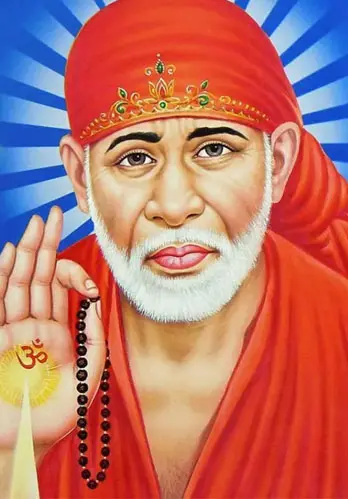 Sai Baba Bhajan Book
-
 Sai Leela
-
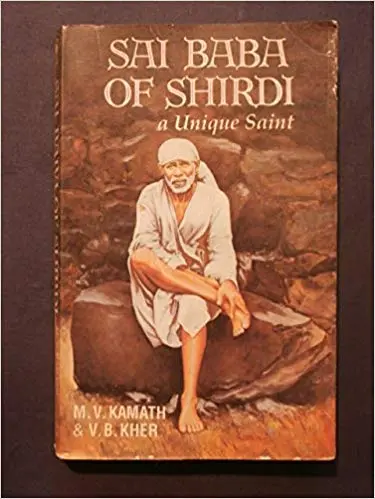 Saibaba Aaarti
-
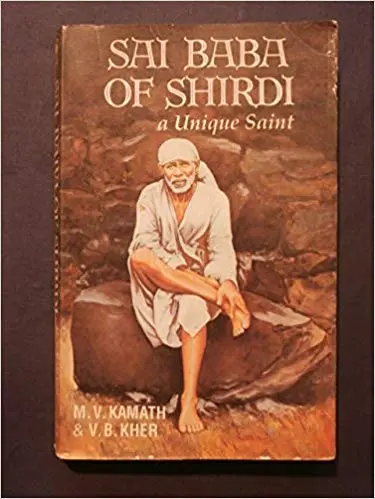 Saibaba Aaarti
-
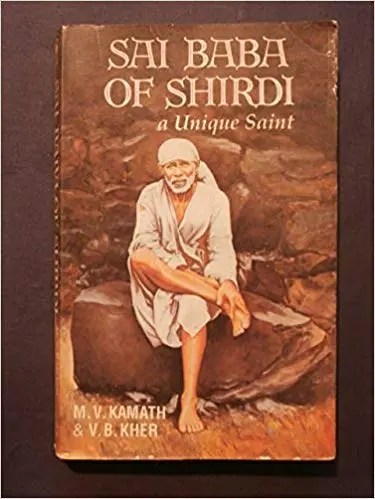 Saibaba Aaarti
-
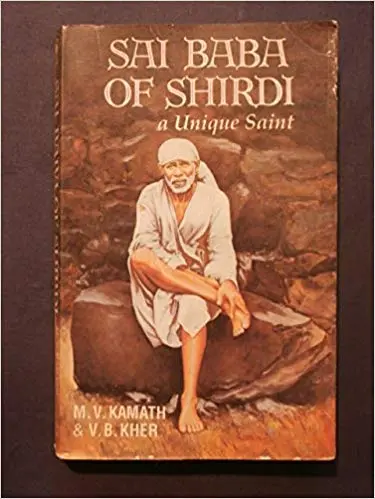 Saibaba Aaarti
-
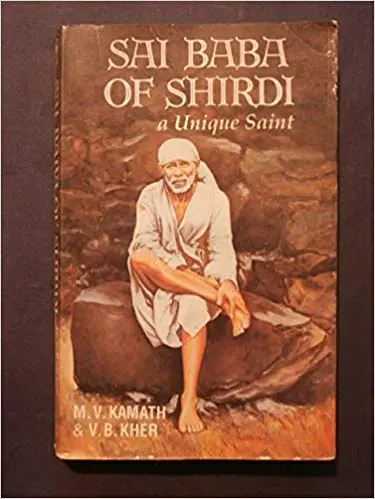 Saibaba Aaarti
-
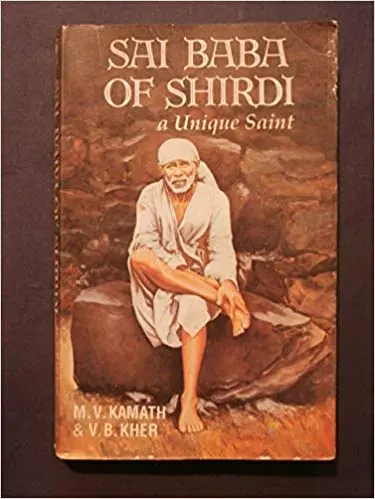 Saibaba Aaarti
-
 Saibaba Aaarti
-
 Saibaba Aaarti
-
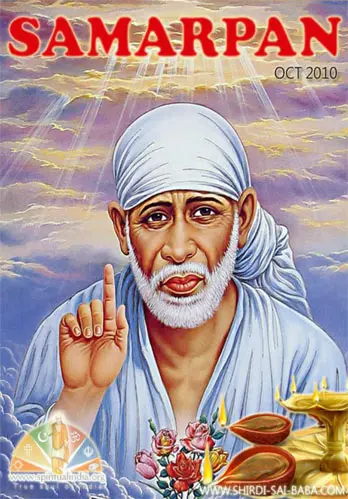 Samaprpan
-
 Shirdi Ke Saibaba Brath
-
 Shirdi Sai Baba: Life, Philosophy & Teachings
-
 Shri Manik Prabhu
-
 Shri Sai Satcharitra
-
 Shri Sai Satcharitra
-
 Shri Sai Satcharitra
-
 Shri Sai Satcharitra
-
 Shri Sai Satcharitra
-
 Shri Sai Satcharitra
-
 Shri Sai Satcharitra
-
 Shri Sai Satcharitra
-
 Shri Sai Satcharitra
-
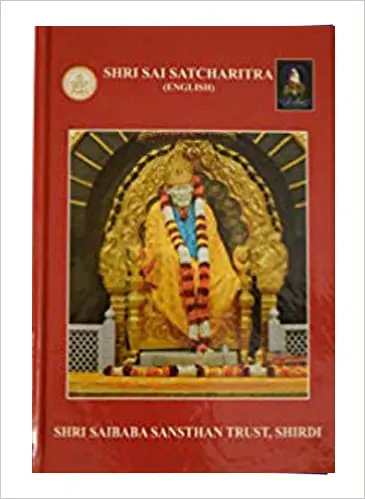 Shri Sai Satcharitra
-
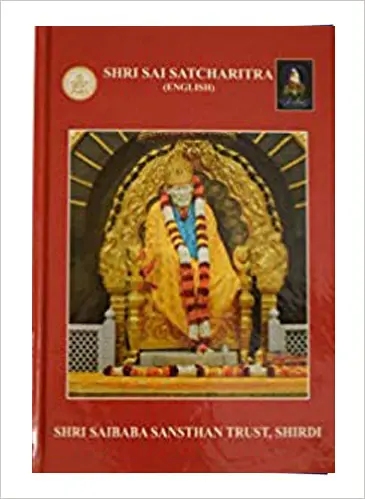 Shri Sai Satcharitra
-
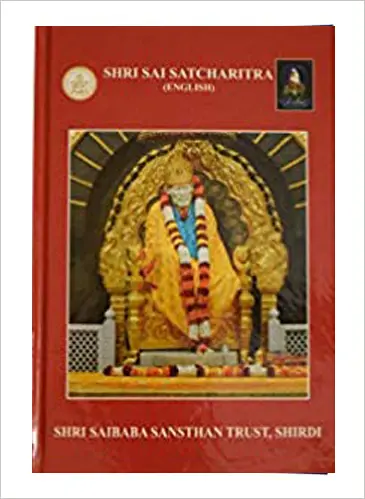 Shri Sai Satcharitra
-
 Shri Sai Satcharitra
-
 Sree Guru Charithra
-
 Sri Guru Charitra (Nitya Parayana Grandham)
-
 Sri Sai Gurucharitra
- Sri Saikalpa
-
 Sri Sainatha Sthavana Manjari
-
 Sri Sainatha Sthavana Manjari
-
 Sri Sainatha Sthavana Manjari
-
 Sri Sainatha Sthavana Manjari
-
 Sri Sainatha Sthavana Manjari
-
 Sri Sainatha Sthavana Manjari
-
 Sri Swami Samarth Maharaj Of Akkalkot
-
 Sripada Sri Vallabha Sampoorna Charithamrutham
-
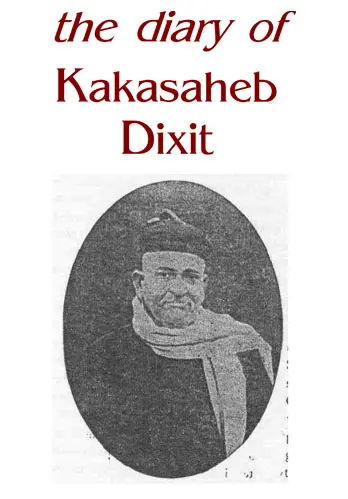 The Diary Of Kakasaheb Dixit
-
 The Shirdi Diary